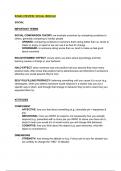
EXAM 4 REVIEW: SOCIAL MODULE
SOCIAL
IMPORTANT TERMS
SOCIAL COMPARISON THEORY: we evaluate ourselves by comparing ourselves to
others, generally comparing to similar people
- UPWARD: comparing ourselves to someone that's doing better than us, tends to
make us angry or upset or we can use it as fuel for change
- DOWNWARD: to someone doing worse than us, tend to make us feel good
about ourselves
ENLIGHTENMENT EFFECT: occurs when you learn about psychology and that
learning causes a change in your behavior
HALO EFFECT: when someone has one positive trait you assume they have many
positive traits; often times that positive trait is attractiveness and therefore if someone’s
attractive you would assume they're nice
SELF-FULFILLING PROPHECY: believing something until you cause it to occur (e.g.
stereotypes, when you believe someone would respond in a certain way you act a
specific way to them, and through that change in behavior they’re led to react how you
expected them to)
ATTITUDES
COMPONENT
- AFFECTIVE: how you feel about something (e.g. chocolate pie = happiness &
joy)
- BEHAVIORAL: how you WANT to respond, not necessarily how you actually
respond (e.g. presented with a choco pie you WANT to shove your face into it,
doesn't mean you would b/c of social norms you will change that behavior)
- COGNITIVE: how you think about the object (e.g. past memories, what the
object is connected to)
DIMENSIONS
- STRENGTH: how strong the attitude is (e.g. if choco pie is your fav dessert you
are unlikely to change the “ABC” of attitude)
, - ACCESSIBILITY: how easily you are able to access those attitudes
- AMBIVALENCE: when you have a positive and negative attitude toward the
object
ATTITUDE CHANGE COMPONENTS
SOURCE: person/company wanting to cause change
RECEIVER: who they're hoping to change
MESSAGE: what they're saying or doing to cause the change
CHANNEL: how they're distributing their message, can be really important b/c different
receivers can have different channels
ATTITUDE CHANGE
COGNITIVE DISSONANCE: when we have two opposing beliefs it makes us
uncomfortable, to avoid that discomfort we try to change something
- people came in to do a boring task, turning knob slightly one at a time
- need participant to tell the next participant that this task is fun and exciting
(researcher is functionally telling participant to lie), “if you do this i’ll pay you a
dollar or 20 bucks”, everyone said yes
- they go and tell the participant (except its not really a participant), half the
participants are lying for a dollar, half lying for 20
- after they lied, researcher asked them how much they enjoyed the very boring
task; most researchers believe 20 bucks participants would have bigger
enjoyment, but 20 bucks participants rated the experiment as very boring, 1
dollar participants rated the experiment as very fun
- the 20 bucks people have justification for lying, while 1 dollar people have no
justification (“i lied, lying is bad”), they cant change what they said to the
participants but they can change their response to the rating (they cant change
the actions but they changed their attitude, kinda like convinced themselves to
think it’s fun)
SELF-PERCEPTION THEORY: we determine our attitude by looking at our behavior; if
we change our behavior we can change our attitude, this may not happen consciously
(e.g. dating someone that enjoys horror movies but b/c you love that person you watch
horror movies with them, changing your behavior to change you attitude about the
object)
, IMPRESSION MANAGEMENT THEORY: express different attitude depending on the
impression you’re trying to get
ELABORATION LIKELIHOOD MODEL: theory of attitude change with two pathways
- CENTRAL PATHWAY focus on the argument for change (e.g. political), hard to
have change but the change that comes with it tends to be long-term
- PERIPHERAL PATHWAY is trying to cause change through any means but your
argument (e.g. kids breakfast cereal, no argument but using toys and mascots to
distract children into buying the cereal), easier to change but that change is
short-lived
FOOT IN THE DOOR (FITD): smaller requests are asked in order to gain compliance
with larger requests
DOOR IN THE FACE (DITF): works in the opposite direction, where larger requests are
asked, with the expectation that they will be rejected, in order to gain compliance for
smaller requests
ATTRIBUTIONS
STABLE VS UNSTABLE: explanation unlikely to change; likely to change
INTERNAL VS EXTERNAL: assuming the person or yourself caused the situation to
happen; something in the environment caused the situation to happen
INDIVIDUALISM vs COLLECTIVISM: making decisions on your own; make decisions
based on the group, prioritize other people first
FUNDAMENTAL ATTRIBUTION ERROR: where we incorrectly attribute a person's
actions. For example, when someone cuts us up on the road, we may think it's because
of their personality. They are simply not nice.
DEFENSIVE ATTRIBUTION ERROR: a bias or error in attributing cause for some event
such that a perceived threat to oneself is minimized (e.g. people might blame an
automobile accident on the other driver's mistake because this attribution lessens their
perception that they themselves are responsible for the accident)
SOCIAL
IMPORTANT TERMS
SOCIAL COMPARISON THEORY: we evaluate ourselves by comparing ourselves to
others, generally comparing to similar people
- UPWARD: comparing ourselves to someone that's doing better than us, tends to
make us angry or upset or we can use it as fuel for change
- DOWNWARD: to someone doing worse than us, tend to make us feel good
about ourselves
ENLIGHTENMENT EFFECT: occurs when you learn about psychology and that
learning causes a change in your behavior
HALO EFFECT: when someone has one positive trait you assume they have many
positive traits; often times that positive trait is attractiveness and therefore if someone’s
attractive you would assume they're nice
SELF-FULFILLING PROPHECY: believing something until you cause it to occur (e.g.
stereotypes, when you believe someone would respond in a certain way you act a
specific way to them, and through that change in behavior they’re led to react how you
expected them to)
ATTITUDES
COMPONENT
- AFFECTIVE: how you feel about something (e.g. chocolate pie = happiness &
joy)
- BEHAVIORAL: how you WANT to respond, not necessarily how you actually
respond (e.g. presented with a choco pie you WANT to shove your face into it,
doesn't mean you would b/c of social norms you will change that behavior)
- COGNITIVE: how you think about the object (e.g. past memories, what the
object is connected to)
DIMENSIONS
- STRENGTH: how strong the attitude is (e.g. if choco pie is your fav dessert you
are unlikely to change the “ABC” of attitude)
, - ACCESSIBILITY: how easily you are able to access those attitudes
- AMBIVALENCE: when you have a positive and negative attitude toward the
object
ATTITUDE CHANGE COMPONENTS
SOURCE: person/company wanting to cause change
RECEIVER: who they're hoping to change
MESSAGE: what they're saying or doing to cause the change
CHANNEL: how they're distributing their message, can be really important b/c different
receivers can have different channels
ATTITUDE CHANGE
COGNITIVE DISSONANCE: when we have two opposing beliefs it makes us
uncomfortable, to avoid that discomfort we try to change something
- people came in to do a boring task, turning knob slightly one at a time
- need participant to tell the next participant that this task is fun and exciting
(researcher is functionally telling participant to lie), “if you do this i’ll pay you a
dollar or 20 bucks”, everyone said yes
- they go and tell the participant (except its not really a participant), half the
participants are lying for a dollar, half lying for 20
- after they lied, researcher asked them how much they enjoyed the very boring
task; most researchers believe 20 bucks participants would have bigger
enjoyment, but 20 bucks participants rated the experiment as very boring, 1
dollar participants rated the experiment as very fun
- the 20 bucks people have justification for lying, while 1 dollar people have no
justification (“i lied, lying is bad”), they cant change what they said to the
participants but they can change their response to the rating (they cant change
the actions but they changed their attitude, kinda like convinced themselves to
think it’s fun)
SELF-PERCEPTION THEORY: we determine our attitude by looking at our behavior; if
we change our behavior we can change our attitude, this may not happen consciously
(e.g. dating someone that enjoys horror movies but b/c you love that person you watch
horror movies with them, changing your behavior to change you attitude about the
object)
, IMPRESSION MANAGEMENT THEORY: express different attitude depending on the
impression you’re trying to get
ELABORATION LIKELIHOOD MODEL: theory of attitude change with two pathways
- CENTRAL PATHWAY focus on the argument for change (e.g. political), hard to
have change but the change that comes with it tends to be long-term
- PERIPHERAL PATHWAY is trying to cause change through any means but your
argument (e.g. kids breakfast cereal, no argument but using toys and mascots to
distract children into buying the cereal), easier to change but that change is
short-lived
FOOT IN THE DOOR (FITD): smaller requests are asked in order to gain compliance
with larger requests
DOOR IN THE FACE (DITF): works in the opposite direction, where larger requests are
asked, with the expectation that they will be rejected, in order to gain compliance for
smaller requests
ATTRIBUTIONS
STABLE VS UNSTABLE: explanation unlikely to change; likely to change
INTERNAL VS EXTERNAL: assuming the person or yourself caused the situation to
happen; something in the environment caused the situation to happen
INDIVIDUALISM vs COLLECTIVISM: making decisions on your own; make decisions
based on the group, prioritize other people first
FUNDAMENTAL ATTRIBUTION ERROR: where we incorrectly attribute a person's
actions. For example, when someone cuts us up on the road, we may think it's because
of their personality. They are simply not nice.
DEFENSIVE ATTRIBUTION ERROR: a bias or error in attributing cause for some event
such that a perceived threat to oneself is minimized (e.g. people might blame an
automobile accident on the other driver's mistake because this attribution lessens their
perception that they themselves are responsible for the accident)