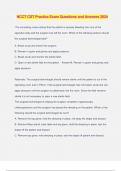
NCCT CST Practice Exam Questions and Answers 2024
NCCT CST Practice Exam Questions and Answers 2024 The circulating nurse notices that the patient is actively bleeding from one of the operative sites and the surgeon has left the room. Which of the following actions should the surgical technologist take? A. Break scrub and inform the surgeon. B. Remain in gown and gloves and apply pressure. C. Break scrub and monitor the sterile field. D. Open a new sterile field for the patient. - Answer-B. Remain in gown and gloves and apply pressure. Rationale: The surgical technologist should remain sterile until the patient is out of the operating room and in PACU. If the surgical technologist has not broken scrub she can apply pressure until the surgeon is called back into the room. Since the field remains sterile it is not necessary to open a new sterile field. The surgical technologist is helping the surgeon complete a laparoscopic cholecystectomy and the surgeon has placed the dressing on the patient. Which of the following should the surgical technologist do next? A. Remove the top glove, hold the dressing in place, roll away the drape and discard. B. Remove Mayo stand, back table and top glove, hold the dressing in place, tear the drape off the patient and discard. C. Remove top glove, hold dressing in place, tear the drape off patient and discard. D. Remove the Mayo stand, back table and top glove, hold the dressing in place, roll away the drape and discard. - Answer-D. Remove the Mayo stand, back table and top glove, hold the dressing in place, roll away the drape and discard. Rationale: The Mayo stand and back table need to remain sterile until the patient is out of the room. The top gloves need replaced to prohibit any debris from getting the dressing dirty. By holding the dressing on with the clean gloves the drape can be removed so any biohazardous materials are contained within the drapes and discarded. A tornado warning is in effect and power has been switched to the generator due to downed electrical lines. The hospital's disaster triage protocol has been activated. A surgical procedure is in progress. Which of the following is the best course of action to ensure patient safety? A. Immediately evacuate the patient to the preoperative holding area. B. Finish the procedure and evacuate the patient. C. Place wet towels under door and finish the procedure. D. Cover the back table until the storm passes. - Answer-B. Finish the procedure and evacuate the patient. Rationale: Follow hospital's disaster plan for tornado preparedness and response. Under Joint Commissions standard codes, this would be categorized as a Code Brown, which is a weather related emergency. The best option in this instance is to complete the case, and then transfer the patient to a safe location for post-operative care. Upon opening a sterilized instrument tray, the surgical technologist finds bioburden inside the lumen of a metal suction. Which of the following actions should the surgical technologist take? A. Isolate the sterilized suction, then flush the bioburden with sterile water. B. Remove the sterilized suction from the sterile field. C. Isolate the sterilized suction on the sterile field with a sterile towel. D. Remove the sterilized instrument tray from the sterile field. - Answer-D. Remove the sterilized instrument tray from the sterile field. Rationale: The surgical technologist should check and inspect instruments. If bioburden is found, the whole tray should be discarded and handed off. (When in doubt throw it out.) The tray should not be left on the sterile field at all, or cleaned on the sterile field, because it would make the field contaminated. While preparing the room for a surgical procedure using the laser, which of the following policies ensure the laser is being used correctly? (Select the three (3) correct answers.) A. Have laparotomy sponges available. B. Post warning signs outside the room C. Place the foot control next to the circulator. D. Do not use alcohol based preps. E. Wear safety goggles. - Answer-B. Post warning signs outside the room. D. Do not use alcohol based preps. E. Wear safety goggles. Rationale: Posting warning signs will prevent surgery doors from opening and causing unnecessary harm to co-workers outside the room. Not using alcohol based preps will decrease the risk of surgical fires. Safety goggles approved for that specific laser will prevent injury to the eye. Laparotomy sponges should be wet if available. The doctor should be in control of the foot control pedal to the laser. During a vaginal hysterectomy the surgical team noticed that the safety belt was left off the patient before the drape was applied and discovered after draping. How can the patient be secured to the OR bed without interrupting the sterile field or procedure? A. The surgical technologist can watch for movement of the patient and inform the circulator. B. The anesthesiologist can secure the head to prevent shifting. C. The circulator can reach under the sterile drape and apply the safety strap. D. The surgeon can request sterile coban to secure the patient. - Answer-C. The circulator can reach under the sterile drape and apply the safety strap. Rationale: The underside of the drape is not sterile, therefore, can be touched by the unsterile circulating nurse, while she secures the patient with the safety strap. The surgical team is at the surgical field and has just completed the time-out. The surgeon turns to the surgical technologist and asks for local. Which of the following actions should the surgical technologist take next before passing the local? A. Read aloud the medication label on the syringe. B. Pass the correctly labeled medication syringe. C. Confirm with the circulator the medication label on the syringe. D. Confirm with the anesthesiologist the medication on the syringe. - Answer-A. Read aloud the medication label on the syringe. Rationale: The medication has already been verified by the circulator and the surgical technologist upon placement on the sterile field. The surgical technologist needs to read aloud the syringe contents when handing the syringe to the surgeon. The anesthesiologist is not part of the sterile team environment. The surgeon is doing a laparoscopic procedure using an endo GIA stapler. He passes the stapler to the surgical technologist and asks him to reload. Which of the following should the technologist do to the stapler before passing back to the surgeon? A. Open the jaws. B. Pre-fire the jaws. C. Lubricate the jaws. D. Close the jaws. - Answer-D. Close the jaws. Rationale: The jaws must be closed to fit through the laparoscopic port. Each refill is single-use, therefore pre-firing the stapler will activate the staples, rendering the reload useless. There is no need to lubricate the jaws. Which member of the surgical team is in charge of the transfer of an immobile or unconscious patient from the OR table to the stretcher? A. surgeon B. circulator C. anesthesia provider D. surgical technologist - Answer-C. anesthesia provider Rationale: The anesthesia provider is in control of the patient transfer and coordinates the move. They have control of the head and the patient's airway. The surgeon most likely has already left the room and cannot help with the transfer. The circulator is on the other side of the bed waiting on the transfer device when anesthesia gives the permission. The surgical technologist is on the other side waiting to help transfer the patient. There should always be 4 people to transfer a patient. Anesthesia is at the head of the bed and one person is on each side with one at the end of the bed to help transfer the feet. The surgical technologist observed a patient fall during the transfer from the gurney to the operating bed. Which of the following items are required in the incident report? (Select the three (3) correct answers.) A. patient's name B. personnel involved C. type of anesthesia used D. location of the incident E. patient's weight - Answer-A. patient's name B. personnel involved D. location of the incident Rationale: In completing an incident report for an occurrence such as this fall, all information regarding the patient and the circumstances around the occurrence should be included. In this case scenario, the patient had not had anesthesia yet so this did not play a factor, nor did the patient's weight. So the best choices for information that needed to be included in the incident report are the patient's name, the personnel involved, and the location of the incident The surgical technologist hears a patient entering the operating room state verbally that he doesn't want the surgery and fears he will not survive. The surgical technologist must inform the A. surgeon. B. anesthesiologist. C. circulating nurse. D. charge nurse. - Answer-C. Circulating nurse Rationale: Per the Joint Commission, informed consent is a process of communication between a clinician and a patient which results in the patient's authorization to undergo a specific surgical procedure. It is the surgical technologist's ethical responsibility to bring it to the attention of the circulator if there is evidence the patient has changed his mind, or needs more information to be able to understand the procedure he is scheduled for. The patient is scheduled for insertion of a permanent pacemaker at 0800. In addition to key surgical team members, the absence of which of the following individuals would cause the case to be delayed? A. unit coordinator B. internal hospital transporter C. manufacturer representative D. sterile processing personnel - Answer-C. manufacturer representative Rationale: The manufacturer representative should be present to calibrate the product for the surgeon's use and serve as a product expert to enhance patient safety. A unit coordinator, hospital transporter, or sterile processing personnel are not required to be present for surgical procedures. During a laparoscopic procedure, the screen on the monitor becomes darker and visualization is impaired. The surgeon discovers that carbon dioxide is escaping. Which of the following should the surgical technologist check first? A. light cord B. camera C. insufflation tubing D. ESU - Answer-C. insufflation tubing
Geschreven voor
- Instelling
- NCCT
- Vak
- NCCT
Documentinformatie
- Geüpload op
- 19 februari 2024
- Aantal pagina's
- 103
- Geschreven in
- 2023/2024
- Type
- Tentamen (uitwerkingen)
- Bevat
- Vragen en antwoorden
Onderwerpen
-
ncct cst practice exam questions and answers 2024

Ook beschikbaar in voordeelbundel