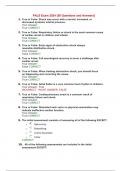
PALS Exam 2024 {50 Questions and Answers}
1. True or False: Shock may occur with a normal, increased, or
decreased systemic arterial pressure.
Your Answer:
True CORRECT
2. True or False: Respiratory failure or shock is the most common cause
of cardiac arrest in children and infants.
Your Answer:
True CORRECT
3. True or False: Early signs of obstructive shock always
resemble distributive shock.
Your Answer:
False CORRECT
4. True or False: Full neurological recovery is never a challenge after
cardiac arrest.
Your Answer:
False CORRECT
5. True or False: When treating obstructive shock, you should focus
on diagnosing and correcting the cause.
Your Answer:
True CORRECT
6. True or False: Atrial flutter is a very common heart rhythm in children.
Your Answer: True
INCORRECT - RIGHT ANSWER: FALSE
7. True or False: Cardiopulmonary arrest is a common result of
respiratory failure and shock.
Your Answer:
True CORRECT
8. True or False: Distended neck veins on physical examination may
indicate ineffective cardiac function.
Your Answer:
True CORRECT
9. The initial assessment consists of assessing all of the following EXCEPT:
o Deformity
o Breathing
o Consciousness
o Color
CORRECT
10. All of the following assessments are included in the initial
assessment EXCEPT:
, o Breathing
o Cardiac arrest
o Exposure
o Airway
INCORRECT - RIGHT ANSWER: CARDIAC ARREST
11. In assessing level of responsiveness, the AVPU scale consists of all of
the following ratings EXCEPT:
o Airway
o Voice
o Alert
o Unresponsive
CORRECT
12. Hypoxemia can be indicated in a child when a room air SpO 2
reading is less than .
o 94%
o 90%
o 97%
o 88%
CORRECT
13. Which of the following symptoms demonstrate increased work
of breathing?
o Grunting
o Nasal flaring
o Use of accessory thoracic muscles
o All of the above
CORRECT
14. Abnormal breath sounds associated with upper airway obstruction
include:
o Crackles
o Stridor
o Decreased breath sounds
o Absent breath sounds
CORRECT
15. Croup medications used for treatment are the following:
1. True or False: Shock may occur with a normal, increased, or
decreased systemic arterial pressure.
Your Answer:
True CORRECT
2. True or False: Respiratory failure or shock is the most common cause
of cardiac arrest in children and infants.
Your Answer:
True CORRECT
3. True or False: Early signs of obstructive shock always
resemble distributive shock.
Your Answer:
False CORRECT
4. True or False: Full neurological recovery is never a challenge after
cardiac arrest.
Your Answer:
False CORRECT
5. True or False: When treating obstructive shock, you should focus
on diagnosing and correcting the cause.
Your Answer:
True CORRECT
6. True or False: Atrial flutter is a very common heart rhythm in children.
Your Answer: True
INCORRECT - RIGHT ANSWER: FALSE
7. True or False: Cardiopulmonary arrest is a common result of
respiratory failure and shock.
Your Answer:
True CORRECT
8. True or False: Distended neck veins on physical examination may
indicate ineffective cardiac function.
Your Answer:
True CORRECT
9. The initial assessment consists of assessing all of the following EXCEPT:
o Deformity
o Breathing
o Consciousness
o Color
CORRECT
10. All of the following assessments are included in the initial
assessment EXCEPT:
, o Breathing
o Cardiac arrest
o Exposure
o Airway
INCORRECT - RIGHT ANSWER: CARDIAC ARREST
11. In assessing level of responsiveness, the AVPU scale consists of all of
the following ratings EXCEPT:
o Airway
o Voice
o Alert
o Unresponsive
CORRECT
12. Hypoxemia can be indicated in a child when a room air SpO 2
reading is less than .
o 94%
o 90%
o 97%
o 88%
CORRECT
13. Which of the following symptoms demonstrate increased work
of breathing?
o Grunting
o Nasal flaring
o Use of accessory thoracic muscles
o All of the above
CORRECT
14. Abnormal breath sounds associated with upper airway obstruction
include:
o Crackles
o Stridor
o Decreased breath sounds
o Absent breath sounds
CORRECT
15. Croup medications used for treatment are the following: