Microbiology Chapter 5 Exam Questions with 100% Correct Answers | Verified | Updated
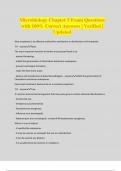
Microbiology Chapter 5 Exam Questions with 100% Correct Answers | Verified | Updated Heat treatment is an effective method for sterilization or disinfection of all materials. T/F - answerFalse The most important function of nitrites in processed foods is to - prevent browning. - inhibit the germination of Clostridium botulinum endospores. - prevent carcinogen formation. - make the food more acidic. - destroy cell membranes of potential pathogens - answerinhibit the germination of Clostridium botulinum endospores. Upon heat treatment, bacteria die at a constant proportion. T/F - answerTrue A common environmental organism that may even grow in certain chemical disinfectants is - Escherichia coli. - Streptococcus pneumoniae. - Pseudomonas aeruginosa. - Influenza virus (enveloped). - Adenoviruses (non-enveloped) - answerPseudomonas aeruginosa. Which is true of iodine? - It readily kills endospores. - It may be used as an antiseptic but not as a disinfectant. - It can be used at any dilution. - It is usually found as tinctures or iodophors. - It may be used as a disinfectant but not as an antiseptic. - answerIt is usually found as tinctures or iodophors. Liquid media containing heat-sensitive components would best be sterilized by - ultraviolet (UV) light at 500 nm. - membrane filtration. - freezing. - lyophilization. - refrigeration. - answermembrane filtration. Microbial death rates may be affected by - pH - temperature - the presence of organics - growth in a biofilm - all are correct - answerAll are correct Moist heat kills microorganisms by - irreversible denaturation of proteins. - destruction of carbohydrates in the cell wall. - denaturation of nucleic acids. - dissolving the capsule. - destruction of the nuclear envelope - answerirreversible denaturation of proteins. Cold and freezing are very effective in killing bacteria. T/F - answerFalse Chemical germicides - may react irreversibly with proteins/enzymes. - may react with cytoplasmic membranes or viral envelopes. - may be disinfecting or even sterilizing. - are sensitive to dilution factor, time of contact, and te
Written for
- Institution
- Microbiology
- Course
- Microbiology
Document information
- Uploaded on
- February 18, 2024
- Number of pages
- 14
- Written in
- 2023/2024
- Type
- Exam (elaborations)
- Contains
- Questions & answers
Subjects
-
microbiology chapter 5 exam questions with 100 co

Also available in package deal