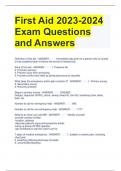
First Aid 2023 -2024 Exam Questions and Answers Definition of first aid - ANSWER Immediate help given to a perso n who is injured or has suddenly taken ill before the arrival of medical aid Aims of first aid - ANSWER 1. Preserve life 2. Promote recovery 3. Prevent injury from worsening 4. Provide comfort and relief by giving assurance to casuality What do es the emergency action plan consist of? - ANSWER 1. Primary survey 2. Secondary survey 3. Recovery position Steps in primary survey - ANSWER DRSABC Danger, response (AVPU), shout, airway (head tilt, chin lift), breathing (look, listen , feel), cpr Number to call for emergency help - ANSWER 995 Number to call for non -emergency help - ANSWER 1777 What to do when you call 995 - ANSWER -identify yourself -provide contact number -location, address -describe patient's signs and symptoms briefly -hang up phone AFTER operator -get somebody to wait for crew to arrive 7 signs of medical emergency - ANSWER 1. sudden or severe pain, including chest pain 2. breathing difficulty /shortness of breath 3. uncontrolled bleeding 4. confusion, disorientation 5. dizziness, numbness, weakness or vision change 6. coughing or vomiting of blood 7. continuous vomiting or diarrhoea 4 different levels of responsiveness - ANSWER AVPU A=alert: able to respond to simple questions and give answers. Eyes are open V=voice: able to respond to voice by answering the questions or moving the head/body P=pain: able to respond to pain. Move or squeal when pinched. U=unresponsive: no response or movement What is secondary survey? - ANSWER Detailed examination of a casualty to look for other injuries or conditions that may not be obvious. Involves a head -to-toe examination. What steps does secondary survey involve? - ANSWER CH ECK C:check for pain, discomfort H: history -briefly ask what happened. Ask for medical history if possible E: Examine head to toe for any missed injuries C: compare opposite side for abnormality K: keep monitoring vital signs When to put someone in recovery position? - ANSWER If there are no injuries, and the casualty is unconscious and breathing. Objective of recovery position - ANSWER 1. Prevents casualty's tongue from falling back and blocking airway 2. Prevents any vomiting to choke casualty What is recovery position? - ANSWER 1. kneel beside casualty, remove accessories or bulky objects found with him. Position casualty with body lying flat facing up 2. Roll victim towards rescuer 3. final r ecovery position Priority of treatment - ANSWER Top priority: potentially saveable, persons in danger of losing their lives Second priority: persons with major trauma or illnesses (NOT life -threatening) Ambulant persons Always help unconscious first always help person closest to you Conscious+breathing -->examination head first, see who has most severe injuries Body positioning for shock - ANSWER -improve blood supply by raising legs -keep in mind head injuries
Exam (elaborations)
First Aid Exam Questions and Answers
Rating
Sold
-
Pages
15
Grade
A+
Uploaded on
18-02-2024
Written in
2023/2024
First Aid Exam Questions and Answers Definition of first aid - ANSWER Immediate help given to a person who is injured or has suddenly taken ill before the arrival of medical aid Aims of first aid - ANSWER 1. Preserve life 2. Promote recovery 3. Prevent injury from worsening 4. Provide comfort and relief by giving assurance to casuality What does the emergency action plan consist of? - ANSWER 1. Primary survey 2. Secondary survey 3. Recovery position Steps in primary survey - ANSWER DRSABC Danger, response (AVPU), shout, airway (head tilt, chin lift), breathing (look, listen, feel), cpr Number to call for emergency help - ANSWER 995 Number to call for non-emergency help - ANSWER 1777 What to do when you call 995 - ANSWER -identify yourself -provide contact number -location, address -describe patient's signs and symptoms briefly -hang up phone AFTER operator -get somebody to wait for crew to arrive 7 signs of medical emergency - ANSWER 1. sudden or severe pain, including chest pain 2. breathing difficulty/shortness of breath 3. uncontrolled bleeding 4. confusion, disorientation 5. dizziness, numbness, weakness or vision change 6. coughing or vomiting of blood 7. continuous vomiting or diarrhoea 4 different levels of responsiveness - ANSWER AVPU A=alert: able to respond to simple questions and give answers. Eyes are open V=voice: able to respond to voice by answering the questions or moving the head/body P=pain: able to respond to pain. Move or squeal when pinched. U=unresponsive: no response or movement What is secondary survey? - ANSWER Detailed examination of a casualty to look for other injuries or conditions that may not be obvious. Involves a head-to-toe examination. What steps does secondary survey involve? - ANSWER CHECK C:check for pain, discomfort H: history-briefly ask what happened. Ask for medical history if possible E: Examine head to toe for any missed injuries C: compare opposite side for abnormality K: keep monitoring vital signs When to put someone in recovery position? - ANSWER If there are no injuries, and the casualty is unconscious and breathing. Objective of recovery position - ANSWER 1. Prevents casualty's tongue from falling back and blocking airway 2. Prevents any vomiting to choke casualty What is recovery position? - ANSWER 1. kneel beside casualty, remove accessories or bulky objects found with him. Position casualty with body lying flat facing up 2. Roll victim towards rescuer 3. final recovery position Priority of treatment - ANSWER Top priority: potentially saveable, persons in danger of losing their lives Second priority: persons with major trauma or illnesses (NOT life-threatening) Ambulant persons Always help unconscious first always help person closest to you Conscious+breathing--examination head first, see who has most severe injuries Body positioning for shock - ANSWER -improve blood supply by raising legs -keep in mind head injuries Causes of respiratory distress/arrest? - ANSWER 1. Choking 2. Drowning 3. Hyperventilation (rarely leads to arrest) 4. Hanging+strangulation 5. Asthma Difference between respiratory distress and arrest? - ANSWER Arrest: breathing has STOPPED. Victim is unconscious Respiratory distress: breathing difficulties (still an emergency situation) Causes of choking - ANSWER 1. foreign body such as food (conscious) 2. tongue (unconscious) Symptoms and signs of choking - ANSWER Difficulty in speaking, breathing, coughing Pale and blue Universal choking sign First aid for choking - ANSWER 1. encourage casualty to cough if casualty is coughing 2. if unsuccessful, perform heimlich manoeuvre (normal adult) or chest thrust (pregnant or obese adult) 3. if casualty turns unconscious, perform unconscious choking technique 4. call for medical emergency help if situation does not improve Steps in Heimlich manoeuvre - ANSWER 1. assess whether casualty is choking: ask, "are you choking? Are you pregnant?" If choking: can't breathe, speak, cough 2. Position of rescuer: if casualty is standing, rescuer stands BEHIND casualty. If casualty is sitting, rescuer KNEELS down and positions himself BEHIND casualty 3. Location of landmark: put arms around casualty's abdomen, place 2 FINGERS BREADTH ABOVE NAVEL AND WELL BELOW TIP OF XIPHOID PROCESS. Make fist with one hand (thumb INSIDE), place thumb side against abdomen, midline and above the 2 fingers' spacing 4. Heimlich manoeuvre: lean casualty forward with one hand, maintaining fist position against abdomen, grasp fist with other hand. Give quick INWARD AND UPWARD thrusts in ONE motion into abdomen until foreign body is expelled or casualty becomes unconscious. Steps in applying chest thrust (pregnant women or obese person) - ANSWER 1. assess if causlaty is choking 2. position of rescuer: BEHIND casualty 3. Location of landmark: place arms UNDER casualty's armpits, encircling the chest. Make fist with one hand. Thumb-side of fist on middle of casualty's breastbone 4. chest-thrust: grab fist with other hand, give quick BACKWARD THRUSTS until foreign body is expelled or the casualty becomes unconscious
Show more
Read less
Institution
First Aid
Course
First Aid
Content preview
Written for
- Institution
- First Aid
- Course
- First Aid
Document information
- Uploaded on
- February 18, 2024
- Number of pages
- 15
- Written in
- 2023/2024
- Type
- Exam (elaborations)
- Contains
- Questions & answers
Subjects
- first aid
- first aid exam
-
first aid exam questions and answers
$12.89
Get access to the full document:
100% satisfaction guarantee
Immediately available after payment
Both online and in PDF
No strings attached

Also available in package deal
Package deal
Bundle For First Aid 2023-2024 Exam Questions and Answers
6
2024
$ 47.64
More info