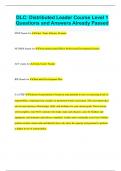
DLC: Distributed Leader Course Level 1 Questions and Answers Already Passed
DLC: Distributed Leader Course Level 1 Questions and Answers Already Passed STEP Stands for Select, Train, Educate, Promote NCOPDS Stands for Noncommissioned Officer Professional Development System ACT stands for Army Career Tracker IDP Stands for Individual Development Plan S in STEP Selection for promotion is based on your potential to serve at increasing levels of responsibility, stemming from a leader's or promotion board's assessment. This assessment takes into account mastery of knowledge, skills, and attributes for your current grade. Those chosen will exemplify a true NCO: someone who leads, trains and educates, cares for Soldiers and equipment, and maintains and enforces standards. Leaders must continually assess how Soldiers perform in their current rank and identify those who show the capacity and potential to perform at higher levels of responsibility. The T in STEP Through training, NCOs achieve the tactical and technical competence that builds confidence and adaptability. Training should occur daily under challenging and realistic conditions, even when deployed. This helps you develop the ability to exercise mature judgement and initiative under stress. This training includes directed or mandatory training common individual and leader tasks, warrior battle drills, unit mission essential list-based collective tasks, and MOS skills. The E in STEP NCO education consists of DLC and NCOPDS. This education will better prepare you for the complexities of today's operational environment while reinforcing the benefits of a deliberate, continuous, sequential, and progressive professional development strategy. The P in STEP Once you are fully trained and educated, meet all prerequisites for promotion pin-on, and are established as promotable to the next rank, you can be promoted. Promotable Soldiers must be competient in the following areas: - The Army Profession - Professional competence - Team building - Adaptability - Lifelong learning -Comprehensive fitness NCOPDS Provides NCOs with progressive leader, technical, and tactical training relevant to the duties, responsibilities, and missions they will perform in operational units after graduation. Basic Leader Course (BLC) BLC prepares the specialist/corporal for duties and responsibilities as a sergeant. Using the Leadership Requirements Model (LRM) through a holistic approach, learners will develop skills in written and oral communications, critical and creative thinking, problem solving, leadership, counseling, drill and ceremonies, how to train Solders, character development, troop leading procedures, and how to build effective teams. As a result, learners will be able to train, lead, and conduct operations at the team level. Advanced Leader Course (ALC) Consists of 2 components, the technical and the leader core competencies (LCC). Army Career Tracker (ACT) Provides a means to create an integrated approach that synchronizes professional development across three domains (operational, institutional, and self- development); provide individual assessment and feedback capabilities; and allow each Soldier or Civilian to collectively view Army training, experiential learning, and education data from a single interface that provides a common training picture as well as their lifelong learning strategy. Saluting the Flag and the National Anthem The US Flag must never be dipped by way of a salute or compliment. The organizational color will be dipped in salute in a military ceremonies while the national anthem of the US, "To the Colors," or a foreign national anthem is playing. It will also be dipped when rendering honors to organizations and individuals during the conduct of military ceremonies. Cannon Salutes Cannon salutes will be fired with a commissioned officer present. Salutes will not be fired between retreat and reveille, on Sundays, or on national holidays (excluding Memorial Day and Independence Day). However, international courtesy or other special occasions could require an exception. Cannon salutes generally will be rendered only to officers and officials of four-star or equivalent grade or higher. Who is Entitled to Honors? Except in the case of the President, a former President, or President-elect of the US, honors are rendered only when a person of high importance visits a military installation that is not their own station. These individuals include the Speaker of the House of Representatives, General of the Army, and the chairman and Vice Chairman of the Joint Chiefs of Staff, to name only a few. What is the Charge to the Noncommissioned Officer? The Charge of the NCO is a statement of responsibilities recited by NCOs during promotion ceremonies. The Charge to the NCO explains the vital role of Army leadership. By reciting this charge, the NCO promises to epitomize discipline, uphold the traditions and standards of the Army, as well as understand and respect the chain of command. The NCO Vision The NCO Vision is a verbalization of the goals of the NCOs. Grounded in heritage, values, and tradition, the NCO Vision
Written for
- Institution
- DLC: Distributed Leader Course Level 1
- Course
- DLC: Distributed Leader Course Level 1
Document information
- Uploaded on
- February 16, 2024
- Number of pages
- 8
- Written in
- 2023/2024
- Type
- Exam (elaborations)
- Contains
- Questions & answers
Subjects
-
dlc distributed leader course level 1 questions a

Also available in package deal