Tattoo License Test PREDICTED Questions and Correct Answers 2024
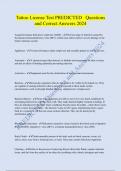
Acquired immune deficiency syndrome (AIDS) - The last stage of infection caused by the human immunodeficiency virus (HIV), which most often results in severe damage to the body's immunse system Applicator - A term referring to either single-use and reusable spatula or similar devices Antiseptic - A chemical agent that destroys or inhibits microorganisms on skin or tissue and has an effect of limiting optimally preventing infection Autoclave - Equipment used for the sterilization of heat resistant instruments Bacteria - Microscopic organisms that are too small to be visible to the naked eye. They are capable of causing infection when a person is exposed to them under certain circumstances, such as through abraded skin (eg. staphylococci, streptococci) Bacterial Spores - Some microorganisms are able to survive in very harsh conditions by enveloping themselves with this thick wall. They make bacteria highly resistant to killing. If they are introduced to the body where conditions become more favorable—when there's more water or more food available—the bacteria "come to life" again, transforming from a spore back to a vegetative cell that can cause serious infection. They can be destroyed by sterilization only Blood borne infections - Infections caused by viruses found in the blood such as hepatitis B virus (HBV), hepatitis C virus (HCV), or human immunodeficiency virus (HIV) Body Fluids - Fluids normally present in the body such as blood, mucous, sweat, oil, saliva, urine, ooze from a festering sore, or tears. They may contain infectious organisms. Cleaning - Refers to the process of removing blood, other body fluids, organic material, tissue, and dirt from the surface of an object by scrubbing with a brush, detergent and water. It greatly reduces the number of microorganisms (including bacterial endospores) on items and is a crucial step in processing. If items haven't first been cleaned, further processing might not be effective. Contamination - A disinfected or sterile item or surface that becomes soiled with microorganisms Cross-contamination - The transfer of microorganisms from one surface to another or from something contaminated to something clean or sterile Detergent - A substance that enhances the cleaning action of water (preferably warm/hot) or another liquid. Disinfectant - A chemical agent that destroys microorganisms, but does not necessarily kill all microbial forms on inanimate objects Disinfection - A process that destroys or kills some, but not all, disease-producing microorganism on an object or surface. (Does not kill spores) Gloves - Protective equipment that must be worn to protect against exposure to blood and other potentially infectious materials. Disposable gloves are single use that are disposed after each use. Most popular are made from latex, but hypo-allergenic gloves, glove liners, powder less gloves, or other alternatives are available for those allergic, Hepatitis B virus (HBV) - Infection of the liver, can cause a life long infection, cirrhosis (scarring), cancer, liver failure, death. Takes 6 weeks to 6 months to produce infection when the virus enters the body Hepatitis C virus (HCV) - Infection of liver cells, 6 weeks to 6 months to produce infection once virus is present, found in the blood of person with disease. Spread by contact with blood of infected person. Human Immunodeficiency Virus (HIV) - Virus that causes AIDS. Takes from 1 to 6 months for blood to test positive for antibodies after virus enters the body
Written for
- Institution
- Tattoo licensing
- Course
- Tattoo licensing
Document information
- Uploaded on
- February 15, 2024
- Number of pages
- 12
- Written in
- 2023/2024
- Type
- Exam (elaborations)
- Contains
- Questions & answers
Subjects

Also available in package deal