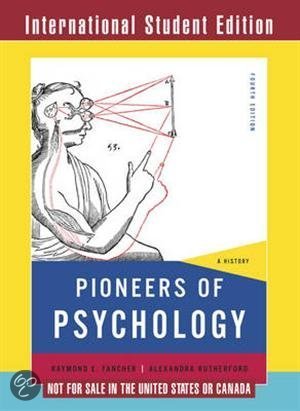
Complete summary of History of Psychology Lectures + Book
Tilburg University
2017-2018
,History of Psychology
Lecture 1
What is psychology?
In order to understand the connecton between environment and behaviour, you need psychology.
It’s the one study who actually studies the person itself.
We can see diferent things when looking at the same picture (bird or duck photo @philosophy). This
depends on our expectaton, motvaton etc.
Pareidolia: to see faces in pictures (for example in pieces of bread or cofee) when there are none.
Preference is important in choosing what you like, when you grow up with a certain kind of culture,
you are going to prefer that over another later in life.
Can psychology be a science?
Psychological experiments cannot be replicated as well as other experiments, the outcomes can vary
when you do the same experiment.
Science is about: doubt, discussion, research and trust (fraud and plagiarism)
Next to Psychology there is:
Physiology: body infuences the mind
Evolution: why we are what we are/the mind has a functon
Statistics: psychological laws can be derived from observatons of groups of people
Introducton
Psychology doesn’t exist for a long tme. The history is stll short, it can be about people or ideas.
Plato – natvist (innate ideas) view of mind , deducton
Aristotle – empirist (tabula rasa) view of mind, inducton.
Sub themes:
1. Women in science
2. Recurring ideas
Chapter 1
Descartes
- Dualism
- How to know certain knowledge? Doubt everything
- Beter work alone than together, because together you might disagree
- I don’t know anything, only that atoms exist and move around the world which cause sensaton
- Came up with mechanistc psychology: your body as a machine
1. Nerves are hollow tubes
2. Celebrospinal fuid in the nerves (also called animal spirit earlier)
3. Causes refex, but also memory and learning
- Automatic refeees (back away from hot fre) & Learned refeees (leave when the bell rings) are
both caused by those fuids
,- Pressure from atoms outside causes the fuids to spread and thus cause internal refexes
- Commotons in the fuids caused emotons like anger and fear
- When there aren’t a lot of spirits in the brain, it’s asleep. When there are a lot, you’re awake.
The theory proved to be wrong, the tubes weren’t hollow and there were no flaments (small
threads) in the nerves causing refexes. It did however help scientsts discover refexes.
- I think therefore I am means mind and body are separate (dualism). I know the idea ‘perfect’ so
there must be a God
He had ideas of Aristotle:
Psyche: the force driving all living things’
Animism: everything has a soul
Vegetative soul: plants (nourishing & reproducing)
Sensitive soul: animals (also memory, sensaton, imaginaton)
Rational soul: humans (also conscious reasoning)
Only the ratonal soul can be studied, the rest is mechanical
Was a fawed theory because he didn’t have any evidence
Analytic geometry: unitng geometry and algebra by saying that any point in space could be
indicated by numerical distances.
Something is only true when I know for sure it is, without prejudgement. A conclusion is only true
when it’s really clear and there is no reason to doubt it.
To have knowledge in the real world, the most axiomatc (self-evident) units of a subject had to be
determined, called simple natures. A simple nature had to be clear and distnct (doubted enough to
be sure it’s true). He concluded only eetension (dimensions occupied of the body) and motion were
simple natures. Everything occurred from these natures, including the body.
By engaging in physiology and combining it with psychology, he set an example that psychology
could be a science.
Heat particles: tniest, united together and formed the sun
Air particles: bigger, flls up all space between objects
Earth particles: biggest, are all material objects including planets and comets
Air partcles cause the basis of light. The vibraton of earth partcles causes the light to vibrate to us
and stpulate the eye so we can see.
He tried to think of the bodily functons (pumping of the heart) etc. as a machine. This worked for
the vegetatve and sensitve soul, but not for the ratonal one, because he couldn’t explain reason in
a mechanic way. This work helped for neuropsychology because it explained the brain.
Innate ideas = ideas of the soul, sensatons you can’t experience like “unity, infnityy
Rationalist = because he thinks the conscious mind is more fundamental than experiences
, Nativist = because he thinks there exist innate ideas
Dualist = because he states body and mind are separate. His dualism was special though because he
thought the two interacted somehow.
Princess Elisabeth of Bohemia didn’t understand how the mind and body could interact.
Mind-body interaction:
body without a mind: automaton (has no consciousness)
mind without a body: innate ideas (has no sensory perceptons)
Problem: how do mind and body interact? (dualism)
1. The body is double (2 heart chambers, eyes, ears, legs etc) but the soul is one. There must be
something that makes you see 1 tree, while you perceive it with 2 eyes.
2. The soul is in the pineal gland because this isn’t divided. If it wants to do something, it moves the
pineal fuid and you move. This can cause sensaton and feelings, but also movements when it moves
the animal spirit. When feeling anger, your soul and body can cause confict because the soul wants
to be ratonal but the body sends a lot of animal spirit to be angry.
Dualism
Your body is just controlled by a litle person, homunculus, in your mind (body is a machine).
Your mind and body are two separate things
Advantages: relates to experience, lay theories, religion, free will
Disadvantages: interacton problem, existence of unconscious processes, it’s not necessary, brain
damage infuences the mind so they are linked
Materialism
Your mind is a product of the brain. Monism.
Reductve materialism: brain = mind
Problem: how can we experience consciousness if there is nothing in the world or your body that
creates it.
Alternatives:
- property dualism
- epihenomenalism (consciousness is a by-product)
- anomalous monism
- functonalism (the mind just exists of sofware)
Pragmatism: If a theory is useful and it works, it’s true. If it doesn’t, discard it. Most psychologists
think like this without taking a positon in the dualism-materialism debate.
Tilburg University
2017-2018
,History of Psychology
Lecture 1
What is psychology?
In order to understand the connecton between environment and behaviour, you need psychology.
It’s the one study who actually studies the person itself.
We can see diferent things when looking at the same picture (bird or duck photo @philosophy). This
depends on our expectaton, motvaton etc.
Pareidolia: to see faces in pictures (for example in pieces of bread or cofee) when there are none.
Preference is important in choosing what you like, when you grow up with a certain kind of culture,
you are going to prefer that over another later in life.
Can psychology be a science?
Psychological experiments cannot be replicated as well as other experiments, the outcomes can vary
when you do the same experiment.
Science is about: doubt, discussion, research and trust (fraud and plagiarism)
Next to Psychology there is:
Physiology: body infuences the mind
Evolution: why we are what we are/the mind has a functon
Statistics: psychological laws can be derived from observatons of groups of people
Introducton
Psychology doesn’t exist for a long tme. The history is stll short, it can be about people or ideas.
Plato – natvist (innate ideas) view of mind , deducton
Aristotle – empirist (tabula rasa) view of mind, inducton.
Sub themes:
1. Women in science
2. Recurring ideas
Chapter 1
Descartes
- Dualism
- How to know certain knowledge? Doubt everything
- Beter work alone than together, because together you might disagree
- I don’t know anything, only that atoms exist and move around the world which cause sensaton
- Came up with mechanistc psychology: your body as a machine
1. Nerves are hollow tubes
2. Celebrospinal fuid in the nerves (also called animal spirit earlier)
3. Causes refex, but also memory and learning
- Automatic refeees (back away from hot fre) & Learned refeees (leave when the bell rings) are
both caused by those fuids
,- Pressure from atoms outside causes the fuids to spread and thus cause internal refexes
- Commotons in the fuids caused emotons like anger and fear
- When there aren’t a lot of spirits in the brain, it’s asleep. When there are a lot, you’re awake.
The theory proved to be wrong, the tubes weren’t hollow and there were no flaments (small
threads) in the nerves causing refexes. It did however help scientsts discover refexes.
- I think therefore I am means mind and body are separate (dualism). I know the idea ‘perfect’ so
there must be a God
He had ideas of Aristotle:
Psyche: the force driving all living things’
Animism: everything has a soul
Vegetative soul: plants (nourishing & reproducing)
Sensitive soul: animals (also memory, sensaton, imaginaton)
Rational soul: humans (also conscious reasoning)
Only the ratonal soul can be studied, the rest is mechanical
Was a fawed theory because he didn’t have any evidence
Analytic geometry: unitng geometry and algebra by saying that any point in space could be
indicated by numerical distances.
Something is only true when I know for sure it is, without prejudgement. A conclusion is only true
when it’s really clear and there is no reason to doubt it.
To have knowledge in the real world, the most axiomatc (self-evident) units of a subject had to be
determined, called simple natures. A simple nature had to be clear and distnct (doubted enough to
be sure it’s true). He concluded only eetension (dimensions occupied of the body) and motion were
simple natures. Everything occurred from these natures, including the body.
By engaging in physiology and combining it with psychology, he set an example that psychology
could be a science.
Heat particles: tniest, united together and formed the sun
Air particles: bigger, flls up all space between objects
Earth particles: biggest, are all material objects including planets and comets
Air partcles cause the basis of light. The vibraton of earth partcles causes the light to vibrate to us
and stpulate the eye so we can see.
He tried to think of the bodily functons (pumping of the heart) etc. as a machine. This worked for
the vegetatve and sensitve soul, but not for the ratonal one, because he couldn’t explain reason in
a mechanic way. This work helped for neuropsychology because it explained the brain.
Innate ideas = ideas of the soul, sensatons you can’t experience like “unity, infnityy
Rationalist = because he thinks the conscious mind is more fundamental than experiences
, Nativist = because he thinks there exist innate ideas
Dualist = because he states body and mind are separate. His dualism was special though because he
thought the two interacted somehow.
Princess Elisabeth of Bohemia didn’t understand how the mind and body could interact.
Mind-body interaction:
body without a mind: automaton (has no consciousness)
mind without a body: innate ideas (has no sensory perceptons)
Problem: how do mind and body interact? (dualism)
1. The body is double (2 heart chambers, eyes, ears, legs etc) but the soul is one. There must be
something that makes you see 1 tree, while you perceive it with 2 eyes.
2. The soul is in the pineal gland because this isn’t divided. If it wants to do something, it moves the
pineal fuid and you move. This can cause sensaton and feelings, but also movements when it moves
the animal spirit. When feeling anger, your soul and body can cause confict because the soul wants
to be ratonal but the body sends a lot of animal spirit to be angry.
Dualism
Your body is just controlled by a litle person, homunculus, in your mind (body is a machine).
Your mind and body are two separate things
Advantages: relates to experience, lay theories, religion, free will
Disadvantages: interacton problem, existence of unconscious processes, it’s not necessary, brain
damage infuences the mind so they are linked
Materialism
Your mind is a product of the brain. Monism.
Reductve materialism: brain = mind
Problem: how can we experience consciousness if there is nothing in the world or your body that
creates it.
Alternatives:
- property dualism
- epihenomenalism (consciousness is a by-product)
- anomalous monism
- functonalism (the mind just exists of sofware)
Pragmatism: If a theory is useful and it works, it’s true. If it doesn’t, discard it. Most psychologists
think like this without taking a positon in the dualism-materialism debate.