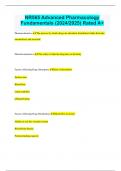
NR565 Advanced Pharmacology Fundamentals (2024/2025) Rated A+
NR565 Advanced Pharmacology Fundamentals (2024/2025) Rated A+ Pharmacokinetics The process by which drugs are absorbed, distributed within the body, metabolized, and excreted. Pharmacodynamics The study of what the drug does to the body Factors Affecting Drug Absorption Rate of dissolution Surface area Blood flow Lipid solubility pH partitioning Factors Affecting Drug Distribution Blood flow to tissues Ability to exit the vascular system Blood-brain barrier Protein-binding capacity Xenobiotics substances that are foreign to the body, usually synthetic chemical compounds; medications are a common example Cytochrome P450 (CYP450) xenobiotic-metabolizing enzymes necessary for the production of cholesterol and steroids and the detoxification of chemicals and drug metabolism. Function of Cytochrome P450 (CYP450) responsible for phase 1 metabolism in which drugs are oxidized, reduced, or hydrolyzed Phase 1 Metabolism of Drugs via P450 Oxidation; Reduction; Hydrolysis Three possible outcomes of phase 1 drug metabolism. -Drug becomes completely inactive -Drug becomes partially inactive but one or more metabolites remain active -Original drug is not pharmacologically active but one metabolite remains active CYP450 Inducers Medications that can increase the rate of another drug's metabolism by elevating CYP450 enzyme activity via increasing enzyme synthesis. decreasing the concentration of the "parent drug" CYP450 Inducer Medications CRAPGPS Carbamazepine Rifampin Alcohol Phenytoin Griseofulvin Phenobarbital Sulfonylureas CYP450 Inhibitors Medications that inhibit the metabolic activity of one or more of the CYP450 enzymes. Higher risk for toxicity; prolongs the pharmacological effect of the "parent drug". CYP450 Inhibitor Medications VISACKGQ Valproate Isoniazid Sulfonamides Amiodarone Chloramphenicol Ketoconazole Grapefruit Juice Quinidine Beers Criteria -potentially Inappropriate Medication (PIM) use in older adults -potentially Inappropriate Medication (PIM) use in older adults due to medication-disease or medication-syndrome interactions that may exacerbate the disease or syndrome -medications to be used cautiously in older adults -clinically significant drug interactions that should be avoided in older adults -medications to be avoided or dosage decreased in the presence of impaired kidney function in older adults Pharmacokinetic Interactions when one medication systemically alters the potency of another medication. Absorption Interaction result of a change due to one medication's effect on another medication's route of entry into the body. Distribution Interaction caused by the amount of unbound/free medications available at the various target sites. Metabolism Interaction concentration of the medication after biotransformation into active and inactive metabolites in higher or lower than expected. Elimination Interaction the body's ability to eliminate medications in pure form or by altering a metabolite from the body. Pharmacodynamic Interactions does not alter or impact absorption, distribution, metabolism, or elimination because of the one medication's ability to manipulate the effect of another medication at its site of action Practice Authority refers to the nurse practitioner's ability to practice without physician oversight prescriptive authority refers to the nurse practitioner's authority to prescribe medications. Full-practice scope Nurse practitioners have the autonomy to evaluate patients, diagnose, order and interpret tests, initiate and manage treatments and prescribe medications, including controlled substances without physician oversight. Reduced-practice scope Nurse practitioners are limited in at least one element of practice. The state requires a formal collaborative agreement with an outside health discipline for the nurse practitioner to provide patient care. Restricted practice scope Nurse practitioners are limited in at least one element of practice by requiring supervision, delegation, or team management by an outside health discipline for the nurse practitioner to provide patient care. Drugs that cannot be ordered via E-Script DEA Scheduled Drugs Drugs that cannot be prescribed or refilled via phone Schedule II drugs Acute Pain An occurrence of fewer than three months and is often precipitated by trauma and acute medical conditions or treatment.
Written for
- Institution
- NR565 Advanced Pharmacology Fundamentals
- Course
- NR565 Advanced Pharmacology Fundamentals
Document information
- Uploaded on
- February 14, 2024
- Number of pages
- 58
- Written in
- 2023/2024
- Type
- Exam (elaborations)
- Contains
- Questions & answers
Subjects
-
nr565 advanced pharmacology fundamentals 2024202

Document also available in package deal