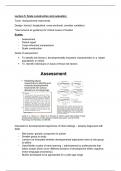
Lecture 5: Scale construction and evaluation
Tools- measurement instruments
Design- format ( longitudinal, cross-sectional, consider variables)
*Use lectures as guidance for critical review of studies
Scales:
- Assessment
- Parent report
- Cross-informant comparisons
- Scale construction
Goals of assessment:
To identify risk factors ( developmentally important characteristics in a target
population) or needs
To identify individuals on basis of those risk factors
Interested in developmental trajectories of infant siblings – already diagnosed with
ASD.
- Risk factor; genetic component to autism
- Smaller group to study
- Landa et al evaluated whether developmental trajectories were at risk group
to define
- Used Mullen scales of early learning ( administered by professionals that
follow scripts which cover different domains of development within cognitive,
motor-language processing )
- Mullen developed to be appropriate for a wide age range
, - Identify four different classes of developmental trajectories
- Two groups decrease across observations in their capacity compared to the
age score expected
- The study was able to identify those specific to language delay
Another exam plan e of the assessment tool
- Teri et al. Neonatal behavioural developmental scale – measures capabilities
of infants right after they are born, indefinity those who are at risk based on
their score nbas- individual focused. Nbas used as a screening tool as a
simple assessment to decide whether to pursue further
assessment/evaluation of health.
Required for assessment:
- Range of content (good example – Mullen scale)
- Standardization ( e.g., nbas score – representing infants’ capabilities )
- Flexibility ( required for different situations – infant not able to perform )
- Concurrent and predictive validity ( should fit with other data with infants,
infants born pre-term have lower nbas scores than infants born in expected
time- concurrent and predictive )
Assessment :
- Researchers develop questionnaires, checklists and inventories that relies on
indirect observations reported by parents/teachers and children
- Can evaluate qs, checklists and inventories by same criteria as professionally
administered assessment tools
- important difference is that with questionnaires, checklists, and inventories,
we want to pay closer attention to who is reporting what
Parent report:
, Practitioners have limited time with a Parents may be unreliable
child, whereas parents are with their observers( not consistent)
child for a longer time within different Parent reports may add systema1c
contexts. The parent report is valid in errors based on biases the parents
terms of the quantity and quality of have about their children
observations. Exclusive reliance on parent reports
may contribute shared method variance
to a study examining rela1ons between
variables
Shared method variance ( using one
data to explore other components=
individual characteristics)
Seifer, R. (2006). Who should collect
our data: parents or trained observers?
In D. M. Teti (Ed.), Handbook of
Research Methods in Developmental
Science (Chapter 7). Oxford: Blackwell.
Childs’ emotionality and regulation across time.
- Decrease with emotionality and increase with regulation across time.
Tools- measurement instruments
Design- format ( longitudinal, cross-sectional, consider variables)
*Use lectures as guidance for critical review of studies
Scales:
- Assessment
- Parent report
- Cross-informant comparisons
- Scale construction
Goals of assessment:
To identify risk factors ( developmentally important characteristics in a target
population) or needs
To identify individuals on basis of those risk factors
Interested in developmental trajectories of infant siblings – already diagnosed with
ASD.
- Risk factor; genetic component to autism
- Smaller group to study
- Landa et al evaluated whether developmental trajectories were at risk group
to define
- Used Mullen scales of early learning ( administered by professionals that
follow scripts which cover different domains of development within cognitive,
motor-language processing )
- Mullen developed to be appropriate for a wide age range
, - Identify four different classes of developmental trajectories
- Two groups decrease across observations in their capacity compared to the
age score expected
- The study was able to identify those specific to language delay
Another exam plan e of the assessment tool
- Teri et al. Neonatal behavioural developmental scale – measures capabilities
of infants right after they are born, indefinity those who are at risk based on
their score nbas- individual focused. Nbas used as a screening tool as a
simple assessment to decide whether to pursue further
assessment/evaluation of health.
Required for assessment:
- Range of content (good example – Mullen scale)
- Standardization ( e.g., nbas score – representing infants’ capabilities )
- Flexibility ( required for different situations – infant not able to perform )
- Concurrent and predictive validity ( should fit with other data with infants,
infants born pre-term have lower nbas scores than infants born in expected
time- concurrent and predictive )
Assessment :
- Researchers develop questionnaires, checklists and inventories that relies on
indirect observations reported by parents/teachers and children
- Can evaluate qs, checklists and inventories by same criteria as professionally
administered assessment tools
- important difference is that with questionnaires, checklists, and inventories,
we want to pay closer attention to who is reporting what
Parent report:
, Practitioners have limited time with a Parents may be unreliable
child, whereas parents are with their observers( not consistent)
child for a longer time within different Parent reports may add systema1c
contexts. The parent report is valid in errors based on biases the parents
terms of the quantity and quality of have about their children
observations. Exclusive reliance on parent reports
may contribute shared method variance
to a study examining rela1ons between
variables
Shared method variance ( using one
data to explore other components=
individual characteristics)
Seifer, R. (2006). Who should collect
our data: parents or trained observers?
In D. M. Teti (Ed.), Handbook of
Research Methods in Developmental
Science (Chapter 7). Oxford: Blackwell.
Childs’ emotionality and regulation across time.
- Decrease with emotionality and increase with regulation across time.