NASM EXAM Prep- Flexibility Continuum
& Training Methods Questions with
Correct Answers
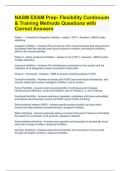
Phase 1 - Corrective (Autogentic Inhibition - phase 1 OPT) - Answers-- SMR & static
stretching
autogenic inhibition - Answers-The process by which neural impulses that sense tension
are greater than the impulses that cause muscles to contract, providing an inhibitory
effect to the muscle spindles.
Phase 2 - Active (reciprocal inhibition - phases 2,3 & 4 OPT) - Answers-- SMR & active
isolated stretching
reciprocal inhibition - Answers-The simultaneous contraction of one muscle and the
relaxation of its antagonist to allow movement to take place
Phase 3 - Functional - Answers-- SMR & dynamic stretching (phase 5 OPT)
Corrective flexibility - Answers-increases joint ROM, improves muscle imbalances, and
corrects altered joint motion; autogenic inhibition; use for phase 1
Active Flexibility - Answers-improves extensibility of soft tissue and increases
neuromuscular efficiency; reciprocal inhibition; use for Phases 2, 3, and 4 training.
Functional flexibility - Answers-maintains integrated, multiplanar soft tissue extensibility
and optimal neuromuscular control; full ROM; use for Phase 5 training
Self-myofascial release (SMR) - Answers-gentle pressure breaks up knots within
muscle and helps release unwanted tension; autogenic inhibition
Static stretching - Answers-passively taking a muscle to the point of tension and holding
the stretch for a minimum of 30 seconds; autogenic inhibition
Active-isolated stretching - Answers-uses agonists and synergists to dynamically move
joints into a range of motion; reciprocal inhibition
Dynamic stretching - Answers-uses force production and momentum to move joints
through full ranges of motion; reciprocal inhibition
& Training Methods Questions with
Correct Answers
Phase 1 - Corrective (Autogentic Inhibition - phase 1 OPT) - Answers-- SMR & static
stretching
autogenic inhibition - Answers-The process by which neural impulses that sense tension
are greater than the impulses that cause muscles to contract, providing an inhibitory
effect to the muscle spindles.
Phase 2 - Active (reciprocal inhibition - phases 2,3 & 4 OPT) - Answers-- SMR & active
isolated stretching
reciprocal inhibition - Answers-The simultaneous contraction of one muscle and the
relaxation of its antagonist to allow movement to take place
Phase 3 - Functional - Answers-- SMR & dynamic stretching (phase 5 OPT)
Corrective flexibility - Answers-increases joint ROM, improves muscle imbalances, and
corrects altered joint motion; autogenic inhibition; use for phase 1
Active Flexibility - Answers-improves extensibility of soft tissue and increases
neuromuscular efficiency; reciprocal inhibition; use for Phases 2, 3, and 4 training.
Functional flexibility - Answers-maintains integrated, multiplanar soft tissue extensibility
and optimal neuromuscular control; full ROM; use for Phase 5 training
Self-myofascial release (SMR) - Answers-gentle pressure breaks up knots within
muscle and helps release unwanted tension; autogenic inhibition
Static stretching - Answers-passively taking a muscle to the point of tension and holding
the stretch for a minimum of 30 seconds; autogenic inhibition
Active-isolated stretching - Answers-uses agonists and synergists to dynamically move
joints into a range of motion; reciprocal inhibition
Dynamic stretching - Answers-uses force production and momentum to move joints
through full ranges of motion; reciprocal inhibition