Cambridge DELTA Module 1 Terms Exam All Possible Questions and Answers with complete solution
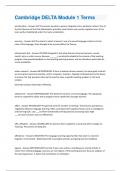
acculturation - Answer-SLA The process by which a person integrates into a particular culture. One of the first theories of SLA that attempted to prioritize social factors over purely cognitive ones. It has been partly rehabilitated under the name socialization. accuracy - Answer-SLA The extent to which a learner's use of a second language conforms to the rules of the language. Once thought to be a precondition for fluency. achievement test - Answer-TESTING Designed to test what learners have learned over a week, month, term or entire course. Because ___ ___s are directly related to the content of the teaching program, they provide feedback on the teaching-learning process, and are therefore useful data for course evaluation. action research - Answer-METHODOLOGY A form of teacher-driven research, the twin goals of which are to improve classroom practice, and to 'empower' teachers. Typically motivated less by the desire to answer the 'big' questions than by the need to solve a specific teaching problem in the local context. planning->acting->observing->reflecting adolescents - Answer-METHODOLOGY The ideal time to learn a second language. This age group tends to outperform adults and to progress more rapidly than younger learners. affect - Answer-PSYCHOLOGY The general word for emotion or feelings. These factors positively or negatively influence language learning. Often contrasted with cognitive factors such as intelligence and learning style. Low ___ive filter=emotionally well-disposed to processing input High ___ive=won't process input so effecitively. affix, affixation - Answer-VOCABULARY An element that is added to a word and which changes its meaning. The process of doing this. affordance - Answer-LINGUISTICS The language learning opportunities that exist in a learner's linguistic 'environment.' Maximized with meaningful activities and giving learners feedback. agency - Answer-METHODOLOGY Control of your own actions, including your mental activity. A notion from critical pedagogy. Learners are not objects of the teaching process; they are subjects of the learning process. A factor that contributes to ed linguistics - Answer-LINGUISTICS Concerned with the application of linguistic theory to solving language-related problems in the real world. Language planning, speech therapy, lexcography, translation studies, forensic linguistics. appraisal - Answer-LINGUISTICS Also called stance; the way speakers and writers use language to express their personal attitude to what is being said or written; one of the main ways that language's interpersonal function is realized; consists of 3 categories: affect (personal feelings), judgment (social values and social esteem), appreciation (opinions). These can all be expressed lexically, grammatically or through the use of paralinguistic devices. appropriacy - Answer-SOCIOLINGUISTICS Using language in a way that is suitable for the context and in a way that meets the expectations of the people you are communicating with. An aspect of sociolinguistic competence, which is a component of a speaker's overall communicative competence. (Dell Hymes) appropriation - Answer-SLA To make something your own. Gaining ownership of a skill by first doing it with someone who is more skilled than you are until you can control or regulate the skill yourself. A key concept in sociocultural learning theory. Language is not simply a behavior that is conditioned through repeated practice, but that it is one of collaborative construction, in which skills are transferred in socially-situated activity
Written for
- Institution
- Cambridge DELTA Module 1 Terms
- Course
- Cambridge DELTA Module 1 Terms
Document information
- Uploaded on
- February 9, 2024
- Number of pages
- 48
- Written in
- 2023/2024
- Type
- Exam (elaborations)
- Contains
- Questions & answers
Subjects

Also available in package deal