CRCR Exam Unit 1
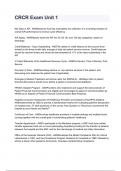
Net Days in AR - ANSMeasures how fast receivables are collected. It is a trending indicator of
overall A/R performance & revenue cycle efficiency.
A/R Aging - ANSReports divide the AR into 30, 60, 90, and 120 day categories, based on
discharge.
Credit Balances - Days Outstanding - ANSThe dollars in credit balance at the account level
divided by the three month daily average of total net patient service revenue. Credit balances
should be resolved timely and should be benchmarked at <1% of the days outstanding in the
AR.
3 Critical Elements of the Healthcare Revenue Cycle - ANSPre-Service, Time of Service, Post
Service
Provision of Care - ANSDescribing elective vs. non-elective services to the patient, and
discussing prior balances the patient has (if applicable).
Emergency Medical Treatment and Active Labor Act (EMTALA) - ANSSays that no patient
financial discussions should occur before a patient is screened and stabilized.
HFMA's Adopter Program - ANSProviders who implement and support the best practices of
Patient Financial Communication are eligible and encouraged to apply for recommendation by
HFMA as an Adopter of Patient Financial Communication Best Practices.
Hospital Consumer Assessment of Healthcare Providers and Systems (HCAHPS) Initiative -
ANSImplemented by CMS to provide a standardized method for evaluating patient's perspective
on hospital care. 27 total questions on the survey. Key Question is "Would you recommend this
hospital to your friends and family?"
Continuum of Care - ANSInvolves healthcare providers in multiple settings and multiple levels
coming together with the overall goal of coordinating patients' healthcare
Transfer Agreements - ANSTo participate in the Medicare program, a SNF must have written
transfer agreement with one or more participating hospitals providing for the transfer of patients
between the hospital and the SNF, and for the interchange of medical and other information.
Office of the Inspector General (OIG) - ANSDeveloped the Model Compliance Plan for clinical
Laboratories in 1997, and the Compliance Program Guidance for Hospitals in 1998, followed by
almost a dozen other guidance documents. Oversees medical billing compliance.
Net Days in AR - ANSMeasures how fast receivables are collected. It is a trending indicator of
overall A/R performance & revenue cycle efficiency.
A/R Aging - ANSReports divide the AR into 30, 60, 90, and 120 day categories, based on
discharge.
Credit Balances - Days Outstanding - ANSThe dollars in credit balance at the account level
divided by the three month daily average of total net patient service revenue. Credit balances
should be resolved timely and should be benchmarked at <1% of the days outstanding in the
AR.
3 Critical Elements of the Healthcare Revenue Cycle - ANSPre-Service, Time of Service, Post
Service
Provision of Care - ANSDescribing elective vs. non-elective services to the patient, and
discussing prior balances the patient has (if applicable).
Emergency Medical Treatment and Active Labor Act (EMTALA) - ANSSays that no patient
financial discussions should occur before a patient is screened and stabilized.
HFMA's Adopter Program - ANSProviders who implement and support the best practices of
Patient Financial Communication are eligible and encouraged to apply for recommendation by
HFMA as an Adopter of Patient Financial Communication Best Practices.
Hospital Consumer Assessment of Healthcare Providers and Systems (HCAHPS) Initiative -
ANSImplemented by CMS to provide a standardized method for evaluating patient's perspective
on hospital care. 27 total questions on the survey. Key Question is "Would you recommend this
hospital to your friends and family?"
Continuum of Care - ANSInvolves healthcare providers in multiple settings and multiple levels
coming together with the overall goal of coordinating patients' healthcare
Transfer Agreements - ANSTo participate in the Medicare program, a SNF must have written
transfer agreement with one or more participating hospitals providing for the transfer of patients
between the hospital and the SNF, and for the interchange of medical and other information.
Office of the Inspector General (OIG) - ANSDeveloped the Model Compliance Plan for clinical
Laboratories in 1997, and the Compliance Program Guidance for Hospitals in 1998, followed by
almost a dozen other guidance documents. Oversees medical billing compliance.