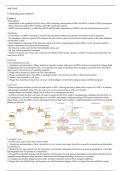
MBC3026F
Lambda phage gene regulation
Lecture 1
Transcription
- transcription is the synthesis of RNA from a DNA template, transcription of DNA into RNA is done by RNA polymerase
- RNA polymerase makes RNA starting at the DNA promoter regions
- mRNA transcript stability is called the mRNA half-life and is dependent on mRNA structure and ribonuclease activity
Translation
- in translation, an mRNA template is used for the ribosomal synthesis of a protein from amino acids in sequence
- the translation initiation region (TIR) indicates the first correct codon for the ribosome and consists of the shine Dalgarno
and initiation codon
- shine Dalgarno is upstream of the initiation codon and allows proper aligning of the mRNA on the ribosome and this
sequence determines the efficiency of translation
- the initiation codon codes for the first definable amino acid
- the stop codon terminated translation
- similar to bacteria and viruses, have polycistronic mRNA which means can have a number of genes transcribed from the
same piece of RNA
Life cycle:
Lytic (reproductive) cycle
1. Adsorption and penetration: Phage attaches to specific receptor and injects ds DNA (in the environment, the phage finds
an appropriate host and absorption has a very specific host range as the phage only recognizes a specific type of bacterial
species due to the presence of a specific receptor)
2. Phage forces bacteria to make viral DNA and proteins
3. Phages assembled where virus DNA is packaged within virus protein coat (this is often self-assembly)
4. Mature virus released by cell lysis
5. Phages that reproduce using a lyric cycle are virulent phages (virulent/lytic phages cannot establish lysogeny)
Lytic cycle
- Phage recognizes receptor on host cell and injects its DNA, forcing the host to make many copies of its DNA, it matures,
makes phages which get released by the cell; Lytic cycles can last from as little as 2 minutes
- lambda phage is a lysogenic phage, and its lifecycle is usually about an hour
- its DNA will enter the host cell; host will start to transcribe the DNA while it simultaneously degrades the host DNA, so
cell machinery is focused on making copies of viral DNA and phage components, phage DNA gets encapsulated in the
phage heads; some host DNA may be incorporated into a phage head, and this is called transduction, cell host lyses and the
phages are released
Lysogenic cycle
- not all viruses can do this, only certain viruses
1. Adsorption and penetration: Most viruses have a very narrow host range, hence have specific recognition and adsorption
to host bacteria
2. Phage does not take control over the bacterium: virus genome integrates into the host genome (a prophage is a virus that
has integrated into the genome of a bacterium)
3. Phage DNA reproduced along with the bacterial chromosome for long periods and appear normal phenotypically but are
normally more pathogenic than bacteria (a bacterium with an integrated phage is known as a lysogen)
4. Lysogens can produce phage particles under stressful conditions such as DNA damage conditions
5. Phages that can establish lytic and lysogeny are called temperate phages which is a phage that can establish lysogeny
, - under stressful conditions, the phage will exit the lysogenic cycle and enter the lytic cycle
Lifecycle of a Temperate Phage Structure of Bacteriophage Lambda
- has a head, collar, tail and tail fiber
- the head contains the double stranded
linear genome
Lambda phage (λ)entry
1. Adsorption: phage identifies host E. Coli. The J protein in the tail tip of the phage binds to the E. coli outer membrane
protein (LamB)
2. Phage DNA injection: linear phage genome is ejected into the cell via an E. coli sugar transport protein, PstM, located in
the inner membrane
3. DNA circularization and ligation: once the DNA has been injected into the cytoplasm, it has cohesive/sticky ends
where the left end and right end (cos sites) come together and form a circle i.e., phage DNA circularizes using cos sites (12
bp GC rich cohesive ends) and host DNA ligase seals nicks which prevents degradation by exonucleases
4. Supercoiling: Host DNA gyrase supercoils lambda DNA, AT rich regions unwind and drives initial transcription and
initial replication (as the supercoiling allows host polymerases to access the DNA promoter region), note that this
circularization also protects the phage DNA from being digested by host DNases which recognize and attach the cos sites
5. Theta replication: phage replicates initially via Theta replication producing copies of the phage transcription and
translation of certain phage genes
Genome of lambda phage
- has a very ordered genome
- for the lytic cycle, need lysis proteins, tail proteins, head proteins and these genes are all clustered together and these genes
are often on polycistronic mRNA therefore get translated in an ordered process, one by one
- the lysogenic cycle involves integrating into the bacterial genome or getting out of the genome so requires integrase and
excisionase genes as well as recombination proteins which are also clustered together
- the regulatory proteins are clustered together
- has a large number of operators and promoters as well as termination sites
Genome regions of lambda phage
- the head/tail: codes for structural proteins
and terminase protein
- recombination: required for integration and excision, codes for Int and Xis
- regulation: two regions; one of which codes for proteins that control the switch between lysis and lysogeny and the second
region codes for Q protein and anti-Q mRNA; these regions also have key promoters and operators
- DNA replication: code for O and P proteins and contain an origin of replication
- lysis: codes for proteins responsible for lysis
Functional clustering
Lambda phage gene regulation
Lecture 1
Transcription
- transcription is the synthesis of RNA from a DNA template, transcription of DNA into RNA is done by RNA polymerase
- RNA polymerase makes RNA starting at the DNA promoter regions
- mRNA transcript stability is called the mRNA half-life and is dependent on mRNA structure and ribonuclease activity
Translation
- in translation, an mRNA template is used for the ribosomal synthesis of a protein from amino acids in sequence
- the translation initiation region (TIR) indicates the first correct codon for the ribosome and consists of the shine Dalgarno
and initiation codon
- shine Dalgarno is upstream of the initiation codon and allows proper aligning of the mRNA on the ribosome and this
sequence determines the efficiency of translation
- the initiation codon codes for the first definable amino acid
- the stop codon terminated translation
- similar to bacteria and viruses, have polycistronic mRNA which means can have a number of genes transcribed from the
same piece of RNA
Life cycle:
Lytic (reproductive) cycle
1. Adsorption and penetration: Phage attaches to specific receptor and injects ds DNA (in the environment, the phage finds
an appropriate host and absorption has a very specific host range as the phage only recognizes a specific type of bacterial
species due to the presence of a specific receptor)
2. Phage forces bacteria to make viral DNA and proteins
3. Phages assembled where virus DNA is packaged within virus protein coat (this is often self-assembly)
4. Mature virus released by cell lysis
5. Phages that reproduce using a lyric cycle are virulent phages (virulent/lytic phages cannot establish lysogeny)
Lytic cycle
- Phage recognizes receptor on host cell and injects its DNA, forcing the host to make many copies of its DNA, it matures,
makes phages which get released by the cell; Lytic cycles can last from as little as 2 minutes
- lambda phage is a lysogenic phage, and its lifecycle is usually about an hour
- its DNA will enter the host cell; host will start to transcribe the DNA while it simultaneously degrades the host DNA, so
cell machinery is focused on making copies of viral DNA and phage components, phage DNA gets encapsulated in the
phage heads; some host DNA may be incorporated into a phage head, and this is called transduction, cell host lyses and the
phages are released
Lysogenic cycle
- not all viruses can do this, only certain viruses
1. Adsorption and penetration: Most viruses have a very narrow host range, hence have specific recognition and adsorption
to host bacteria
2. Phage does not take control over the bacterium: virus genome integrates into the host genome (a prophage is a virus that
has integrated into the genome of a bacterium)
3. Phage DNA reproduced along with the bacterial chromosome for long periods and appear normal phenotypically but are
normally more pathogenic than bacteria (a bacterium with an integrated phage is known as a lysogen)
4. Lysogens can produce phage particles under stressful conditions such as DNA damage conditions
5. Phages that can establish lytic and lysogeny are called temperate phages which is a phage that can establish lysogeny
, - under stressful conditions, the phage will exit the lysogenic cycle and enter the lytic cycle
Lifecycle of a Temperate Phage Structure of Bacteriophage Lambda
- has a head, collar, tail and tail fiber
- the head contains the double stranded
linear genome
Lambda phage (λ)entry
1. Adsorption: phage identifies host E. Coli. The J protein in the tail tip of the phage binds to the E. coli outer membrane
protein (LamB)
2. Phage DNA injection: linear phage genome is ejected into the cell via an E. coli sugar transport protein, PstM, located in
the inner membrane
3. DNA circularization and ligation: once the DNA has been injected into the cytoplasm, it has cohesive/sticky ends
where the left end and right end (cos sites) come together and form a circle i.e., phage DNA circularizes using cos sites (12
bp GC rich cohesive ends) and host DNA ligase seals nicks which prevents degradation by exonucleases
4. Supercoiling: Host DNA gyrase supercoils lambda DNA, AT rich regions unwind and drives initial transcription and
initial replication (as the supercoiling allows host polymerases to access the DNA promoter region), note that this
circularization also protects the phage DNA from being digested by host DNases which recognize and attach the cos sites
5. Theta replication: phage replicates initially via Theta replication producing copies of the phage transcription and
translation of certain phage genes
Genome of lambda phage
- has a very ordered genome
- for the lytic cycle, need lysis proteins, tail proteins, head proteins and these genes are all clustered together and these genes
are often on polycistronic mRNA therefore get translated in an ordered process, one by one
- the lysogenic cycle involves integrating into the bacterial genome or getting out of the genome so requires integrase and
excisionase genes as well as recombination proteins which are also clustered together
- the regulatory proteins are clustered together
- has a large number of operators and promoters as well as termination sites
Genome regions of lambda phage
- the head/tail: codes for structural proteins
and terminase protein
- recombination: required for integration and excision, codes for Int and Xis
- regulation: two regions; one of which codes for proteins that control the switch between lysis and lysogeny and the second
region codes for Q protein and anti-Q mRNA; these regions also have key promoters and operators
- DNA replication: code for O and P proteins and contain an origin of replication
- lysis: codes for proteins responsible for lysis
Functional clustering