MNG2602 Learning Unit 1: [Features of Contemporary Organisatons & New Management Challenges]
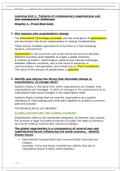
Learning Unit 1: Features of contemporary organisations and
new management challenges
Chapter 3 – Prescribed book
1. Cite reasons why organisations change
The Information Technology revolution and the emergence of globalisation
are two factors that forces organisations to change fundamentally.
These factors enabled organisations to function in a fast-changing,
dynamic environment.
- Globalisation is the economic and social interaction process whereby
different countries worn together to create a global economy.
- It involves economic, technological, political and cultural exchanges
between different countries, and is the result of advances in
communication, transportation, and infrastructure (The IT revolution).
- The result of the process of globalisation is globality.
2. Identify and discuss the forces that stimulate change in
organisations. (6 change stiuli)
Systems theory is the basis from which organisations are studied, how
organisations are managed. It refers to changes in the environment of an
organisation that cause changes in the organisation itself.
Systems theory implies that we view the organisation as a system
consisting of value-adding parts that worn together to achieve a common
goal and purpose.
The following forces are identifedd
GLOBALISATION AND THE GLOBAL ECONOMY
Globalisation refers to the worldwide integration of marnets, and cultures,
the removal of legal and political barriers to trade, the death of distance
as a factor limiting material and cultural exchanges.
The global organisation is a consequence of several new and
sophisticated forces infuencing the world economy. Identify
theses forces
International transportation and communication have become
cheaper.
(example, China and Korea manufacture clothes that sell at
competitive prices in other world marnets.)
pg. 1
, MNG2602 Learning Unit 1: [Features of Contemporary Organisatons & New Management Challenges]
Organisations copy and apply new product or process technologies
because they possess a highly educated wornforce, technological
and managerial capabilities, and advanced telecommunications and
transportation infrastructures.
Marnets are becoming more homogeneous because consumers are
acquiring a taste for foreign products.
Cost structures differ from country to country, maning it possible for
organisations to tane advantage of lower-cost locations for support
activities or production.
Cross border learning increases the possibility of organisations
expanding their capabilities.
Final marnets are trading 24 hours a day around the world.
Global standards and regulations for trade and commerce, fnance,
products, and services hagave emerged.
Globalisation is the catalyst for the worldwide merging of economic and
social forces, interest and commitments, values and tastes, and
challenges and opportunities.
Global economy is defned as an economy with the capacity to worn as a
unit in real time on a planetary scale.
ADVANCES IN TECHNOLOGY
- The information revolution and other technological advance have
had a powerful infuence on business.
RADICAL TRANSFORMATION OF THE WORLD OF WORK
- The world of worn has transformed.
- Organisations have moved from focussing on reducing defects and
streamlining business processes to focussing on managing
continuous and radical change.
- The emphasis is on creating organisations in which worn is re-
organised, redesigned, or re-engineered to improve performance.
INCREASED POWER AND DEMAND OF THE CUSTOMER
- New communication, transportation IT allow customers to compare
prices, quality, availability, etc. between local organisations and
organisations abroad.
- Consumers are able to choose products and services they want
according to the criteria they set in terms of the followingd
o Cost (most economical choice)
o Quality (best quality, meeting and exceeding the customer’s
expectations)
o Time (available as soon as possible)
pg. 2
Learning Unit 1: Features of contemporary organisations and
new management challenges
Chapter 3 – Prescribed book
1. Cite reasons why organisations change
The Information Technology revolution and the emergence of globalisation
are two factors that forces organisations to change fundamentally.
These factors enabled organisations to function in a fast-changing,
dynamic environment.
- Globalisation is the economic and social interaction process whereby
different countries worn together to create a global economy.
- It involves economic, technological, political and cultural exchanges
between different countries, and is the result of advances in
communication, transportation, and infrastructure (The IT revolution).
- The result of the process of globalisation is globality.
2. Identify and discuss the forces that stimulate change in
organisations. (6 change stiuli)
Systems theory is the basis from which organisations are studied, how
organisations are managed. It refers to changes in the environment of an
organisation that cause changes in the organisation itself.
Systems theory implies that we view the organisation as a system
consisting of value-adding parts that worn together to achieve a common
goal and purpose.
The following forces are identifedd
GLOBALISATION AND THE GLOBAL ECONOMY
Globalisation refers to the worldwide integration of marnets, and cultures,
the removal of legal and political barriers to trade, the death of distance
as a factor limiting material and cultural exchanges.
The global organisation is a consequence of several new and
sophisticated forces infuencing the world economy. Identify
theses forces
International transportation and communication have become
cheaper.
(example, China and Korea manufacture clothes that sell at
competitive prices in other world marnets.)
pg. 1
, MNG2602 Learning Unit 1: [Features of Contemporary Organisatons & New Management Challenges]
Organisations copy and apply new product or process technologies
because they possess a highly educated wornforce, technological
and managerial capabilities, and advanced telecommunications and
transportation infrastructures.
Marnets are becoming more homogeneous because consumers are
acquiring a taste for foreign products.
Cost structures differ from country to country, maning it possible for
organisations to tane advantage of lower-cost locations for support
activities or production.
Cross border learning increases the possibility of organisations
expanding their capabilities.
Final marnets are trading 24 hours a day around the world.
Global standards and regulations for trade and commerce, fnance,
products, and services hagave emerged.
Globalisation is the catalyst for the worldwide merging of economic and
social forces, interest and commitments, values and tastes, and
challenges and opportunities.
Global economy is defned as an economy with the capacity to worn as a
unit in real time on a planetary scale.
ADVANCES IN TECHNOLOGY
- The information revolution and other technological advance have
had a powerful infuence on business.
RADICAL TRANSFORMATION OF THE WORLD OF WORK
- The world of worn has transformed.
- Organisations have moved from focussing on reducing defects and
streamlining business processes to focussing on managing
continuous and radical change.
- The emphasis is on creating organisations in which worn is re-
organised, redesigned, or re-engineered to improve performance.
INCREASED POWER AND DEMAND OF THE CUSTOMER
- New communication, transportation IT allow customers to compare
prices, quality, availability, etc. between local organisations and
organisations abroad.
- Consumers are able to choose products and services they want
according to the criteria they set in terms of the followingd
o Cost (most economical choice)
o Quality (best quality, meeting and exceeding the customer’s
expectations)
o Time (available as soon as possible)
pg. 2