BIOL 235 CHAPTER 10 TEST EXAM (QUESTIONS AND ANSWERS)
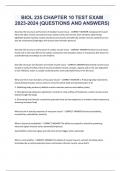
BIOL 235 CHAPTER 10 TEST EXAM (QUESTIONS AND ANSWERS) Describe the structure and function of skeletal muscle tissue - CORRECT ANSWER-Composed of muscle fibre cells (also contain connective tissue, blood vessels and nerves), have striations (alternating light/dark protein bands); usually voluntary (consciously controlled by somatic nervous system) but can also be involuntary (diaphragm and muscles that maintain posture) Describe the structure and function of cardiac muscle tissue - CORRECT ANSWER-Striated muscle tissue found only in the heart (forms the walls); contraction and relaxation action is involuntary (the heart has autorhythmicity that keeps its own rhythm) Describe structure and function of smooth muscle tissue - CORRECT ANSWER-Nonstriated muscle tissue located in walls of hollow internal structures (blood vessels, airways, organs) and on the skin (attached to hair follicles); action is usually involuntary (has some autorhythmicity in the GI tract) What are the 4 main functions of muscular tissue? - CORRECT ANSWER-1. Producing body movements (need skeletal muscles, bones, joints to move the whole body and localized parts of it) 2. Stabilizing body positions (skeletal muscles maintain posture and stabilize joints) 3. Storing/moving substances (sphincters contract to stop outflow of food/urine, cardiac muscles move blood through the body) 4. Generating heat (muscle contraction generates heat by thermogenesis to maintain body temperature, shivering increases heat) What are the 4 special properties of muscular tissue? - CORRECT ANSWER-Electrical excitability, contractility, extensibility, elasticity What is electrical excitability? - CORRECT ANSWER-The ability to respond to stimuli by producing electrical signals (muscle action potentials/impulses) Autorhythmic electrical signals and chemical stimuli trigger action potentials What is contractility? - CORRECT ANSWER-The ability of muscle tissue to contract forcefully when stimulated by an action potential (some contractions shorten muscle, some don't) What is extensibility? - CORRECT ANSWER-The ability of muscle to stretch without damage (smooth muscle stretches the most); connective tissue keeps muscles within contractile range so they don't get damaged What is elasticity? - CORRECT ANSWER-The ability of muscular tissue to return to its original length and shape after contraction or extension What is a somatic motor neuron? - CORRECT ANSWER-Neurons that stimulate skeletal muscle to contract (have a threadlike axon extending from the brain to a group of muscle fibres) Describe the nerve and blood vessel components of skeletal muscles - CORRECT ANSWER-Skeletal muscles have an artery and 1 or 2 accompanying veins that go with each nerve penetrating a skeletal muscle (capillaries are also plentiful in muscular tissue) Describe the connective tissue components of skeletal muscles - CORRECT ANSWER-Connective tissue surrounds and protects muscle tissue Hypodermis (sub-Q layer) separates muscles from skin and provides a pathway for nerves/blood/lymphatic vessels Fascia is a dense band of irregular connective tissue that supports and surrounds muscles (holds muscles with similar functions together) What is the epimysium? - CORRECT ANSWER-Outer layer of connective tissue covering muscles What is the perimysium? - CORRECT ANSWER-Connective tissue sheath that surrounds groups of muscle fibres (separated into fascicles; this is where meat tears) What is the endomysium? - CORRECT ANSWER-Connective tissue that penetrates fascicles and separates individual muscle fibres from each other What is a tendon? - CORRECT ANSWER-A rope-like connective tissue that attaches muscle to the periosteum of a bone What is an aponeurosis? - CORRECT ANSWER-A broad, flat tissue (like a tendon) What is a sarcolemma? - CORRECT ANSWER-The plasma membrane of a muscle cell What are transverse (T) tubules? - CORRECT ANSWER-Inward folds of the sarcolemma that are filled with interstitial fluid and tunnel in toward the centre of each muscle fibre (part of microscopic anatomy) What is sarcoplasm? - CORRECT ANSWER-Cytoplasm of a muscle fibre, found within sarcolemma and contains glycogen and myoglobin (protein that binds oxygen and releases it for ATP production) What are myofibrils? - CORRECT ANSWER-Contractive organelles of skeletal muscle (striations that extend the entire length of a muscle) What is the sarcoplasmic reticulum (SR)? - CORRECT ANSWER-Network of fluid-filled membranous sacs that encircle each myofibril and store calcium ions in a relaxed muscle fibre, include: terminal cisterns (dilated end sacs of the SR that bump against T-tubules from both sides and release calcium ions that trigger muscle contraction) triad (formed by a T-tubule and 2 terminal cisterns) What is muscular hypertrophy? - CORRECT ANSWER-Muscle growth (enlargement of existing fibres) that occurs after birth, results from repetitive forceful muscular activity (increases production of myofibrils, mitochondria, SR and other organelles) What is fibrosis? - CORRECT ANSWER-The replacement of muscle fibres by fibrous scar tissue What is muscular atrophy? - CORRECT ANSWER-A decrease in the size of individual muscle fibres resulting from loss of myofibrils (2 types): disuse atrophy: caused when muscles aren't used (reversible) denervation atrophy: when nerve supply is disrupted or cut, fibres are irreversibly replaced by fibrous connective tissue (muscles can shrink to 1/4 size)
Written for
- Institution
- BIOL 235
- Course
- BIOL 235
Document information
- Uploaded on
- February 6, 2024
- Number of pages
- 14
- Written in
- 2023/2024
- Type
- Exam (elaborations)
- Contains
- Questions & answers
Subjects
- what a
-
biol 235 chapter 10 test exam question
-
describe the structure and function of skeletal mu
-
describe the structure and function of cardiac mus
-
describe structure and function of smooth muscle t

Document also available in package deal