HARDWARE
CPU
Measuring
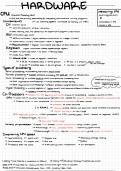
CPU (Central Processing Unit) cores
legquad , dual
&
-
chip that has
primary responsibility for interpreting commands and
running programs
components ( all containing registers + connected to
memory via FSB) clock speed in GHz
CU (Control Unit) cache in MB
↳ controls execution of each instruction
↳ tells ALU , I10 devices how respond
memory ,
to to a
program's instructions
ALU CArithmetic
Logic Unit)
↳
performs arithmetic +
logical operation/ calculations on
integer numbers
↳ break store in
down current instruction registers
-> Accumulator
=
register that stores the result of each execution (loaded from saved to RAM)
Registers (types
:
accumulator, address register storage register)
,
Store
↳ current instruction its data +
memory
+
access
↳ made from SRAM
↳ Word size =
width of register
+ data bus
↳ if 32 bit processes data in 32-bit ( :. 64 bits 2 phases)
7 doesn't meaneaster
te in
groups
if 64 bit >
processes data in 64-bit groups (... 64 bits in I phase
Types of processing
Serial processing processing instructions
-> one at a time
Parallel processing ->
multiple processors the same job
Isplit up between them (
,
processing
Em
Multi-processing >
multiple physical cores that share the
processing load
thread-set of instructions
↳ SMP
(Symmetrical MultiProcessing) =
multiple processors treated
equally instance of a computer
process =
ASMP program
-
(Asymmetrical MultiProcessing) =
different processors assigned special tasks being executed
Hyper-threading - multiple registers (i logical cores) that execute different threads of a
program
->
appears to execute
simultaneously
CO-Processors -
"Assistant" to CPU by taking
over burden of some of the
processing (process in parallel to <Pul
GPU -s takes task of complex mathematical geometric calc . needed for
graphics rendering (+ scientific computations)
->
Graphics card-u main components -> motherboard connection for data power
->
processor to render each pixel
(VRAM) to
memory to store details abt each pixel store completed pics temporarily
monitor connection view
images
-> to
->
Integrated graphics (GPU embedded on CPU , shares system RAM instead of Separate VRAM)
Advantages
->
- cost
+
->
less heat power
usage
Maths co-processor to
helps ALL process complex calculations
using numeric data
Advantage processed faster.
-> is calc .
improving performance
Disadvantages
-> In cost ,
required motherboard space , greater power consumption
CPU speed
Improving
->
->
Hyperthreading (1) logical core) -
Register size Secondary storage latency
-
Multiprocessing (11 physical core) -
Bus size
->
Buffers
->
Increasing level 1 ,7 , 3 Co-processors
->
/clock multiplication
cache Overclocking
-n
Latency to
time taken for a component to respond (blatency =>Tefficiency) (latency
= wasted clock ticks)
Seek time
- time taken for read/write head to find the
right track on
platters
Access time -> time taken to access data from HDD (latency +
seek time)
,
CPU
Measuring
CPU (Central Processing Unit) cores
legquad , dual
&
-
chip that has
primary responsibility for interpreting commands and
running programs
components ( all containing registers + connected to
memory via FSB) clock speed in GHz
CU (Control Unit) cache in MB
↳ controls execution of each instruction
↳ tells ALU , I10 devices how respond
memory ,
to to a
program's instructions
ALU CArithmetic
Logic Unit)
↳
performs arithmetic +
logical operation/ calculations on
integer numbers
↳ break store in
down current instruction registers
-> Accumulator
=
register that stores the result of each execution (loaded from saved to RAM)
Registers (types
:
accumulator, address register storage register)
,
Store
↳ current instruction its data +
memory
+
access
↳ made from SRAM
↳ Word size =
width of register
+ data bus
↳ if 32 bit processes data in 32-bit ( :. 64 bits 2 phases)
7 doesn't meaneaster
te in
groups
if 64 bit >
processes data in 64-bit groups (... 64 bits in I phase
Types of processing
Serial processing processing instructions
-> one at a time
Parallel processing ->
multiple processors the same job
Isplit up between them (
,
processing
Em
Multi-processing >
multiple physical cores that share the
processing load
thread-set of instructions
↳ SMP
(Symmetrical MultiProcessing) =
multiple processors treated
equally instance of a computer
process =
ASMP program
-
(Asymmetrical MultiProcessing) =
different processors assigned special tasks being executed
Hyper-threading - multiple registers (i logical cores) that execute different threads of a
program
->
appears to execute
simultaneously
CO-Processors -
"Assistant" to CPU by taking
over burden of some of the
processing (process in parallel to <Pul
GPU -s takes task of complex mathematical geometric calc . needed for
graphics rendering (+ scientific computations)
->
Graphics card-u main components -> motherboard connection for data power
->
processor to render each pixel
(VRAM) to
memory to store details abt each pixel store completed pics temporarily
monitor connection view
images
-> to
->
Integrated graphics (GPU embedded on CPU , shares system RAM instead of Separate VRAM)
Advantages
->
- cost
+
->
less heat power
usage
Maths co-processor to
helps ALL process complex calculations
using numeric data
Advantage processed faster.
-> is calc .
improving performance
Disadvantages
-> In cost ,
required motherboard space , greater power consumption
CPU speed
Improving
->
->
Hyperthreading (1) logical core) -
Register size Secondary storage latency
-
Multiprocessing (11 physical core) -
Bus size
->
Buffers
->
Increasing level 1 ,7 , 3 Co-processors
->
/clock multiplication
cache Overclocking
-n
Latency to
time taken for a component to respond (blatency =>Tefficiency) (latency
= wasted clock ticks)
Seek time
- time taken for read/write head to find the
right track on
platters
Access time -> time taken to access data from HDD (latency +
seek time)
,