

Summary Evolutionary Genetics
Lecture 1 – Introduction
Evolutionary Genetics
1. Molecular evolution
2. Phylogeny
3. Evolution mechanisms & population genetics
What are genes?
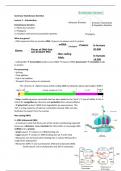
- DNA sequences that can produce RNA → genes not always result in protein
- Coding DNA → transcription leads to pre-mRNA → mature mRNA (processed) → translation leads
to protein
Pre-processing:
- Splicing
- 5’cap addition
- Poly-A tail addition
- Transport (from nucleus to cytoplasm)
- 5’cap: modified guanine nucleotide that has been added to the ‘front’ / 5’ end of mRNA → this is
critical for recognition by ribosome and protection from enzyme RNases
- 3’ poly-A tail: protect mRNA from degradation by exonucleases. This
‘tail’ is a long sequence of adenine nucleotides (several 100), and also
facilitates the export from the nucleus.
Non-coding RNA’s
1. rRNA (ribosomal RNA)
- A molecule is cells that forms part of the protein-synthesizing organelle
known as a ribosome. Helps translate the information in messenger RNA
(mRNA) into a protein.
- Small subunit → contains an mRNA binding site
- Large subunit → contains 3 tRNA binding sites (A, P and E site)
- Ribosomes can be found either floating free in cytosol OR bound to
rough ER (in eukaryotes)
- Ribosomes differ in size in prokaryotes (70S) and eukaryotes (80S).
- Small subunit: 16S in prokaryotes and 18S in eukaryotes
,2. tRNA (transfer RNA)
- Helps decode a mRNA sequence (codon / 3 nucleotides) into a protein (translation).
3. LncRNA (long non-coding RNA)
- There are many genes that give rise to distinct
transcripts (more than 28.000 in humans)
- We only know the function of very few of them
- LncRNA are longer than 200 nucleotides
- They’re not translated into a protein because
they lack long open reading frames
- E.g. Xist (X-inactive specific transcript) →
inactivation of 1 of the 2 X-chromosomes in
female mammals → a lncRNA binds to one the X-
chromosomes to inactivate it → monoallelic
expression
4. Small ncRNA (microRNA / miRNA)
- Play an important role in in post-transcriptional gene regulation → miRNA’s regulate their targets by
translational inhibition or induction of degradation
- Small ncRNA is shorter than 200 nucleotides
5. siRNA (short interfering RNA)
- Interferes with the expression of specific genes with complementary nucleotide sequences by
degrading mRNA after transcription → thus preventing translation
6. piRNA → DNA methylation → preventing transcription
What are mutations
- Changes in the DNA → can be good/bad (affecting fitness), neutral or nearly neutral
- Selection: is an allele maintained or removed form population
Types of proteins
- Antibodies
- Enzymes
- Hormonal proteins
- Structural proteins
- Storage proteins
- Transport proteins
,Protein folding
- Primary structure: sequence of amino acid chain (polypeptide)
- Secondary structure: local folding of polypeptide chain into α -helix (spiral) or β-sheet (sheet)
- Tertiary structure: 3D folding pattern of a protein due to amino acids that are not laying next to
each other, such as hydrogen bonds or hydrophobic interactions.
- Quaternary structure: protein consisting of more than one amino acid chain
Active site: the region of an enzyme where substrate molecules bind and undergo a chemical
reaction → the amino acids here form a temporary bond with the substrate
Types of mutations
1. Silent: change of a single nucleotide does not affect the sequence of amino acid chain
2. Missense: change of a single nucleotide does affect the sequence of amino acid chain
3. Nonsense: point mutation that results in a premature stop codon or a nonsense codon
Nucleotides
- Purines (two ring structure): Adenine, Guanine → are larger
- Pyrimidines (one ring structure): Cytosine, Thymine (DNA), Uracil (RNA)
A. Point mutations (SNP’s): Transitions are (twice) more likely to happen than transversions
- Transitions: Purine → purines OR pyrimidines → pyrimidines
- Transversions: Purine → pyrimidines
B. Insertion: insertion of a nucleotide in the DNA sequence
C. Deletion: deletion of a nucleotide in the DNA sequence
, Origin of genes
- Ribozymes (RNA enzyms): RNA-molecules that function as
protein enzymes → first genes may have encoded for just RNA
- After building a small collection of genes, the following things
happened:
- Mutations
- Polyploidy (di-, tri-, tetraploid)
- Duplication (e.g. alleles of hemoglobin)
Polyploidy (or ploidy) allows for mutation accumulation → if the
mutation is beneficial in the population, it’ll become fixed
- Also, more genetic diversity
Genome structure: Prokaryotes vs. Archaea vs. Eukaryotes
Eukaryotes
- Intro-exon structure (huge variation among eukaryotes)
- DNA divided over chromosomes (vary in size)
- Chromosomes located inside nucleus
- Chromosomal DNA that is packaged by 8 histones is called a
nucleosome (plays a role in epigenetic regulation)
- Eukaryotes with mainly diploid or haploid stage
- ‘Single gene’ transcription units (few exceptions)
Bacteria
- No introns (few exceptions)
- Circular chromosomes and circular plasmids
- Several operon type transcription units
Archaea
- Some introns (different proportions from eukaryotic introns)
- TATA box-like binding sites (like eukaryotes, unlike bacteria)
- Circular chromosomes and circular plasmids
- DNA associated with histone-like proteins (also bind to the DNA)
- Several operon type transcription units
TATA box → continued sequence of T’s and A’s.
Lecture 1 – Introduction
Evolutionary Genetics
1. Molecular evolution
2. Phylogeny
3. Evolution mechanisms & population genetics
What are genes?
- DNA sequences that can produce RNA → genes not always result in protein
- Coding DNA → transcription leads to pre-mRNA → mature mRNA (processed) → translation leads
to protein
Pre-processing:
- Splicing
- 5’cap addition
- Poly-A tail addition
- Transport (from nucleus to cytoplasm)
- 5’cap: modified guanine nucleotide that has been added to the ‘front’ / 5’ end of mRNA → this is
critical for recognition by ribosome and protection from enzyme RNases
- 3’ poly-A tail: protect mRNA from degradation by exonucleases. This
‘tail’ is a long sequence of adenine nucleotides (several 100), and also
facilitates the export from the nucleus.
Non-coding RNA’s
1. rRNA (ribosomal RNA)
- A molecule is cells that forms part of the protein-synthesizing organelle
known as a ribosome. Helps translate the information in messenger RNA
(mRNA) into a protein.
- Small subunit → contains an mRNA binding site
- Large subunit → contains 3 tRNA binding sites (A, P and E site)
- Ribosomes can be found either floating free in cytosol OR bound to
rough ER (in eukaryotes)
- Ribosomes differ in size in prokaryotes (70S) and eukaryotes (80S).
- Small subunit: 16S in prokaryotes and 18S in eukaryotes
,2. tRNA (transfer RNA)
- Helps decode a mRNA sequence (codon / 3 nucleotides) into a protein (translation).
3. LncRNA (long non-coding RNA)
- There are many genes that give rise to distinct
transcripts (more than 28.000 in humans)
- We only know the function of very few of them
- LncRNA are longer than 200 nucleotides
- They’re not translated into a protein because
they lack long open reading frames
- E.g. Xist (X-inactive specific transcript) →
inactivation of 1 of the 2 X-chromosomes in
female mammals → a lncRNA binds to one the X-
chromosomes to inactivate it → monoallelic
expression
4. Small ncRNA (microRNA / miRNA)
- Play an important role in in post-transcriptional gene regulation → miRNA’s regulate their targets by
translational inhibition or induction of degradation
- Small ncRNA is shorter than 200 nucleotides
5. siRNA (short interfering RNA)
- Interferes with the expression of specific genes with complementary nucleotide sequences by
degrading mRNA after transcription → thus preventing translation
6. piRNA → DNA methylation → preventing transcription
What are mutations
- Changes in the DNA → can be good/bad (affecting fitness), neutral or nearly neutral
- Selection: is an allele maintained or removed form population
Types of proteins
- Antibodies
- Enzymes
- Hormonal proteins
- Structural proteins
- Storage proteins
- Transport proteins
,Protein folding
- Primary structure: sequence of amino acid chain (polypeptide)
- Secondary structure: local folding of polypeptide chain into α -helix (spiral) or β-sheet (sheet)
- Tertiary structure: 3D folding pattern of a protein due to amino acids that are not laying next to
each other, such as hydrogen bonds or hydrophobic interactions.
- Quaternary structure: protein consisting of more than one amino acid chain
Active site: the region of an enzyme where substrate molecules bind and undergo a chemical
reaction → the amino acids here form a temporary bond with the substrate
Types of mutations
1. Silent: change of a single nucleotide does not affect the sequence of amino acid chain
2. Missense: change of a single nucleotide does affect the sequence of amino acid chain
3. Nonsense: point mutation that results in a premature stop codon or a nonsense codon
Nucleotides
- Purines (two ring structure): Adenine, Guanine → are larger
- Pyrimidines (one ring structure): Cytosine, Thymine (DNA), Uracil (RNA)
A. Point mutations (SNP’s): Transitions are (twice) more likely to happen than transversions
- Transitions: Purine → purines OR pyrimidines → pyrimidines
- Transversions: Purine → pyrimidines
B. Insertion: insertion of a nucleotide in the DNA sequence
C. Deletion: deletion of a nucleotide in the DNA sequence
, Origin of genes
- Ribozymes (RNA enzyms): RNA-molecules that function as
protein enzymes → first genes may have encoded for just RNA
- After building a small collection of genes, the following things
happened:
- Mutations
- Polyploidy (di-, tri-, tetraploid)
- Duplication (e.g. alleles of hemoglobin)
Polyploidy (or ploidy) allows for mutation accumulation → if the
mutation is beneficial in the population, it’ll become fixed
- Also, more genetic diversity
Genome structure: Prokaryotes vs. Archaea vs. Eukaryotes
Eukaryotes
- Intro-exon structure (huge variation among eukaryotes)
- DNA divided over chromosomes (vary in size)
- Chromosomes located inside nucleus
- Chromosomal DNA that is packaged by 8 histones is called a
nucleosome (plays a role in epigenetic regulation)
- Eukaryotes with mainly diploid or haploid stage
- ‘Single gene’ transcription units (few exceptions)
Bacteria
- No introns (few exceptions)
- Circular chromosomes and circular plasmids
- Several operon type transcription units
Archaea
- Some introns (different proportions from eukaryotic introns)
- TATA box-like binding sites (like eukaryotes, unlike bacteria)
- Circular chromosomes and circular plasmids
- DNA associated with histone-like proteins (also bind to the DNA)
- Several operon type transcription units
TATA box → continued sequence of T’s and A’s.


