MATH 110 Module 8 Exam
Exam Page 1
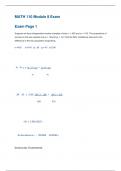
Suppose we have independent random samples of size n1 = 420 and n2 = 510. The proportions of
success in the two samples are p1= .38 and p2 = .43. Find the 99% confidence interval for the
difference in the two population proportions.
n1=420 n2=510 p1=.38 p2=.43 z=2.58
P1 - P2 ± z √p1 (1 - p1) + p2 (1 - p2)
n1 n2
.38 - .43 ± 2.58 √.38 (1 - .38) + .43 (1 - .43)
420 510
-.05 ± 2.58(.03227)
So the interval is ( -.1332566 .0332566 )
Instructor Comments
, Very good.
Answer Key
Suppose we have independent random samples of size n1 = 420 and n2 = 510. The proportions of
success in the two samples are p1= .38 and p2 = .43. Find the 99% confidence interval for the
difference in the two population proportions.
From table 6.1, we see that 99% confidence corresponds to z=2.58. Notice that the sample sizes are
each greater than 30, so we may use eqn. 8.2:
So, the interval is (.-.1333,.03326).
Exam Page 2
In certain hospital, nurses are required to constantly make rounds to check in on all of the patients.
The nursing supervisor would like to know if there is a difference between the number of rounds
completed per shift by the nurses on the day shift compared to the nurses on the night shift. So, the
nursing supervisor checks the records of 61 day shift nurses and finds that they complete an
average (a mean) of 39 rounds per shift with a standard deviation of 6.1 rounds per shift. The
nursing supervisor also checks the records of 49 night shift nurses and finds that they complete an
average (a mean) of 29 rounds per shift with a standard deviation of 5.2 rounds per shift.
a) Find the 98% confidence interval for estimating the difference in the population means (µ1 - µ2).
b) Can you be 98% confident that there is a difference in the means of the two populations?
a) z=2.33
Exam Page 1
Suppose we have independent random samples of size n1 = 420 and n2 = 510. The proportions of
success in the two samples are p1= .38 and p2 = .43. Find the 99% confidence interval for the
difference in the two population proportions.
n1=420 n2=510 p1=.38 p2=.43 z=2.58
P1 - P2 ± z √p1 (1 - p1) + p2 (1 - p2)
n1 n2
.38 - .43 ± 2.58 √.38 (1 - .38) + .43 (1 - .43)
420 510
-.05 ± 2.58(.03227)
So the interval is ( -.1332566 .0332566 )
Instructor Comments
, Very good.
Answer Key
Suppose we have independent random samples of size n1 = 420 and n2 = 510. The proportions of
success in the two samples are p1= .38 and p2 = .43. Find the 99% confidence interval for the
difference in the two population proportions.
From table 6.1, we see that 99% confidence corresponds to z=2.58. Notice that the sample sizes are
each greater than 30, so we may use eqn. 8.2:
So, the interval is (.-.1333,.03326).
Exam Page 2
In certain hospital, nurses are required to constantly make rounds to check in on all of the patients.
The nursing supervisor would like to know if there is a difference between the number of rounds
completed per shift by the nurses on the day shift compared to the nurses on the night shift. So, the
nursing supervisor checks the records of 61 day shift nurses and finds that they complete an
average (a mean) of 39 rounds per shift with a standard deviation of 6.1 rounds per shift. The
nursing supervisor also checks the records of 49 night shift nurses and finds that they complete an
average (a mean) of 29 rounds per shift with a standard deviation of 5.2 rounds per shift.
a) Find the 98% confidence interval for estimating the difference in the population means (µ1 - µ2).
b) Can you be 98% confident that there is a difference in the means of the two populations?
a) z=2.33