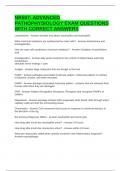
ABFM CVA 58 Questions with 100% Correct Answers | Updated | Guaranteed A+
True statements regarding the long-term prognosis for death and disability in a patient who has had a stroke include which of the following? (Mark all that are true.) Early recovery of neurologic function is a sign of a good prognosis The severity of the stroke as measured by the National Institutes of Health Stroke Scale can be used to predict long-term prognosis In general, lacunar strokes cause more severe disability than ischemic strokes of the major cerebral arteries The risk of recurrence of stroke is higher in the second year after a stroke than in the first year Patients who have two strokes in the same arterial territory will typically recover more quickly the second time Patients with poor function prior to the stroke are less likely to make a complete recovery to their pre-stroke state - ️️A, B, F The National Institutes of Health Stroke Scale (NIHSS) score predicts the long-term outcome for patients with stroke. The NIHSS score at 6 days is a more accurate predictor than the score in the first 24 hours (SOR B). Consistent markers of better long-term recovery include younger age, less severe initial symptoms, early recovery from symptoms, and good social support (SOR B). Lacunar infarcts are more likely to be followed by either complete recovery or minimal disability (SOR B).The risk of recurrence is highest immediately after a stroke and falls throughout the first year, reaching a plateau thereafter that is still higher than that of the general population (SOR B). Multiple strokes in the same area tend to create more severe disability than the first stroke (SOR B). Poor functional ability prior to the stroke is a poor prognostic factor for recovery (SOR B). A 74-year-old male has an acute ischemic stroke. He has a history of hypertension adequately controlled with medication. CT does not indicate any hemorrhagic component.Which one of the following is true about early anticoagulation with heparin or low molecular weight heparin in this situation? Urgent anticoagulation is recommended to prevent recurrent stroke Urgent anticoagulation is recommended to prevent neurologic worsening Urgent anticoagulation is recommended to improve neurologic outcomes Urgent anticoagulation should be avoided in stroke Initiation of anticoagulant therapy within 24 hours of treatment with intravenously administered rtPA is recommended - ️️D
Geschreven voor
- Instelling
- ABFM
- Vak
- ABFM
Documentinformatie
- Geüpload op
- 5 februari 2024
- Aantal pagina's
- 36
- Geschreven in
- 2023/2024
- Type
- Tentamen (uitwerkingen)
- Bevat
- Vragen en antwoorden