HESI MILESTONE 2 Actual Exam Questions and Answers Latest 2024/25 (100% Solved)
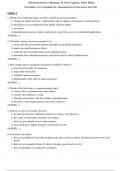
HESI MILESTONE 2 Actual Exam Questions and Answers Latest 2024/25 (100% Solved) The nurse is performing an assessment on a client with a diagnosis of left-sided heart failure. Which assessment component would elicit specific information regarding the client's left-sided heart function? 1. Listening to lung sounds 2. Palpating for organomegaly 3. Assessing for jugular vein distention 4. Assessing for peripheral and sacral edema - Listening to lung sounds. The client with heart failure may present with different symptoms, depending on whether the right or the left side of the heart is failing. Peripheral and sacral edema, jugular vein distention, and organomegaly all are manifestations of problems with right-sided heart function. Lung sounds constitute an accurate indicator of left-sided heart function. The registered nurse (RN) is educating a new RN about the use of oxygen for clients with angina pectoris. Which statement by the new nurse indicates that the teaching has been effective? 1. "Oxygen has a calming effect." 2. "Oxygen will prevent the development of any thrombus." 3. "The pain of angina pectoris occurs because of a decreased oxygen supply to heart cells." 4. "Oxygen dilates the blood vessels so that they can supply more nutrients to the heart muscle." - "The pain of angina pectoris occurs because of a decreased oxygen supply to heart cells." The pain associated with angina results from ischemia of myocardial cells. The pain often is precipitated by activity that places more oxygen demand on heart muscle. Supplemental oxygen will help meet the added demands on the heart muscle. Oxygen does not dilate blood vessels or prevent thrombus formation and does not directly calm the client. The nurse has provided dietary instructions to a client with coronary artery disease. Which statement by the client indicates an understanding of the dietary instructions? 1. "I'll need to become a strict vegetarian." 2. "I should use polyunsaturated oils in my diet." 3. "I need to substitute eggs and whole milk for meat." 4. "I should eliminate all cholesterol and fat from my diet." - "I should use polyunsaturated oils in my diet." The client with coronary artery disease needs to avoid foods high in saturated fat and cholesterol such as eggs, whole milk, and red meat. These foods contribute to HESI MILESTONE 2 Actual Exam Questions and Answers Latest 2024/25 100% Solved increases in low-density lipoproteins. The use of polyunsaturated oils is recommended to control hypercholesterolemia. It is not necessary to eliminate all cholesterol and fat from the diet. It is not necessary to become a strict vegetarian. The home care nurse has taught a client with heart failure and a problem of inadequate cardiac output about helpful lifestyle adaptations to promote health. Which statement by the client best demonstrates an understanding of the information provided? 1. "I will try to exercise vigorously to strengthen my heart muscle." 2. "I will eat enough daily fiber to prevent straining during bowel movement." 3. "I will drink 3000 to 3500 mL of fluid daily to promote good kidney function." 4. "Drinking 2 to 3 oz of liquor each night will promote blood flow by enlarging blood vessels." - "I will eat enough daily fiber to prevent straining during bowel movement." Standard home care instructions for a client with this problem include, among others, lifestyle changes such as avoiding alcohol intake, avoiding activities that increase the demands on the heart, instituting a bowel regimen to prevent straining and constipation, and maintaining fluid and electrolyte balance. Consuming 3000 to 3500 mL of fluid and exercising vigorously will increase the cardiac workload. A client with heart failure has been experiencing difficulty with completion of daily activities, as evidenced by exertional fatigue and increased blood pressure. Which observation by the nurse best indicates client progress in meeting goals for this problem? 1. Ambulates 10 feet (3 meters) farther each day 2. Verbalizes the benefits of increasing activity 3. Chooses a healthy diet that meets caloric needs 4. Sleeps without awakening throughout the night - Chooses a healthy diet that meets caloric needs Each of the options indicates a positive outcome on the part of the client. Both option 2 and the correct one relate to the client problem of difficulty with completion of daily activities. However, the question asks about progress. The correct option is more action-oriented and therefore is the better choice. Option 3 would most likely indicate progress if the client had a problem of inadequate nutritional intake. Option 4 would be a satisfactory outcome for a client experiencing difficulty sleeping. A client with coronary artery disease is scheduled to have a diagnostic exercise stress test. Which instruction would the nurse plan to provide to the client about this procedure? 1. Eat breakfast just before the procedure. 2. Wear firm, rigid shoes, such as work boots. 3. Wear loose clothing with a shirt that buttons in front. 4. Avoid cigarettes for 30 minutes before the procedure. - Wear loose clothing with a shirt that buttons in front. The client needs to wear loose, comfortable clothing for the procedure. Electrocardiogram (ECG) lead placement is enhanced if the client wears a shirt that buttons in the front. The client needs to receive nothing by mouth after bedtime or for a minimum of 2 hours before the test. The client would wear rubber-soled, supportive shoes, such as athletic training shoes. The client needs to avoid smoking, alcohol, and caffeine on the day of the test. Inadequate or incorrect preparation can interfere with the test, with the potential for a false-positive result. A client recovering from pulmonary edema is preparing for discharge. What would the nurse plan to teach the client to do to manage or prevent recurrent symptoms after discharge? 1. Weigh self on a daily basis. 2. Sleep with the head of the bed flat. 3. Take a double dose of the diuretic if peripheral edema is noted. 4. Withhold prescribed digoxin if slight respiratory distress occurs. - Weigh self on a daily basis. The client can best determine fluid status at home by weighing himself or herself on a daily basis. Increases of 2 to 3 lb (0.9 to 1.4 kg) in a short period are reported to the primary health care provider (PHCP). The client needs to sleep with the head of the bed elevated. During recumbent sleep, fluid (which has seeped into the interstitium with the assistance of the effects of gravity) is rapidly reabsorbed into the systemic circulation. Sleeping with the head of the bed flat is therefore avoided. The client does not modify medication dosages without consulting the PHCP. The nurse is caring for a client with acute pancreatitis and is monitoring the client for paralytic ileus. Which piece of assessment data would alert the nurse to this occurrence? 1. Inability to pass flatus 2. Loss of anal sphincter control 3. Severe, constant pain with rapid onset 4. Firm, nontender mass palpable at the lower right costal margin - Inability to pass flatus An inflammatory reaction such as acute pancreatitis can cause paralytic ileus, the most common form of nonmechanical obstruction. Inability to pass flatus is a clinical manifestation of paralytic ileus. Loss of sphincter control is not a sign of paralytic ileus. Pain is associated with paralytic ileus, but the pain usually manifests as a more constant generalized discomfort. Option 4 is the description of the physical finding of liver enlargement. The liver may be enlarged in cases of cirrhosis or hepatitis. Although this client may have an enlarged liver, an enlarged liver is not a sign of paralytic ileus or intestinal obstruction. The nurse is caring for a client with a resolved intestinal obstruction who has a nasogastric tube in place. The primary health care provider has now prescribed that the nasogastric tube be removed. What is the priority nursing assessment prior to removing the tube? 1. Checking for normal serum electrolyte levels 2. Checking for normal pH of the gastric aspirate 3. Checking for proper nasogastric tube placement 4. Checking for the presence of bowel sounds in all four quadrants - Checking for the presence of bowel sounds in all four quadrants Distention, vomiting, and abdominal pain are a few of the symptoms associated with intestinal obstruction. Nasogastric tubes may be used to remove gas and fluid from the stomach, relieving distention and vomiting. Bowel sounds return to normal as the obstruction is resolved and normal bowel function is restored. Discontinuing the nasogastric tube before normal bowel function may result in a return of the symptoms, necessitating reinsertion of the nasogastric tube. Serum electrolyte levels, pH of the gastric aspirate, and tube placement are important assessments for the client with a nasogastric tube in place but would not assist in determining the readiness for removing the nasogastric tube. The nurse is caring for a client who is on strict bed rest and creates a plan of care with goals related to the prevention of deep vein thrombosis and pulmonary emboli. Which nursing action is most helpful in preventing these disorders from developing? 1. Restricting fluids 2. Placing a pillow under the knees 3. Encouraging active range-of-motion exercises 4. Applying a heating pad to the lower extremities - Encouraging active range-of-motion exercises Clients at greatest risk for deep vein thrombosis and pulmonary emboli are immobilized clients. Basic preventive measures include early ambulation, leg elevation, active leg exercises, elastic stockings, and intermittent pneumatic calf compression. Keeping the client well hydrated is essential because dehydration predisposes to clotting. A pillow under the knees may cause venous stasis. Heat would not be applied without a primary health care provider's prescription. The nurse is caring for a teenage client admitted to the hospital with a suspected diagnosis of acute appendicitis. Which laboratory result should the nurse expect to note if the client does have appendicitis? 1. Leukopenia with a shift to the left 2. Leukocytosis with a shift to the left 3. Leukopenia with a shift to the right 4. Leukocytosis with a shift to the right - Leukocytosis with a shift to the left
Written for
- Institution
- HESI MILESTONE
- Course
- HESI MILESTONE
Document information
- Uploaded on
- February 5, 2024
- Number of pages
- 15
- Written in
- 2023/2024
- Type
- Exam (elaborations)
- Contains
- Questions & answers
Subjects
- hesi milestone
- hesi milestone 2
- latest updated 2024
- graded
- verified answers
-
hesi milestone 2 actual exam questions and answers

Also available in package deal