NCCT Practice Exam Questions with 100% Correct Answers | Updated & Verified
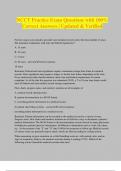
NCCT Practice Exam Questions with 100% Correct Answers | Updated & Verified For how many years should a provider store medical records (select the least number of years that maintains compliance with state and federal regulations)? A. 15 years B. 10 years C. 5 years D. 20 years - answerCorrect response: 10 years Rationale: Federal and state regulations require a minimum storage time frame for medical records. State regulations may require a longer or shorter time frame, depending on the state. Every medical provider should routinely check state and federal requirements to remain compliant. As of the date this question was submitted (2015), a 7 to 10 year time frame would meet all federal and state medical record storage requirements. Flow charts, progress notes, and narrative notation are all examples of A. medical record charting styles. B. patient documentation in a SOAP format. C. recording patient information in a medical record. D. patient chart filing systems. - answerCorrect response: recording patient information in a medical record. Rationale: Patient information can be recorded in the medical record in a variety of ways. Progress notes, flow charts and narrative notation are all effective ways to document a patient's medical information. The SOAP format is the documentation system chosen by many physicians. S=Subjective patient interview information, O=Objective information such as vitals, lab values, etc., A=Assessment of the "S" and "O" data, P=Plan for treatment or follow-up. Medical records of various styles are generally kept in charts, which are filed according to a filing system. When measuring oxygen saturation on a child breathing room air, with normal color, and no signs of respiratory distress, the medical assistant obtains a reading of 79%. Which of the following actions should the medical assistant take next? A. supplement the child with oxygen per protocol B. take a full set of vital signs C. reposition the finger probe D. notify the physician - answerCorrect response: reposition the finger probe Rationale: Oxygen saturation (O2 Sat or Pulse Ox) on a child with a structurally normal heart should be >92% . Patient movement, poor probe attachment, or nail polish can distort the sensor reading during monitoring. Always observe the child's condition first, and machine reading 2nd when troubleshooting. O2 saturation should be obtained and documented as part of a full set of vital signs for patients being evaluated for respiratory conditions. Which of the following is the best way to correct AC interference on an ECG? A. Ask the patient not to move while performing the test. B. Move the patient to a quiet room. C. Check that the patient does not have a cell phone close by. D. Offer the patient a blanket if she is cold. - answerCorrect response: Check that the patient does not have a cell phone close by. Rationale: AC is alternating current interference and it can be caused by a nearby electrical device (such as a cell phone). Patient movement (either voluntary or shivering from the cold) can cause other artifact on an ECG, but not the same as AC interference. Moving the patient to a quiet room would not alleviate AC interference. Which of the following documents is also called an advanced directive? A. subpoena B. informed consent C. living will D. assignment of benefits - answerCorrect respo
Written for
- Institution
- NCCT
- Course
- NCCT
Document information
- Uploaded on
- February 1, 2024
- Number of pages
- 66
- Written in
- 2023/2024
- Type
- Exam (elaborations)
- Contains
- Questions & answers
Subjects
-
ncct practice exam questions with 100 correct ans

Also available in package deal