

Page 1 of 822 Test Bank for Basic and Clinical Pharmacology 14th Edition by Bertram G. Katzung Chapter s 1 - 66 Complete Page 2 of 822 Table of Contents 1. Introduction: The Nature of Drugs & Drug Development & Regulation 2. Drug Receptors & Pharmacodynamics 3. Pharmacokinetics & Pharmacodynamics: Rational Dosing & the Time Course of Drug Action 4. Drug Biotransformation 5. Pharmacogenomics 6. Introduction to Autonomic Pharmacology 7. Cholinoceptor -Activating & Cholinesterase -Inhibiting Drugs 8. Cholinoceptor -Blocking Drugs 9. Adrenoceptor Agonists & Sympathomimetic Drugs 10. Adrenoceptor Antagonist Drugs 11. Antihypertensive Agents 12. Vasodilators & the Treatment of Angina Pectoris 13. Drugs Used in Heart Failure 14. Agents Used in Cardiac Arrhythmias 15. Diuretic Agents 16. Histamine, Serotonin, & the Ergot Alkaloids 17. Vasoactive Peptides 18. The Eicosanoids: Prostaglandins, Thromboxanes, Leukotrienes, & Related Compounds 19. Nitr ic Oxide 20. Drugs Used in Asthma 21. Introduction to the Pharmacology of CNS Drugs 22. Sedative -Hypnotic Drugs 23. The Alcohols 24. Antiseizure Drugs 25. General Anesthetics 26. Local Anesthetics 27. Skeletal Muscle Relaxants 28. Pharmacologic Management of Parkinsonism & Other Movement Disorders 29. Antipsychotic Agents & Lithium 30. Antidepressant Agents 31. Opioid Agonists & Antagonists 32. Drugs of Abuse 33. Agents Used in Cytopenias; Hematopoietic Growth Factors 34. Drugs Used in Disorders of Coagul ation 35. Agents Used in Dyslipidemia 36. Nonsteroidal Anti -Inflammatory Drugs, Disease -Modifying Antirheumatic Drugs, Nonopioid Analgesics, & Drugs Used in Gout 37. Hypothalamic & Pituitary Hormones 38. Thyroid & Antithyroid Drugs Page 3 of 822 39. Adrenocorticosteroid s & Adrenocortical Antagonists 40. The Gonadal Hormones & Inhibitors 41. Pancreatic Hormones & Antidiabetic Drugs 42. Agents That Affect Bone Mineral Homeostasis 43. Beta -Lactam & Other Cell Wall - & Membrane -Active Antibiotics 44. Tetracyclines, Macrolides, Clindamycin, Chloramphenicol, Streptogramins, & Oxazolidinones 45. Aminoglycosides & Spectinomycin 46. Sulfonamides, Trimethoprim, & Quinolones 47. Antimycobacterial Drugs 48. Antifungal Agents 49. Antiviral Agents 50. Miscellaneous Antimicrobi al Agents; Disinfectants, Antiseptics, & Sterilants 51. Clinical Use of Antimicrobial Agents 52. Antiprotozoal Drugs 53. Clinical Pharmacology of the Antihelminthic Drugs 54. Cancer Chemotherapy 55. Immunopharmacology 56. Introduction to Toxicology: Occup ational & Environmental 57. Heavy Metal Intoxication & Chelators 58. Management of the Poisoned Patient 59. Special Aspects of Perinatal & Pediatric Pharmacology 60. Special Aspects of Geriatric Pharmacology 61. Dermatologic Pharmacology 62. Drugs Used in the Treatment of Gastrointestinal Diseases 63. Therapeutic & Toxic Potential of Over -the-Counter Agents 64. Dietary Supplements & Herbal Medications 65. Rational Prescribing & Prescription Writing 66. Important Drug Interactions & Their Mechanisms Page 4 of 822 Chapter 1. Introduction: The Nature of Drugs & Drug Development & Regulation 1. A nurse working in radiology administers iodine to a patient who is having a computed tomography (CT) scan. The nurse working on the oncology unit administers chemotherapy to patients who have cancer. At the Public Health Department, a nurse administers a measles -mumps -rubella (MMR) vaccine to a 14-month -old child as a routine immunization. Which branch of pharmacology best describes the actions of all three nurses? A) Pharmac oeconomics B) Pharmacotherapeutics C) Pharmacodynamics D) Pharmacokinetics ANSWER: B Feedback: Pharmacology is the study of the biologic effects of chemicals. Nurses are involved with clinical pharmacology or pharmacotherapeutics, which is a branch of pharmacology that deals with the uses of drugs to treat, prevent, and diagnose disease. The radiology nurse is administering a drug to help diagnose a disease. The oncology nurse is administering a drug to help treat a disease. Pharmacoeconomics include s any costs involved in drug therapy. Pharmacodynamics involves how a drug affects the body and pharmacokinetics is how the body acts on the body. 2. A physician has ordered intramuscular (IM) injections of morphine, a narcotic, every 4 hours as needed for pain in a motor vehicle accident victim. The nurse is aware this drug has a high abuse potential. Under what category would morphine be classified? A) Schedule I B) Schedule II
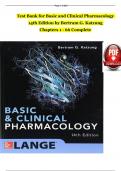
Preview 4 out of 825 pages
Exam (elaborations)
Basic and Clinical Pharmacology 14th Edition TEST BANK by Bertram G. Katzung, Verified Chapters 1 - 66, Complete Newest Version
Preview 4 out of 825 pages
TEST BANK For Basic and Clinical Pharmacology, 14th Edition by Bertram G. Katzung, Verified Chapters 1 - 66, Complete Newest Version TEST BANK For Basic and Clinical Pharmacology, 14th Edition by Bertram G. Katzung, Verified Chapters 1 - 66, Complete Newest Version Basic and Clinical Pharmacology 14th Edition Test Bank Chapters pdf Basic and Clinical Pharmacology 14th Edition Test Bank pdf Download Basic and Clinical Pharmacology 14th Edition Test Bank Questions Answers keys Download Basic and Clinical Pharmacology 14th Edition Test Bank Chapters Questions Answers keys Basic and Clinical Pharmacology 14th Edition Test Bank Ebook Download Basic and Clinical Pharmacology 14th Edition Chapters pdf Basic and Clinical Pharmacology 14th Edition pdf Download Basic and Clinical Pharmacology 14th Edition Questions Answers keys Basic and Clinical Pharmacology 14th Edition Ebook Download Basic and Clinical Pharmacology 14th Edition Answers keys
Content preview
Connected book
Document information
- Uploaded on
- February 1, 2024
- Number of pages
- 825
- Written in
- 2023/2024
- Type
- Exam (elaborations)
- Contains
- Questions & answers
$19.49
Wrong document? Swap it for free
Within 14 days of purchase and before downloading, you can choose a different document. You can simply spend the amount again.
Written by students who passed
Immediately available after payment
Read online or as PDF

Reputation scores are based on the amount of documents a seller has sold for a fee and the reviews they have received for those documents. There are three levels: Bronze, Silver and Gold. The better the reputation, the more your can rely on the quality of the sellers work.

