Anatomy
Definition: Respiration
❖ Biochemical- cellular respiration
o Process in which nutrients are converted into useful energy in cell
o ‘The oxidative process of living cells where chemical energy from organic molecules is released by
metabolism involving consumption of O2 and liberation of CO2 and H2O
▪ Palmitoyl Acid + 23O2 + 131Pi + 13lADP 3- → l6CO2 + 146H2O + 13lATP 4+
▪ Glucose + 6O2 + 36Pi + 36ADP 3- + 36H+ → 6CO2 + 42H2O + 36ATP 4+
❖ Physiological- gaseous exchange
o The process by which organism exchanges gases with its environment’- process and regulation
o Control of levels of gasses in tissues
▪ Movement of O2/CO2 in and out of lungs- ventilation
▪ Movement of O2/CO2 across alveolar and endothelial membrane
▪ Transfer of O2/CO2 in blood to tissues
▪ Movement of O2/CO2 across endothelial and cell membranes to mitochondria
o Physiological control of breathing
o Molecular regulation of transfer
Respiratory System Roles
❖ Gas exchange- regulation of blood (tissue) pH- altered by changing blood CO2 levels
❖ Voice production- movement of air past vocal folds makes sound and speech
❖ Olfaction- smell occurs when airborne molecules drawn into nasal cavity
❖ Protection- against particles/ microorganisms by preventing entry and removing them
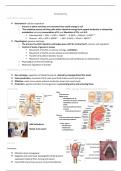
Anatomy URT- Nasal/ Oral Cavity and Pharynx
Turbinates
Add turbulence
Needs to be warm
Larynx
Functions:
❖ Maintain open passageway
❖ Epiglottis and ventricular (aryepiglottic) folds prevent
swallowed material from moving into larynx
❖ Vocal folds are primary source of sound production
, ❖ Conducting zone
o URT
o Tracheobronchial Tree - ~ 150mls
❖ Respiratory zone
o Respiratory bronchioles to alveoli
o Site for gas exchange- ~ 4200-6000mls
Tracheobronchial Tree
Trade of resistance and dead space
❖ Part of Conducting Zone
o Trachea to terminal bronchioles ciliated- for removal of
debris
o Passageway- for air movement
o For correct function we need:
▪ Limited resistance/ Turbulence
▪ Minimal size (dead space)
o Cartilage holds tube system open
▪ Smooth muscle controls diameter and in smaller
bronchioles- LENGTH
Branching of Airways
❖ Trachea branches into 2 bronchi- one of each lung
o In man these branch ~22 more times before
terminating in cluster of alveoli
Tracheobronchial Tree has specialised epithelium
Pseudostratified Mucociliary epithelium- Turbulence isn’t bad at all
Respiratory Zone- Structure of Alveoli
Each cluster of alveoli is surrounded by elastic fibres and
network of capillaries
❖ 300 million alveoli in 2 lungs
❖ Walls of respiratory unit- very thin and surrounded by capillaries –
known as respiratory membrane
❖ Area available for gas diffusion large in humans- ~50-100 m2
❖ Diffusion path length- very small- ~1μm takes ~1ms for O2 molecule to
travel
, Ventilation- Movement of air into and out of lungs
Ventilation
❖ Lung floats in thoracic cavity- surrounded by thin layer of pleural fluid (1-3mls)
o Lung isn’t directly attached to any muscle
❖ Continual transfer of fluid into lymphatic channels- maintains
negative pressure between visceral surface of lung pleura and
parietal pleural surface of thoracic activity
❖ Therefore, lungs are held to thoracic wall and movement of wall
alters lungs size
Ventilation
❖ Movement of air through lungs is induced by volume changes and hence pressure changes in lung
compartments
❖ Air moves from area of higher pressure to area of lower pressure
o Pressure is inversely related to volume
o Pleural pressure (P)- pressure in interpleural space
▪ Always slightly negative
o Alveolar pressure (A)- pressure inside lung alveoli
o Transpulmonary pressure- alveolar pressure- pleural pressure
▪ Theoretical measure= force that tends to distend alveoli
Changing Alveolar Volume
Pleural pressure
❖ Pleural pressure at beginning of inspiration -5cm H2O
❖ During normal inspiration- expansion of chest cage pulls outward on lungs
❖ Maximal inspiration- 7.5 H2O
❖ Always negative- loss of integrity of chest wall – leads to
Pneumothorax air entering chest activity and lung
collapses from chest wall
Definition: Respiration
❖ Biochemical- cellular respiration
o Process in which nutrients are converted into useful energy in cell
o ‘The oxidative process of living cells where chemical energy from organic molecules is released by
metabolism involving consumption of O2 and liberation of CO2 and H2O
▪ Palmitoyl Acid + 23O2 + 131Pi + 13lADP 3- → l6CO2 + 146H2O + 13lATP 4+
▪ Glucose + 6O2 + 36Pi + 36ADP 3- + 36H+ → 6CO2 + 42H2O + 36ATP 4+
❖ Physiological- gaseous exchange
o The process by which organism exchanges gases with its environment’- process and regulation
o Control of levels of gasses in tissues
▪ Movement of O2/CO2 in and out of lungs- ventilation
▪ Movement of O2/CO2 across alveolar and endothelial membrane
▪ Transfer of O2/CO2 in blood to tissues
▪ Movement of O2/CO2 across endothelial and cell membranes to mitochondria
o Physiological control of breathing
o Molecular regulation of transfer
Respiratory System Roles
❖ Gas exchange- regulation of blood (tissue) pH- altered by changing blood CO2 levels
❖ Voice production- movement of air past vocal folds makes sound and speech
❖ Olfaction- smell occurs when airborne molecules drawn into nasal cavity
❖ Protection- against particles/ microorganisms by preventing entry and removing them
Anatomy URT- Nasal/ Oral Cavity and Pharynx
Turbinates
Add turbulence
Needs to be warm
Larynx
Functions:
❖ Maintain open passageway
❖ Epiglottis and ventricular (aryepiglottic) folds prevent
swallowed material from moving into larynx
❖ Vocal folds are primary source of sound production
, ❖ Conducting zone
o URT
o Tracheobronchial Tree - ~ 150mls
❖ Respiratory zone
o Respiratory bronchioles to alveoli
o Site for gas exchange- ~ 4200-6000mls
Tracheobronchial Tree
Trade of resistance and dead space
❖ Part of Conducting Zone
o Trachea to terminal bronchioles ciliated- for removal of
debris
o Passageway- for air movement
o For correct function we need:
▪ Limited resistance/ Turbulence
▪ Minimal size (dead space)
o Cartilage holds tube system open
▪ Smooth muscle controls diameter and in smaller
bronchioles- LENGTH
Branching of Airways
❖ Trachea branches into 2 bronchi- one of each lung
o In man these branch ~22 more times before
terminating in cluster of alveoli
Tracheobronchial Tree has specialised epithelium
Pseudostratified Mucociliary epithelium- Turbulence isn’t bad at all
Respiratory Zone- Structure of Alveoli
Each cluster of alveoli is surrounded by elastic fibres and
network of capillaries
❖ 300 million alveoli in 2 lungs
❖ Walls of respiratory unit- very thin and surrounded by capillaries –
known as respiratory membrane
❖ Area available for gas diffusion large in humans- ~50-100 m2
❖ Diffusion path length- very small- ~1μm takes ~1ms for O2 molecule to
travel
, Ventilation- Movement of air into and out of lungs
Ventilation
❖ Lung floats in thoracic cavity- surrounded by thin layer of pleural fluid (1-3mls)
o Lung isn’t directly attached to any muscle
❖ Continual transfer of fluid into lymphatic channels- maintains
negative pressure between visceral surface of lung pleura and
parietal pleural surface of thoracic activity
❖ Therefore, lungs are held to thoracic wall and movement of wall
alters lungs size
Ventilation
❖ Movement of air through lungs is induced by volume changes and hence pressure changes in lung
compartments
❖ Air moves from area of higher pressure to area of lower pressure
o Pressure is inversely related to volume
o Pleural pressure (P)- pressure in interpleural space
▪ Always slightly negative
o Alveolar pressure (A)- pressure inside lung alveoli
o Transpulmonary pressure- alveolar pressure- pleural pressure
▪ Theoretical measure= force that tends to distend alveoli
Changing Alveolar Volume
Pleural pressure
❖ Pleural pressure at beginning of inspiration -5cm H2O
❖ During normal inspiration- expansion of chest cage pulls outward on lungs
❖ Maximal inspiration- 7.5 H2O
❖ Always negative- loss of integrity of chest wall – leads to
Pneumothorax air entering chest activity and lung
collapses from chest wall