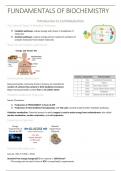
FUNDAMENTALS OF BIOCHEMISTRY
Introduction to Cell Metabolism
Two General Types of Metabolic Pathways
❖ Catabolic pathways- release energy and involve in breakdown of
molecules
❖ Anabolic pathways- require energy and are involved in synthesis of
complex molecules from simpler molecules
What are we trying to understand?
Carbohydrate classifications
Monosaccharides commonly found in humans are classified to
number of carbons they contain in their backbone structures
Major monosaccharides contain four to six carbon atoms
Oxidative catabolism of glucose
Serves 2 functions-
1) Production of ‘FREE ENERGY’ in form of ATP
2) Production of intermediates from glycolysis and TCA cycle- provide material other metabolic pathways
Oxidative metabolism- Chemical process in which oxygen is used to make energy from carbohydrates- also called
aerobic metabolism, aerobic respiration, and cell respiration
Importance of glucose
Ultimate fate of glucose
C6H12O6 + 6O2 ↔ 6CO2 + 6H2O
Standard free energy change (∆Go’) for reaction is -2834 kJmol-1
- This energy can be used in form of ATP- to meet body’s requirements
,Biology can’t use all of its energy in ONE go
- Instead, it uses controlled release approach in which each enzymes performs small step- hence multiple steps
required- thus forming metabolic pathway
Standard free energy change (∆Go’) for reaction is -2834 kJmol-1 – LARGE and NEGATIVE
- Energy released from fuel oxidation that isn’t used for work- its transformed into and released as HEAT
How do we characterise metabolic pathway?
Use change in Gibbs free energy to characterise individual steps along pathway
Why follow change in energy of system? Is there not a better method?
1) Life requires energy
2) Before all of structural biology techniques- use this approach to generate reliable results without need to
know molecular details
3) Individual values are additive allowing for global overview
4) It can be applied to all metabolic pathways
5) Allows historically determined data – to still be used in comparative studies
Review of ∆Go’- Standard Gibbs free energy change
❖ ∆Go’- change in Gibbs free energy at pH 7.0 under standard conditions
o Provides information about what happens to free energy- energy available to do work- during
chemical/ biological reaction
o Amount of free energy available to do work is related to difference in energy levels between
products and reactions
❖ ∆G - change in Gibbs free energy at pH 0 (1M [H+]) under standard conditions
o
Simple chemical reaction: A ↔ B, then ∆Go’ free energy tells what happens to energy as you go from A to B. Tells
whether or not energy is available to do work
❖ If ∆Go’ is NEGATIVE- Free energy is released- reaction is Exergonic
❖ If ∆Go’ is POSITIVE- Free energy is absorbed- reaction in Endergonic
Exergonic reaction or Endergonic reaction- entropy is not involved
Release of energy- biological uses
❖ Biochemical work- energy-requiring chemical reactions
❖ Heat generation
❖ Transport work- establishment of ionic gradients
❖ Mechanical work- muscle contraction
o Heart- specialist in transformation of ATP chemical bond energy into mechanical work
▪ If heart weren’t able to regenerate ATP- all of its ATP would be Hydrolysed in less than 1
minute – absolute requirement for Oxidative phosphorylation
Equilibrium Constant
Kc- equilibrium constant- is ratio of concentration of products to reactants
Q- reaction quotient- measurement of ratio of concentration of products to reactants at
anytime other than equilibrium
a,b,c and d- stoichiometric coefficients of balanced reaction between reagents
A,B,C and D
, Magnitude of Equilibrium Constant
Free Energy and Chemical Equilibria
At Equilibrium- concentrations of reactants and products remain constant
- no change in reaction mixture, then no change in free energy
- ∆G= 0
Linking K and ∆G: the van’t Hoff isotherm
∆GO- free energy change under standard conditions
Gas constant, R- 8.31JK-1mol-1
T- temperature (K)
Equation ∆Go = -RT lnK allows:
1) To predict if reaction happens spontaneously/ or not, if K is known
2) To estimate if reaction lies left or right, if ∆Go is known
Values of Kc ([Products]/[Reactants]) and ∆Go’
∆Go’ and ∆G
❖ Compare free energy changes for different reactions- necessary to express ∆G values relative to some
standard state, ∆Go’
Relationship between free energy of reaction at any moment in time (∆G) and standard-state free energy of
reaction (∆Go’):
❖ ∆G= ∆Go’ + RT ln Q
where Q= [Products]/[Reactants]
At equilibrium ∆G=0 hence ∆Go’= -RT lnQ
Hence, ∆G is dependent on:
1) Constant term- whose value depends only on reaction taking place
2) Variable term- depends on concentration of reactants and products
Introduction to Cell Metabolism
Two General Types of Metabolic Pathways
❖ Catabolic pathways- release energy and involve in breakdown of
molecules
❖ Anabolic pathways- require energy and are involved in synthesis of
complex molecules from simpler molecules
What are we trying to understand?
Carbohydrate classifications
Monosaccharides commonly found in humans are classified to
number of carbons they contain in their backbone structures
Major monosaccharides contain four to six carbon atoms
Oxidative catabolism of glucose
Serves 2 functions-
1) Production of ‘FREE ENERGY’ in form of ATP
2) Production of intermediates from glycolysis and TCA cycle- provide material other metabolic pathways
Oxidative metabolism- Chemical process in which oxygen is used to make energy from carbohydrates- also called
aerobic metabolism, aerobic respiration, and cell respiration
Importance of glucose
Ultimate fate of glucose
C6H12O6 + 6O2 ↔ 6CO2 + 6H2O
Standard free energy change (∆Go’) for reaction is -2834 kJmol-1
- This energy can be used in form of ATP- to meet body’s requirements
,Biology can’t use all of its energy in ONE go
- Instead, it uses controlled release approach in which each enzymes performs small step- hence multiple steps
required- thus forming metabolic pathway
Standard free energy change (∆Go’) for reaction is -2834 kJmol-1 – LARGE and NEGATIVE
- Energy released from fuel oxidation that isn’t used for work- its transformed into and released as HEAT
How do we characterise metabolic pathway?
Use change in Gibbs free energy to characterise individual steps along pathway
Why follow change in energy of system? Is there not a better method?
1) Life requires energy
2) Before all of structural biology techniques- use this approach to generate reliable results without need to
know molecular details
3) Individual values are additive allowing for global overview
4) It can be applied to all metabolic pathways
5) Allows historically determined data – to still be used in comparative studies
Review of ∆Go’- Standard Gibbs free energy change
❖ ∆Go’- change in Gibbs free energy at pH 7.0 under standard conditions
o Provides information about what happens to free energy- energy available to do work- during
chemical/ biological reaction
o Amount of free energy available to do work is related to difference in energy levels between
products and reactions
❖ ∆G - change in Gibbs free energy at pH 0 (1M [H+]) under standard conditions
o
Simple chemical reaction: A ↔ B, then ∆Go’ free energy tells what happens to energy as you go from A to B. Tells
whether or not energy is available to do work
❖ If ∆Go’ is NEGATIVE- Free energy is released- reaction is Exergonic
❖ If ∆Go’ is POSITIVE- Free energy is absorbed- reaction in Endergonic
Exergonic reaction or Endergonic reaction- entropy is not involved
Release of energy- biological uses
❖ Biochemical work- energy-requiring chemical reactions
❖ Heat generation
❖ Transport work- establishment of ionic gradients
❖ Mechanical work- muscle contraction
o Heart- specialist in transformation of ATP chemical bond energy into mechanical work
▪ If heart weren’t able to regenerate ATP- all of its ATP would be Hydrolysed in less than 1
minute – absolute requirement for Oxidative phosphorylation
Equilibrium Constant
Kc- equilibrium constant- is ratio of concentration of products to reactants
Q- reaction quotient- measurement of ratio of concentration of products to reactants at
anytime other than equilibrium
a,b,c and d- stoichiometric coefficients of balanced reaction between reagents
A,B,C and D
, Magnitude of Equilibrium Constant
Free Energy and Chemical Equilibria
At Equilibrium- concentrations of reactants and products remain constant
- no change in reaction mixture, then no change in free energy
- ∆G= 0
Linking K and ∆G: the van’t Hoff isotherm
∆GO- free energy change under standard conditions
Gas constant, R- 8.31JK-1mol-1
T- temperature (K)
Equation ∆Go = -RT lnK allows:
1) To predict if reaction happens spontaneously/ or not, if K is known
2) To estimate if reaction lies left or right, if ∆Go is known
Values of Kc ([Products]/[Reactants]) and ∆Go’
∆Go’ and ∆G
❖ Compare free energy changes for different reactions- necessary to express ∆G values relative to some
standard state, ∆Go’
Relationship between free energy of reaction at any moment in time (∆G) and standard-state free energy of
reaction (∆Go’):
❖ ∆G= ∆Go’ + RT ln Q
where Q= [Products]/[Reactants]
At equilibrium ∆G=0 hence ∆Go’= -RT lnQ
Hence, ∆G is dependent on:
1) Constant term- whose value depends only on reaction taking place
2) Variable term- depends on concentration of reactants and products