MSN610 Module 3 Quiz - SG4 with complete solutions
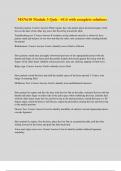
MSN610 Module 3 Quiz - SG4 with complete solutions External rotation -Correct Answer-While supine, have the patient place the lateral aspect of the foot on the knee of the other leg, move the flexed leg toward the table Trandelenburg test -Correct Answer-If weakness in hip abductor muscles is observed, have patient stand and balance on one foot and then the other, note symmetry while standing behind the patient Ballottement -Correct Answer-Used to identify excess fluid or effusion Have patient extend knee and apply downward pressure on the suprapatellar pouch with the thumb and finger of one hand, push the patella sharply downward against the femur with the fingers of the other hand, suddenly release pressure, note any clicking, tapping or fluid wave Bulge sign -Correct Answer-Used to identify excess fluid Have patient extend the knee and milk the medial aspect of the knee upward 2-3 times, note bulge of returning fluid McMurray Test -Correct Answer-Used to identify torn medial/lateral meniscus Have patient lie supine and flex the knee with the foot flat on the table, maintain flexion with the thumb and index finger on either side of the joint space while stabilizing the knee, hold the heel with the other hand, rotate the foot and lower leg to the lateral position, extend the knee to a 90 degree angle, return the knee to full flexion, repeat the procedure rotating the foot and lower leg to the medial position Drawer Test -Correct Answer-Used to identify instability of anterior cruciate ligament/posterior cruciate ligament Have patient lie supine, flex the knee, place the foot flat on examination table, pull the tibia sliding forward of the femur and push the tibia backward Varus and valgus stress test -Correct Answer-Used to identify medial collateral ligament instability Have patient lie supine and extend the knee, stabilize the femur and apply varus force against the ankle towad the midline and internally rotate, then apply valgus force away from the midline against the ankle To assess muscle strength of the temporalis and masseter muscles... -Correct Answer-have patient clench teeth while muscle contraction is palpated and opposing force is applied To asses ROM of the temporomandibular joint... -Correct Answer-Have patient move jaw from side to side To assess strength of the trapezius... -Correct Answer-Have patient maintain shrugged shoulder while an opposing force is applied To assess ROM of cervical spine -Correct Answer-Have patient bend the head backward, chin toward the ceiling When palpating the patient's elbow it should be flexed at __ degrees -Correct Answer-70 To evaluate the ROM of the thoracic and lumbar spine... -Correct Answer-Have the patient bend from side to side, bend forward at the waist and touch the toes and swing the upper trunk in a circular motion Barlow-Ortolani maneuver -Correct Answer-To detect hip dislocation in newborn Allis sign -Correct Answer-To detect hip dislocation or shortened femur Assess muscle strength in a child by... -Correct Answer-asking the child to stand, rising from a supine position Which muscle characteristics should a nurse inspect as part of a thorough musculoskeletal examination; Tone Atrophy Symmetry Hypertrophy Fasciculations -Correct Answer-Atrophy, symmetry, hypertrophy, fasicu
Written for
- Institution
- MSN 610
- Module
- MSN 610
Document information
- Uploaded on
- January 30, 2024
- Number of pages
- 6
- Written in
- 2023/2024
- Type
- Exam (elaborations)
- Contains
- Questions & answers
Subjects
-
msn610 module 3 quiz sg4 with complete solutions

Also available in package deal