Endo NBDE II Questions & Answers Accurate Review Solution A+
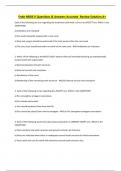
Endo NBDE II Questions & Answers Accurate Review Solution A+ Each of the following are true regarding the treatment tooth with a sinus tract EXCEPT one. Which is the EXCEPTION? a) Antibiotics are indicated b) The tooth should be treated with a root canal c) Root-end surgery should be performed if the tract persists after the root-canal d) The sinus tract should heal within a month of the root canal - ANS-Antibiotics are indicated 2. Which of the following is the MOST LIKELY adverse effect of internally bleaching an endodontically treated tooth with superoxide? a) Demineralizeation of tooth structure b) External cervical root resorption c) Reinfection of the canal d) Weakening of the remaining tooth structure - ANS-b) External cervical root resorption 3. Each of the following is true regarding pins EXCEPT one. Which is the EXCEPTION? a) Pins strengthen amalgam restorations b) Pins should not be bent c) Pins should be placed 1mm from the DEJ d) Pins should be placed 2mm into the amalgam - ANS-a) Pins strengthen amalgam restorations 4. Each of the following statements about post preparation is CORRECT EXCEPT one. Which is the EXCEPTION? a) Posts reinforce the tooth structure and prevent vertical root fractures b) Posts are indicated when there is inadequate coronal tooth structure for fixed restorations c) Posts retain the core for teeth with extensive coronal tooth structure loss d) It is recommended that at least 5mm of gutta percha should remain in the root canal after the post space is prepared - ANS-a) Posts reinforce the tooth structure and prevent vertical root fractures 5. Which of the following materials is typically used for the walking bleach technique? a) Sodium Perborate b) 30% Hydrogen peroxide c) 30% Carbamide peroxide d) 2.6% Sodium Hypochlorite e) 10% Phosphoric acid f) 14% Carbamide peroxide - ANS-a) Sodium perborate 6. The prognosis for internal bleaching is best if the etiology of the stain is... a) Precipitation of metallic salts b) Silver-containing root canal sealers c) Necrotic pulp tissue d) Amalgam restorations - ANS-c) Necrotic pulp tissue 7. When restoring an endodontically treated tooth with amalgam, what depth into each root canal should be achieved to obtain satisfactory retention? a) 1mm b) 2mm c) 3mm d) 4mm e) 5mm - ANS-c) 3 mm 8. Each of the following is a reason for placing a post in the restoration of an endodontically treated posterior tooth EXECEPT one. Which is the EXCEPTION? a) To enhance the retention of the core b) To strengthen the root c) To enhance the resistance of the restoration to lateral forces - ANS-c) To strengthen the root 9. Which of the following describes the function of calcium hydroxide in apexification? a) Induction of osteoclasts b) Creating a low pH conducive to bone growth c) Creating a High pH conducive to bone growth d) Stimulating secondary dentin formation - ANS-c) Creating a high pH conducive to bone growth 10. Which of the following describe functions of the pulp? CONTINUES...
Written for
- Institution
- Endo NBDE II
- Course
- Endo NBDE II
Document information
- Uploaded on
- January 30, 2024
- Number of pages
- 26
- Written in
- 2023/2024
- Type
- Exam (elaborations)
- Contains
- Questions & answers
Subjects
- endo nbde ii
-
endo nbde ii questions answers accurate review s
-
each of the following are true regarding the treat
-
which of the following is the most likely adverse
-
each of the following is true regar

Also available in package deal