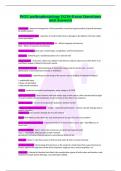
WGU pathophysiology D236-Exam Questions and Answers
acromegaly - abnormal enlargement of the extremities caused by hypersecretion of growth hormone by pituitary gland Acute Kidney Injury (AKI) - rapid loss of renal function due to damage to the kidneys; formerly called acute renal failure Alzheimer's disease vs parkinson's disease - Alz - affects language and memory Park - affects all executive functioning anemia can cause - pelvic pain, menorrhagia, constipation, uterine leiomyomas aneurysm - ballooning of a weakened portion of an arterial wall angina pectoris - chest pain, which may radiate to the left arm and jaw, that occurs when there is an insufficient supply of blood to the heart muscle Antiandrogen therapy - (Spironolactone or flutamide) causes lack of testosterone > erectyle dysfunction or decreased bone density or hotflashes Artherosclerosis - Hardening and narrowing of the arteries due to buildup of cholesterol plaques helial injury cell formation streak formation Asthma - treatment resistant bronchospasm, same category of COPD basal cell carcinoma - Most common and least severe type of skin cancer; often characterized by light or pearly nodules. Rarely metastasize, most common on face due to sun exposure benign neoplasm - noncancerous growths, stationary, distinct borders benign vs malignant hypertension - benign - "essential hypertension", chronic vascular damage due to sodium retention. malignant - acute vascular damage due to renin release Bursa - fluid-filled sac that allows for easy movement of one part of a joint over another Cause and sign of spina bifida - results from failure of neural tube to close. sign - fluid filled sac on lower back. causes of diabetes - type 1: beta cells in pancreas are destroyed (autoimmune) type 2: overweight, body becomes insulin resistant gestational: hormones during pregnancy cause glucose levels to rise CD4 cells - Helper T cells that mature in thymus that active B cells to create immunity cerebral contusion - the bruising of brain tissue as the result of a head injury that causes the brain to bounce against the rigid bone of the skull; symptoms: ringing in ears, severe headache, n/v.
Written for
- Institution
- WGU pathophysiology D236
- Course
- WGU pathophysiology D236
Document information
- Uploaded on
- January 27, 2024
- Number of pages
- 9
- Written in
- 2023/2024
- Type
- Exam (elaborations)
- Contains
- Questions & answers
Subjects
-
acromegaly abnormal enlargement of the extremiti
-
alzheimers disease vs parkinsons disease alz
-
aneurysm ballooning of a weakened portion of an
-
antiandrogen therapy spironolactone or flutamid

Also available in package deal