LMSW Practice Questions and Answers Already Passed
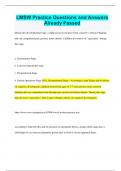
LMSW Practice Questions and Answers Already Passed During this developmental stage, a child possesses progress from concrete to abstract thinking and can comprehend past, present, future themes. Children also tend to be "egocentric" during this stage. a. Sensorimotor Stage b. Concrete Operational stage c. Preoperational Stage d. Formal Operations Stage c. Preoperational Stage - According to Jean Piaget and his theory on cognitive development, children between the ages of 2-7 years possess more concrete thinking and can comprehend time through past, present and future themes. During this stage they are more "egocentric". This is part of Piaget's theory on cognitive development. According to John Bowlby and his position on attachment theory, during which stage does a child begin to cry when an unfamiliar person tries to hold or closely approach them. a. Learned behavior b. Stranger anxiety c. Separation anxiety d. Separation Anxiety Disorder b. Stranger anxiety - Stranger anxiety begins in an infant at 5 to 9 months old when an unfamiliar person other than the child's parents attempts to hold or closely approach the child. This behavior intensifies about one year and discontinues when the child reaches 2 years of age.Learned behavior is a set of behaviors learned when the child interacts with his or her caretaker (mother) who provides food as comfort. This helps to form attachment. Separation anxiety begins around 6 to 8 months and the behaviors include being upset and anxious when the caregiver is out of his or her sight or leaves the room. Separation Anxiety Disorder occurs later in childhood and is characterized by excessive worry about being away from a caregiver. This behavior is not typical or appropriate for the age of the child at which it occurs. In which of the five stages of Maslow's hierarchy of needs does an individual experience his or her true calling, dealing with the world around them "as it is" and has a glimmer of what it is like to be complete? a. Esteem needs b. Safety needs c. Physiological needs d. Self-actualization d. Self-actualization - according to Maslow, is where a person needs to be his or herself despite one's environment. Typically, only 1% of the population consistently operates on this level. An individuals who is "self actualized" is in a position to find his or her true calling (i.e, an actor, writer, or musician). The other listed answer options are other needs in the hierarchy. Craig is a client who just entered into psychotherapy to address issues surrounding trauma. His therapist, a licensed clinical social worker, finds that he has the inability to acknowledge his true feelings when he describes the nature of this past sexual abuse. Craig states, "I just can't believe my Dad would do this to me. He wouldn't do this to me because he's my Dad". Which defense mechanism is Craig exhibiting? a. Denial b. Acting out c. Compensation d. Dissociation a. Denial A case worker is currently working with a client her age assisting her in accessing services through the local community center. The case worker finds the client rude and self-centered. When reviewing the case with her supervisor, the case worker informs her supervisor that the client "hates her". Which defensive mechanism is this case worker exhibiting? a. Introjection b. Projective Identification c. Projection d. Incorporation c. Projection - Projection, which the case worker is exhibiting, is a primitive defense, attributing one's disowned attitudes, wishes, and feelings onto some external object or person. In this case, the case worker does not like certain behaviors of the client and projects her feelings of dislike onto the client.Projective Identification is a form of projection. However, its more utilized with individuals diagnosed with Borderline Personality Disorder (BPD), which they are unconsciously perceiving others' behaviors as a reflection of one's own identity. Introjection is generally where a person adopts or replicates the behaviors or attributes of others. Incorporation is a primitive behavior where "psychic" representations of a person (parts of a person) are figuratively ingested. This individual is not exhibiting their true authentic self. According to systems theory, what is another term for "steady state"? a. Input b. Homeostasis c. Open system d. Differentiation
Written for
- Institution
- LMSW - Licensed Master Social Worker
- Course
- LMSW - Licensed Master Social Worker
Document information
- Uploaded on
- January 25, 2024
- Number of pages
- 50
- Written in
- 2023/2024
- Type
- Exam (elaborations)
- Contains
- Questions & answers
Subjects
-
lmsw practice questions and answers already passed

Also available in package deal