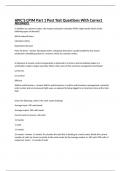
APIC'S CPIM Part 1 Post Test Questions With Correct Answers
In addition to customer orders, the master production schedule (MPS) might handle which of the following types of demand? Bill-of-material items Interplant orders Dependent demand Parts list items - Answer Interplant orders: Interplant demand is usually handled by the master production scheduling system in a manner similar to customer orders. A shipment of remote control components is delivered to a factory and immediately taken to a workstation ready to begin assembly. What is the name of this inventory management technique? Lot-for-lot Lot control Efficient Wall-to-wall inventory - Answer Wall-to-wall inventory: In wall-to-wall inventory management, materials enter a plant and are processed right away, as opposed to being logged in an inventory store until a later date. Given the following, what is the work center backlog? Average input: 100 units/week Average output: 100 units/week Current work in process: 160 units .63 weeks 1 week 1.6 weeks 2.6 weeks - Answer 1.6 weeks: To calculate the load that is backlog at a work center, divide the current number of units (or hours) currently at the work center by the average output, or 160 units/100 units of output per week = 1.6 weeks of load. Which correctly identifies the following examples of costs as internal failure (I), external failure (E), appraisal costs (A), and prevention costs (P)? Operator training= I; product recalls and loss of customers = E; scrap and machine maintenance= A; in-line inspection = P Machine maintenance and in-line inspections = I; scrap and loss of customers = E; product recalls = A; operator training = P Scrap = I; product recalls and loss of customers = E; in-line inspections = A; machine maintenance and operator training = P Product recalls = I; scrap and in-line inspections = E; loss of customers = - Answer Scrap = I; product recalls and loss of customers = E; in-line inspections = A; machine maintenance and operator training = P: Scrap is an internal failure cost because it occurs without the customer seeing it. Product recalls and loss of customers are external failure costs because the first is directly experienced by customers and the second is a direct customer reaction to poor quality. In-line inspections are an appraisal cost because this is an example of a quality control activity. Machine maintenance and operator training are examples of prevention costs because these are investments designed to reduce the chances of quality problems occurring in the first place. Companies typically make final purchasing decisions based on which of the following supplier characteristics? Supplier fixed cost Product advertising Delivery reliability Free-on-board shipping - Answer Delivery reliability: Besides perfect quality, a key final purchasing decision point is delivery reliability. Ensuring that purchase deliveries arrive on time is an essential feature of supplier partnerships. What type of demand inventory ordering model includes fixed reorder cycles, fixed reorder quantities, optional replenishment, and hybrid models? Material requirements planning Independent Drum-buffer-rope Kanban - Answer Independent: independent demand inventory ordering models include fixed reorder cycles, fixed reorder quantities, optional replenishment, and hybrid models, among others. Dependent demand inventory ordering models include material requirements planning, kanban, and drum-buffer-rope. What is the primary difference between enterprise resources planning (ERP) and manufacturing resource planning (MRP II)? ERP is computer-based, but MRP II is not. ERP integrates additional business functions, including human resources, research and development, logistics, and others. ERP includes manufacturing information only. ERP provides a balance between production, marketing, and information technology. - Answer ERP integrates additional business functions, including human resources, research and development, logistics, and others.: ERP provides more than just manufacturing information; it integrates business functions like human resources, research and development, and logistics. MRP II and ERP are both computer-based, and both provide a balance between production, marketing, and information technology. The day 56 log for a work center shows planned input of 14 hours, actual input of 16 hours, and a cumulative input variance of -2 hours. For the same day the planned output was 15 hours, the actual output was 14 hours and the cumulative output variance was -5 hours. The day 55 log showed the planned backlog was 7 hours and the actual backlog was 6 hours. What is the planned backlog for day 56? 0 hours 6 hours -7 hours 8 hours - Answer 6 hours: Planned Backlog = Previous Planned Backlog + Planned Input - Planned Output = 7 hours + 14 hours - 15 hours = 6 hours. For the past six months, a manufacturer has experienced monthly forecast deviations of 15, -6, 12, 8, -18, and -4 units. What is the mean absolute deviation for these months? 1.16 9.33 10.5 11.67 - Answer 10.5: To calculate the mean absolute deviation, first make each deviation positive and sum these absolute values: 15 + 6 + 12 + 8 + 18 + 4 = 63 units. Next, divide by the number of periods (6): 63/6 = 10.5. When are final assembly schedules typically used? When production is a continuous flow process When all assemblies are the same with no variation in product structure When products come from an engineer-to-order production strategy When there are many options and it is difficult to forecast which combination the customer will want - Answer When there are many options and it is difficult to forecast which combination the customer will want: When there are many possible combinations of options, it can be impractical to store every possible configuration. Using a final assembly schedule, combinations are assembled based on customer order input. Which of the following should be done as part of the last step in the purchasing cycle for materials to be used in a traditional manufacturing process to reduce the risk of paying for incorrect materials or quantities? Compare the name, part number, quantity, description, and price of goods ordered versus delivered. Compare the incoming order with the status of the order to determine if there are discrepancies. Do a three-way match between purchase order, receiving report, and invoice. Do a three-way match between the purchase order, the purchase requisition, and the MRP (materials requirements planning) released order. - Answer Do a three-way match between purchase order, receiving report, and invoice.: The purchasing cycle consists of the following steps: Receiving purchase requisition Selecting suppliers Determining the right price Issuing purchase orders Ensuring that delivery dates are met Receiving goods and closing the order Approving suppliers' invoice for payment During the receiving goods step, the incoming order is compared to the purchase order and packing slip. This results in a receiving report. During the approve payments step, the purchasing department performs a three-way match between the purchase order, the receiving report, and the invoice to make sure that quantities and materials are correct. Which of the following is a measure of customer service? Capacity utilization Percentage of orders shipped on time Inventory turns Master schedule fill rate - Answer Percentage of orders shipped on time: The percentage of customer orders shipped on time is perhaps the most important metric in the business and a key measure of customer service. Which of the following warehouse roles deals with grouping different items into an order? Physical supply channel Manufacturing channel Distribution channel Transaction channel - Answer Distribution channel: The distribution channel is concerned with the transfer or delivery of goods or services to the customer, including grouping items into an order. Which method of sourcing refers to an organization that is the only supplier capable of meeting (usually technical) requirements for an item? Multisourcing Unisourcing Single-source supplier Sole-source supplier - Answer Sole-source supplier: A sole-source supplier is the only supplier capable of meeting (usually technical) requirements for an item.
Geschreven voor
- Instelling
- CPIM - Certified in Production & Inventory Management
- Vak
- CPIM - Certified in Production & Inventory Management
Documentinformatie
- Geüpload op
- 25 januari 2024
- Aantal pagina's
- 16
- Geschreven in
- 2023/2024
- Type
- Tentamen (uitwerkingen)
- Bevat
- Vragen en antwoorden
Onderwerpen
- apics cpim stuvia
-
apics cpim part 1 post test questions with correc
-
in addition to customer orders the master product
-
parts list items answer interplant orders inter

Ook beschikbaar in voordeelbundel