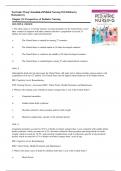
Christensen & Kockrow Adult Health Nursing, 5th Edition Test Bank
TABLE OF CONTENT 1. Introduction to anatomy and physiology 2. Care of the surgical patient 3. Care of the patient with an integumentary disorder 4. Care of the patient with a Musculoskeletal disorder 5. Care of the patient with a gastrointestinal disorder 6. Care of the patient with a gallbladder, liver, biliary tract or exocrine pancreatic disorder 8. Care of the patient with a cardiovascular or peripheral vascular disorder 9. Care of the patient with a respiratory disorder 10. Care of the patient with a urinary disorder 11. Care of the patient with an endocrine disorder 12. Care of the patient with a reproductive disorder 13. Care of the patient with a visual or auditory disorder 14. Care of the patient with a neurological disorder 15. Care of the patient with an Immune disorder 16. Care of the patient with HIV/AIDS 17. Care of the patient with Cancer Chapter 1: Introduction to Anatomy and Physiology MULTIPLE CHOICE 1. The anatomic term means toward the midline. a. anterior b. posterior c. medial d. cranial ANS: C The term medial indicates an anatomic direction toward the midline. DIF: Cognitive Level: Knowledge REF: Page 1 OBJ: 2 TOP: Anatomic terminology KEY: Nursing Process Step: Assessment MSC: NCLEX: Physiological Integrity 2. What are the smallest living components in our body? a. Cells b. Organs c. Electrons d. Osmosis ANS: A Cells are considered to be the smallest living units of structure and function in our body. DIF: Cognitive Level: Knowledge REF: Page 4 OBJ: 6 TOP: Structural levels of organization KEY: Nursing Process Step: N/A MSC: NCLEX: Physiological Integrity 3. What is the largest organelle, responsible for cell reproduction and control of other organelles? a. Nucleus b. Ribosome c. Mitochondrion d. Golgi apparatus ANS: A The nucleus is the largest organelle within the cell. DIF: Cognitive Level: Knowledge REF: Page 5 OBJ: 8 TOP: Parts of the cell KEY: Nursing Process Step: Assessment MSC: NCLEX: Physiological Integrity 4. When the patient complains of pain in the bladder, the patient will indicate discomfort in which body cavity? a. Pelvic b. Mediastinum c. Dorsal d. Abdominal ANS: A A subdivision called the pelvic cavity contains the lower portion of the large intestine (lower sigmoid colon, rectum), urinary bladder, and internal structures of the reproductive system. DIF: Cognitive Level: Comprehension REF: Page 3, Figure 1-4 OBJ: 5 TOP: Body cavity KEY: Nursing Process Step: Assessment MSC: NCLEX: Physiological Integrity 5. The four phases of cell division all occur in: a. diffusion. b. mitosis. c. osmosis. d. filtration. ANS: B During mitosis, the cell goes through four phases: prophase, metaphase, anaphase, and telophase. DIF: Cognitive Level: Knowledge REF: Page 7 OBJ: 9 TOP: Cell division KEY: Nursing Process Step: N/A MSC: NCLEX: Physiological Integrity 6. Telophase is which phase of cell reproduction during mitosis? a. First phase b. Latent phase c. Final phase d. Spindle phase ANS: C During mitosis, the cell goes through four phases: prophase, metaphase, anaphase, and telophase.
Written for
- Institution
-
Chamberlain College Of Nursing
- Course
-
NR 200
Document information
- Uploaded on
- January 24, 2024
- Number of pages
- 5
- Written in
- 2023/2024
- Type
- Exam (elaborations)
- Contains
- Questions & answers
Subjects
-
christensen kockrow adult health nursing 5th ed