MTM Questions and Answers with Certified Solutions
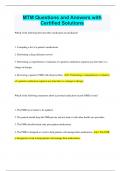
MTM Questions and Answers with Certified Solutions Which of the following best describes medication reconciliation? 1. Compiling a list of a patient's medications. 2. Performing a drug utilization review. 3. Performing a comprehensive evaluation of a patient's medication regimen any time there is a change in therapy. 4. Reviewing a patient's PMR with all prescribers. 3. Performing a comprehensive evaluation of a patient's medication regimen any time there is a change in therapy Which of the following statements about a personal medication record (PMR) is true? 1. The PMR never needs to be updated. 2. The patient should keep the PMR private and not share it with other health care providers. 3. The PMR should include only prescription medications. 4. The PMR is designed as a tool to help patients self-manage their medications. 4. The PMR is designed as a tool to help patients self-manage their medications. Which of the following is a business purpose related to monitoring and evaluating patient outcomes? 1. Tracking of changes in a patient's health and functional status. 2. Revision of the care plan as needed. 3. Demonstration of cost-benefit to payers. 4. Measurement of patient satisfaction. 3. Demonstration of cost-benefit to payers. A useful acronym to keep in mind when developing goals is SMART, which stands for: 1. Specific, material, achievable, realistic, time-limited. 2. Specific, measurable, achievable, realistic, time-limited. 3. Specific, measurable, adaptable, realistic, time-limited. 4. Specific, measurable, achievable, realistic, thoughtful. 3. Specific, measurable, adaptable, realistic, time-limited. What is a significant drawback to the use of clinical practice guidelines? 1. They often do not comprehensively address the needs of patients with multiple diseases. 2. Almost all are updated on a yearly basis, making it difficult to keep track of all the changes. 3. Most professional groups charge high fees for the use of their guidelines. 4. Quality measures of pharmacy practice are usually unrelated to clinical practice guidelines. 1. They often do not comprehensively address the needs of patients with multiple diseases. Which of the following activities is generally associated with the "implement" step of the Pharmacist's Patient Care Process? 1. Provide education and self-management training to the patient or caregiver. 2. Assess immunization status and the need for preventive care and other health care services, where appropriate. 3. Evaluate relevant health data that may include medical history, health and wellness information, biometric test results, and physical assessment findings. 4. Review each medication for appropriateness, effectiveness, safety, and patient adherence. 1. Provide education and self-management training to the patient or caregiver. Using motivational interviewing, how might a pharmacist respond to a patient who rates his or her confidence in ability to change a behavior as a 2 on a 10-point scale? 1.
Geschreven voor
- Instelling
- MTM
- Vak
- MTM
Documentinformatie
- Geüpload op
- 24 januari 2024
- Aantal pagina's
- 30
- Geschreven in
- 2023/2024
- Type
- Tentamen (uitwerkingen)
- Bevat
- Vragen en antwoorden
Onderwerpen
-
mtm questions and answers with certified solutions

Ook beschikbaar in voordeelbundel