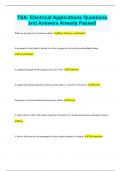
TSA: Electrical Applications Questions and Answers Already Passed
TSA: Electrical Applications Questions and Answers Already Passed What are the pins of a transistor called? Base, Collector, and Emitter A automatic switch that is similar to a fuse in purpose, but can be used multiple times. Circuit Breaker A material through which charges can easily flow. Conductor A negatively charged particle found in atoms that is a carrier of electricity. Electron The process used in modern nuclear power plants. Fission A safety device with a thin metal strip that will melt if too much current passes through a circuit. Fuse A device that uses an electromagnet to detect small amounts of current. Galvanometer Allowing charges to flow directly from the circuit into Earth in the event of a short circuit. Grounded A method of charging an object by means of the electric field or another object; the objects have no direct contact. Induction A material through which charges cannot easily flow. Insulator A circuit that has been manufactured on a chip (a tiny slice of semiconductor), which can contain thousands of diodes, transistors, and resistors. Integrated Circuit LED stands for this. Light Emitting Diode A device that attracts any material containing iron. Magnet The angle between geographic north to which a compass needle points. Magnetic Declination A region in which the magnetic fields of all atoms are lined up in the same direction. Magnetic Domain The region around a magnet where the magnetic force is exerted. Magnetic Field Invisible lines that map out the magnetic field around a magnet. Magnetic Field Lines A force produced when magnetic poles interact. Magnetic Force The ends of a magnetic object, where the magnetic force is strongest. Magnetic Pole The force of attraction or repulsion of magnetic materials. Magnetism The energy an object has due to its movement or change in position. Mechanical Energy The small uncharged particle that is found in the nucleus of an atom. Neutron The arrow on the emitter is pointing out on the schematic of this type transistor. NPN The core at the center of every atom. Nucleus The law that states that resistance is equal to voltage divided by current. Ohm's Law An electric circuit with multiple paths. Parallel Circuit A magnet made of material that keeps its magnetism. Permanent Magnet The arrow on the emitter is pointing in on the schematic of this type transistor. PNP The rate at which one form of energy is transformed into another: measured in watts. Power A positively charged particle that is part of an atom's nucleus. Proton The measurement of how difficult it is for charges to flow through a material. Resistance A material that conducts current under certain conditions. Semiconductor An electric circuit with a single path. Series Circuit A connection that allows current to take an unintended path. Short Circuit A coil of wire with a current that acts as a bar magnet. Solenoid The loss of static electricity as electric charges transfer from one object to another. Static Discharge A buildup of charges on an object. Static Electricity A transformer that decreases voltage. Step-Down Transformer A transformer that increases voltage. Step-Up Transformer A magnet made from a material that easily loses its magnetism. Temporary Magnet A convenient attachment point used to connect a cell of battery to a circuit. Terminal The round prong of a plug that connects any metal pieces in an appliance to safety. Third Prong A device that increases or decreases voltage. Transformer An electronic component used to amplify an electronic signal or to switch current on and off. Transistor The difference in electrical potential energy between two places in a circuit. Voltage A device that creates an electrical potential energy difference in an electric current; for example batteries and generators. Voltage Source A device used to measure voltage, or electrical potential energy difference. Voltmeter What turns the generator in hydroelectric plants. Water A diode that can conduct in reverse bias and is commonly used in voltage regulation. Zener Diode A resistor with the bands brown, black, blue, has a resistance of __MEG ohms. 10 A resistor with the bands orange, yellow, orange, has a resistance of __ ohms. 34K A resistor with a gold band as the forth one has a tolerance of __% 5 A resistor with the bands green, black, black, has a resistance of __ ohms. 50 How many pins does a transistor have? 3 How many pins are on a 555 Timer Circuit? 8 When R1 and R2 are connected in a series, what is the total resistance? R1 + R2 When R1 and R2 are connected in parallel, what is the total resistance? (R1 x R2) / (R1 + R2) When R1, R2, and R3 are connected in parallel, what is the total resistance? 1 / ((1 / R1) + (1 / R2) + (1 / R3)) Circuit component "Q1" could either be a transistor or this. SCR If a resistor is 64 ohms, what are the colors of its first three bands? blue, yellow, black If a resistor is 620k ohms, what are the colors of its first three bands? blue, red, yellow If a resistor is 62 ohms, what are the colors of its first three bands? blue, red, black What petroleum is made from. Crude Oil The largest primary source of electrical energy in the United States. Coal What positive and negative particles do when brought together. Attract What two negative particles do when brought together. Repel How much one horsepower is. 746 watts The unit resistance is measured in. Ohms The unit power is measured in. Watt The unit capacitance is measured in. Farad (Microfarad)
Written for
- Institution
- TSA: Electrical Applications
- Course
- TSA: Electrical Applications
Document information
- Uploaded on
- January 24, 2024
- Number of pages
- 9
- Written in
- 2023/2024
- Type
- Exam (elaborations)
- Contains
- Questions & answers
Subjects
-
tsa electrical applications questions and answers

Also available in package deal