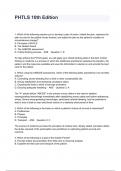
PHTLS 10th Edition Exam Questions And Answers
PHTLS 10th Edition Exam Questions And Answers 1. Which of the following requires you to develop a plan of action, initiate the plan, reassess the plan as care for the patient moves forward, and adjust the plan as the patient's condition or circumstances change? A. Principles of PHTLS B. The Golden Period C. The XABCDE assessment D. Critical thinking process - ANS Question 1: D To help achieve the PHTLS goals, you will apply your critical thinking skills in the field. Critical thinking in medicine is a process in which the healthcare practitioner assesses the situation, the patient, and the resources available and uses the information to decide on and provide the best care for the patient. 2. When using the XABCDE assessment, which of the following takes precedence over all other actions? A. Controlling severe bleeding from a limb or other compressible site B. Airway stabilization and assessing circulatory status C. Exposing the body to allow a thorough evaluation D. Ensuring adequate breathing - ANS Question 2: A The "X" placed before "ABCDE" in the primary survey refers to the need to address exsanguinating hemorrhage immediately after establishing scene safety and before addressing airway. Severe exsanguinating hemorrhage, particularly arterial bleeding, has the potential to lead to loss of total or near total blood volume in a relatively short period of time. 3. Which of the following is the basis on which a patient's chance of survival is maximized? A. Preferences B. Phases C. Principles D. Transport - ANS Question 3: C The science of medicine provides the principles of medical care. Simply stated, principles define the duties required of the prehospital care practitioner in optimizing patient survival and outcome. 4. Which of the following is a goal of the Golden Period? A. Provide written documentation from field care to receiving hospital. B. Expedite the field care and transport of the patient. C. Use a team approach for optimal patient care. D. Use the XABCDE approach to patient assessment. - ANS Question 4: B One of your most important responsibilities as a prehospital care practitioner is to spend as little time on the scene as possible and expedite your field care and transport of the patient.Studies show that the time from injury to arrival at the appropriate site for definitive care is critical to survival. 1. You are called to the scene of a possible mass casualty motor vehicle collision on the highway. Once you arrive on scene, what is your first priority? A. Immediately begin triaging patients. B. Treat the patient with the most visible blood loss. C. Determine the need for additional resources. D. Assess the scene and ensure it is safe. - ANS Question 1: D Ensure safety for responders, bystanders, and patient(s). The first consideration when approaching any scene is the safety of all emergency responders. When EMS personnel become victims, they not only can no longer assist others, but also add to the number of patients. 2. A trauma patient from the highway incident is holding her right arm, and you note a significant amount of blood steadily flowing from a long gash. This is an example of what type of hemorrhage? A. Capillary bleeding B. Venous bleeding C. Arterial bleeding D. Road rash - ANS Question 2: B Venous bleeding typically results in a steady flow of dark red blood. 3. What is the best way to control the bleeding? A. Direct pressure B. Elevation of the arm above the heart C. Tourniquet D. Occlusive dressing - ANS Question 3: A With venous bleeds, direct pressure is usually sufficient to stop the flow. 4. The patient is wearing long sleeves, and you are having trouble visualizing the wound. What should you do? A. Cut the cloth away from the site until the entire wound site is visible. B. Leave the clothing in place. Put gauze over the wound. C. Remove the patient's shirt. D. Cut through the slash on the sleeve, and use the material as a makeshift tourniquet. - ANS Question 4: A Clothing can be quickly removed by cutting. You cannot treat what you cannot see. 1. You are called to the scene of an explosion and fire at a chemical plant where you find multiple casualties.Triage has begun. Your first patient is a 40-year-old man who was near the source of the explosion. He is unconscious and has extensive injuries. You note gurgling respirations. Why should you use the trauma jaw thrust maneuver first when dealing with a trauma patient? A. It's an easy technique that always works to open the airway. B. It allows you to open the airway with little or no movement of the head and cervical spine. C. Other techniques and interventions don't work as well. D. It can relieve a variety of anatomic airway obstructions in patients who are breathing spontaneously. - ANS Question 1: B Manual maneuvers like the trauma jaw thrust or chin lift are always the first airway maneuver you should make when treating a trauma patient. In patients with suspected head, neck, orfacial trauma, the cervical spine is maintained in a neutral in-line position.The trauma jaw thrust maneuver allows you to open the airway with little or no movement of the head and cervical spine. 2. The patient becomes apneic. You suspect he has a cervical injury. Which type of airway should you use? A. Supraglottic airway B. Blind nasotracheal intubation C. Oropharyngeal airway D. Surgical airway - ANS Question 2: A The supraglottic airway's greatest advantage is that it can be inserted independent of the patient's position, which may be especially important in trauma patients with high suspicion of cervical injury. 3. Why might it be more difficult to deal with an airway obstruction in a child? A. Children have longer tracheas. B. Children have larger heads and tongues so there is a greater potential for airway obstruction. C. Children have smaller heads, so there is less room to clear the obstruction. D. A child's epiglottis is smaller and stiffer than an adult's. - ANS Question 3: B Children have larger heads and tongues as compared to an adult so there is a greater potential for airway obstruction in a pediatric patient. Y
Written for
- Institution
- PHTLS
- Course
- PHTLS
Document information
- Uploaded on
- January 24, 2024
- Number of pages
- 10
- Written in
- 2023/2024
- Type
- Exam (elaborations)
- Contains
- Questions & answers
Subjects


Also available in package deal