MTTC Integrated Science Exam 100% Accurate!!
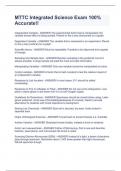
Independent Variable - ANSWER The experimental factor that is manipulated; the variable whose effect is being studied. Placed on the x-axis (horizontal) on a graph. Dependent Variable - ANSWER The variable that is measured in an experiment. Placed on the y-axis (vertical) on a graph. Scientific theory - ANSWER Must be repeatable. Possible to be disproved and capable of change. Sampling and Sample Size - ANSWER Random sampling is the preferred, but isn't always possible. A large sample will yield the most accurate information. Manipulating Variables - ANSWER Only one variable should be manipulated at a time. Control variable - ANSWER A factor that is held constant to test the relative impact of an independent variable Response to Lab Accident - ANSWER In most cases, 911 should be called immediately. Response to Fire in a Beaker or Flask - ANSWER Do not use a fire extinguisher. Just place a watch glass or wet towel over it to cut off Oxygen supply. Guidelines for Dissections - ANSWER Specimens should be rinsed before using. Latex glover preferred. Avoid use of formaldehyde/dispose of correctly. Need to provide alternative for students with moral objections to assingment. Storing Lab Chemicals - ANSWER Store all in secured, dry area. Acids locked in separate area. Origin of Biological Sciences - ANSWER Traced back to ancient Greeks (i.e. Aristotle) Andrea Vesalius - ANSWER Dissected human bodies; created a book on anatomy Anton van Leeuwenhoek - ANSWER Father of Microscopy, first to see and describe bacteria, yeast plants, and microscopic life found in water Scanning Electron Microscope (SEM) - ANSWER Instead of a light, a beam of electrons pass through specimen. Resolution about 1,000 times greater than light microscope. Will kill specimen though. Robert Hooke - ANSWER Famous for Hook's law describing elasticity. But called a "virtuoso", able to contribute findings to any major field in science Carl Von Linnaeus - ANSWER Famous for binomial system of nomenclature. Each living organism has two names, a genus and species. Considered father of modern ecology and taxonomy Pasteur - ANSWER Discovered role of microorganisms in the cause of disease, pasteurization, and rabies vaccine. Koch's Postulates - ANSWER Specific diseases caused by specific pathogens Cell theory - ANSWER Cell is the common structural unit in plants and animals. Proposed by Mattias Scheleiden and Schwann. Watson and Crick - ANSWER Discovered the structure of DNA was a double helix (in the 1950s). Made it possible to understand how DNA replicated and synthesized proteins Commonalities Among all Sciences - ANSWER - Systems, order, and organization - Evidence, models, and explanation - Constancy, change, and measurement - Evolution and equilibrium - Form and function Empirical Evidence - ANSWER All evidence is empirical; all evidence must be observed by the five sense. Peer-reviewed Journals - ANSWER Most accepted source for information on scientific experiments and studies Air Pollution - ANSWER Chemicals in the air; include carbon monoxide, sulfur dioxide, and chlorofluorocarbons (CFC's) Water Pollution - ANSWER Contaminants enter water by ground runoff or by leaching Thermal pollution - ANSWER Factories dump water at high temperatures which increases normal water temperatures. This means the water can hold less gas, disrupting the ecosystem Greenhouse gasses - ANSWER I.e. carbon dioxide and nitrous oxide. Concentration of them is increased by burning fossil fuels. These gasses absorb and trap heat, therefore warming the planet Acid ran - ANSWER Sulfur and nitrous oxides converted to acids and contaminate water supplies Prokaryotes - ANSWER Single-celled organisms that do not have a membrane-bound nucleus Flagella - ANSWER Appendages on bacteria cells; used for movement Pili - ANSWER Used by bacteria cells to attach to other cells Cell Wall - ANSWER a thin membrane around the cytoplasm of a cell Cell membrane - ANSWER a phospholipid layer that covers a cell's surface and acts as a barrier between the inside of a cell and the cell's environment Eukaryotes - ANSWER organisms whose cells contain a nucleus and other membrane bound organelles Nucleus - ANSWER a part of the cell containing DNA and RNA and responsible for growth and reproduction Nucleolus - ANSWER The organelle where ribosomes are made, synthesized and partially assembled, located in the nucleus Ribosomes - ANSWER site of protein synthesis Endoplasmic Reticulum - ANSWER an internal membrane system in which components of cell membrane and some proteins
École, étude et sujet
- Établissement
- MTTC Integrated Science
- Cours
- MTTC Integrated Science
Infos sur le Document
- Publié le
- 23 janvier 2024
- Nombre de pages
- 22
- Écrit en
- 2023/2024
- Type
- Examen
- Contient
- Questions et réponses
Sujets
-
mttc integrated science exam 100 accurate
-
mttc integrated science exam stuvia
-
independent variable answer the experimental fac
-
dependent variable answer the variable that is

Document également disponible en groupe