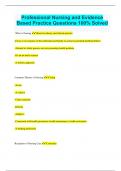
Professional Nursing and Evidence Based Practice Questions 100% Solved
Professional Nursing and Evidence Based Practice Questions 100% Solved What is Nursing -Based on theory and clinical practice -Focus is on response of the individual and family to actual or potential health problems -Attuned to whole person, not just presenting health problem -It's an art and a science -A holistic approach Common Themes of Nursing -Caring -An art -A science -Client centered -Holistic -Adaptive -Concerned with health promotion, health maintenance, health restoration -A helping profession Recipients of Nursing Care -Consumer -Patient -Client Consumer Healthcare can be offered to one person or a group Patient Comes from latin word meaning to suffer. A passive person Client An active recipient of healthcare. *preferred term* Scope of Nursing -Promoting health and wellness -Preventing illness -Restoring health -Caring for the dying Practice settings for nursing -Acute care hospitals -Home care -Community agencies -Ambulatory clinics -Health maintenance organizations -Nursing practice centers Nurse practice acts (indvidual to each state) -Legal acts that regulate the practice of nursing in the US and Canada -Each state has its own -Purpose: To protect the public -Nurses are responsible for knowing and complying with their states practice act as it governs their practice Standards of Nursing Practice ANA -Describe responsibilities for which nurses are accountable -Generic; use it to establish a foundation -Provide for practice of nursing regardless of area of specialization -Specialty organizations may develop specific standards for their area NOT OPEN TO NEGOTIATION AND ALWAYS OVERRIDE INSTITUTIONAL POLICIES Standard 1:Professionalism Assessment -The nurse collects patient health date Standard 2: Professionalism Diagnosis -The nurse analyzes the assessment date in determining diagnosis Standard 3: Professionalism Outcome Identification -The nurse identifies expected outcomes individualized to the patient Standard 4: Professionalism Planning -The nurse develops a plan of care that prescribes interventions to attain expected outcomes Standard 5: Professionalism Implementation -The nurse implements the interventions identified in the plan Standard 6: Professionalism Evaluation -The nurse evaluates the patients progress toward attainment of outcomes Standard 1: Performance Quality of Care -The nurse systematically evaluates the quality and effectiveness of nursing practice Standard 2: Performance Performance Appraisal -The nurse evaluates ones own nursing practice in relation to professional standards and relevant statues and regulations Standard 3: Performance Education -The nurse acquires and maintains current knowledge in nursing practice Standard 4: Performance Collegiality - The nurse interacts with and contributes to the professional development of peers and other health care providers Standard 5: Performance Ethics -The nurses decisions and actions on behalf of patients are determined in an ethical manner. Standard 6: Performance Collaboration -The nurse collaborates with the patient family and other health care providers in providing patient care Standard 7: Performance Research -The nurse uses research findings in practice Standard 8: Performance Resource Utilization -The nurse considers factors related to safety effectiveness and const in planning and delivering patient care. Nursing as a profession is distinguished by: -Prolonged specialized training to acquire body of knowledge pertinent to role -Orientation of individual towards service -Ongoing research -Code of ethics -Autonomy -Professional organization Roles of nursing -Caregiver -Teacher -Communicator -Client advocate -Counselor -Change agent -Leader -Manager Sources of Nursing Knowledge -Tradition: passed from generation to generation -Authoritative: from experts -Clinical experience -Trial and error -Intuition -Logical reasoning -Scientific: research Evidence based Practice -Decreases the uncertainty that clinicians and patients experience -Produces better outcomes and higher levels of satisfaction -Process by which nurses make click decisions using the best available research evidence, their clinical expertise and patient preferences -It is a 3 in 1 approach Why evidence based practice? -Issues in healthcare delivery -practice variation - system issues -Decrease adverse events -Improvement in patient outcomes -Improve practice cultures -Nursing care is not centered on diagnosis, but a clients response to an illness 5 steps of evidence based practice 1. Ask a burning clinical question 2. Collect the most relevant and best evidence 3. Critically appraise the evidence 4. Integrate all evidence with ones clinical expertise, patient preferences, and values in making a practice decision or change 5. Evaluate the practice decision or change The Iowa Model of EBP: Identifying a trigger -Problem focused or knowledge focused -Is the problem a priority? If yes, -Form a team -Write the question (PICO) -Review and critique relevant literature How to make a PICO question P- the patient population I-the potential issue or intervention to be placed C- the comparison of interest O- the desired outcome Levels of Evidence 1 is the strongest 5 is the weakest The Iowa Model of EBP: Piloting The Change in Practice -If there is evidence to make a change in practice, pilot change -select outcomes to be achieved -Collect baseline data -Design evidence based practice guideline -Implement EBP on pilot units -Evaluate process and outcomes -Modify practice guideline in accordance with results The Iowa Model of EBP: is change appropriate? Yes; institute the change in process No; continue to evaluate quality of care and new knowledge
Written for
- Institution
- Professional Nursing and Evidence
- Course
- Professional Nursing and Evidence
Document information
- Uploaded on
- January 22, 2024
- Number of pages
- 10
- Written in
- 2023/2024
- Type
- Exam (elaborations)
- Contains
- Questions & answers
Subjects
-
professional nursing and evidence based practice q

Also available in package deal