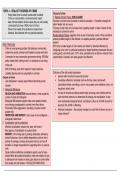
TOPIC 4 – REALIST THEORIES OF CRIME
- Reject idea crime is socially constructed via labels Causes of crime
- Crime is a real problem, concerned about impact 3. Rational Choice Theory; RON CLARKE
- take criminal statistics at face value (they are not socially Decision to commit crime is based on rational calculation – if benefits outweigh the
constructed but show a REAL level of crime) risks= likelier and vice versa
- Street crime needs to be tackled as impacts lives The way to stop crime is to increase risks of getting caught or make it harder for the
- Marxists, Neo Marxists offer no practical solutions individual to commit the crime
Routine Activity Theory suggests crime as part of everyday routine if three conditions
present (suitable target for the offender, no capable guardian, potential offender
present
RIGHT REALISM SCP aims to make targets of crime harder and riskier for potential offenders by
- Crime is a real growing problem that destroys communities, ‘designing out a crime’ in particular locations by ‘target hardening’ measures like post
undermines social cohesion and threatens society work ethic coding goods, anti-climb paint, CCTV, locks, premises and car alarms- reduced crime
- Correspond w neo-conservative government during 1970/80s- opportunities in locations and pose greater risk offenders
policy makers feel ‘nothing works’- no solutions to curb rising
crime rate
- Shift in thinking, away from research, toward solutions
- Labelling theories are too sympathetic to criminal Criticisms of the right realist explanation
Causes of crime Ignores wider structural causes like poverty
- Less interested in causes (reject Marxist idea that poverty Overstates offender’s rationality and how far they make cost-benefit
causes) calculations before committing a crime- may explain some utilitarian crime, not
1. Biological differences impulsive/ violent crime
WILSON AND HERNSTEIN biosocial theory; crime caused by Its view of criminals as rational actors freely choosing crime conflicts with its
combo of social and biological claim that their behaviour is determined by biology and socialisation. It also
Biological diffs between people make some people innately over emphasises biological factors; according to Lilly et al, IQ diffs account for
more strongly predisposed to commit crime than others. less than 3% of diffs in offending
Personality traits (aggression, risk taking, impulse control= Historical evaluation – Has society changed so much that the theory is just no
greater risk)
longer relevant?
HERNSTEIN AND MURRAY; main cause is low intelligence –
biologically determined
2. Socialisation and the underclass
effective socialisation reduces risk, learn self control
Best agency of socialisation is nuclear family
MURRAY; crime rising due to growing underclass, defined by
deviant behaviour- due to welfare dependency culture- led to
decline of marriage, increase lone parent fam as can live off
benefits- no longer responsible for supporting fams, no need to
work
Single mothers ineffective socialisation agents, esp for boys-
absent father lack paternal discipline, male role models- so turn
to delinquent role models on street, gain status via crime rather
than steady job and families = FECKLESS PARENTING
, TOPIC 4 – REALIST THEORIES OF CRIME 2
TACKLING CRIME
- RIGHT REALISTS do not see the point of trying to deal with causes of crime as cannot be easily
changes- instead seek practical measures to make it less attractive
- Main focus on control, containment and punishment of offenders rather than eliminating the underlying
causes of offending/ rehabilitating them
- Crime prevention policies- reduce reward, increase costs, ‘target hardening’, prison use, punish soon
after offence, maximise the deterrent effect.
- Zero tolerance; WILSON AND KELLING article Broken Windows argues essential to maintain the
orderly character of neighbourhoods to prevent crime taking hold. Any sign of deterioration, such as
graffiti or vandalism, dealt w immediately.
- Advocate ‘zero tolerance’ policy towards undesirable behaviour (prostitution, begging, drunkenness)-
police focus on controlling the street so law abiding citizens feel safe- supporters of zero tolerance
policing claim this achieved huge reductions in crime after it was introduced in New York
- USE EXAMPLE OF ERIC GARNER
ZERO TOLERANCE; AN URBAN MYTH?
- First introduced in New York 1994- widely applauded for reducing crime- however, JOCK YOUNG
argues that its ‘success’ was a myth peddled by politicians and police keen to take the credit for failing
crime- crime rates in NY already falling since 1985- before this and also fell in other US cities that didn’t
have this
- YOUNG argues police need arrests to justify their existence and NY shortage of serious crime led
police there to ‘define deviance up’- took to arrest people for minor deviant acts that had previously
fallen outside their net- relabelled as worthy of punishment
- After ZTP was introduced in 1994, police and politicians wrongly claimed cracking down on these minor
crimes had been the cause of decline. The success of ZTP was just a product of the police’s way of
coping with a decline that had already occurred
Other criticisms
- Preoccupied with petty street crime and ignores corporate crime, which is more costly and harmful
- Gives police free rein to discriminate against minorities, youth and homeless
- Over emphasises control of disorder, rather than tackling causes of neighbourhood decline such as
lack of investment
- Zero tolerance and target hardening just lead to displacement of crime to other areas
- Reject idea crime is socially constructed via labels Causes of crime
- Crime is a real problem, concerned about impact 3. Rational Choice Theory; RON CLARKE
- take criminal statistics at face value (they are not socially Decision to commit crime is based on rational calculation – if benefits outweigh the
constructed but show a REAL level of crime) risks= likelier and vice versa
- Street crime needs to be tackled as impacts lives The way to stop crime is to increase risks of getting caught or make it harder for the
- Marxists, Neo Marxists offer no practical solutions individual to commit the crime
Routine Activity Theory suggests crime as part of everyday routine if three conditions
present (suitable target for the offender, no capable guardian, potential offender
present
RIGHT REALISM SCP aims to make targets of crime harder and riskier for potential offenders by
- Crime is a real growing problem that destroys communities, ‘designing out a crime’ in particular locations by ‘target hardening’ measures like post
undermines social cohesion and threatens society work ethic coding goods, anti-climb paint, CCTV, locks, premises and car alarms- reduced crime
- Correspond w neo-conservative government during 1970/80s- opportunities in locations and pose greater risk offenders
policy makers feel ‘nothing works’- no solutions to curb rising
crime rate
- Shift in thinking, away from research, toward solutions
- Labelling theories are too sympathetic to criminal Criticisms of the right realist explanation
Causes of crime Ignores wider structural causes like poverty
- Less interested in causes (reject Marxist idea that poverty Overstates offender’s rationality and how far they make cost-benefit
causes) calculations before committing a crime- may explain some utilitarian crime, not
1. Biological differences impulsive/ violent crime
WILSON AND HERNSTEIN biosocial theory; crime caused by Its view of criminals as rational actors freely choosing crime conflicts with its
combo of social and biological claim that their behaviour is determined by biology and socialisation. It also
Biological diffs between people make some people innately over emphasises biological factors; according to Lilly et al, IQ diffs account for
more strongly predisposed to commit crime than others. less than 3% of diffs in offending
Personality traits (aggression, risk taking, impulse control= Historical evaluation – Has society changed so much that the theory is just no
greater risk)
longer relevant?
HERNSTEIN AND MURRAY; main cause is low intelligence –
biologically determined
2. Socialisation and the underclass
effective socialisation reduces risk, learn self control
Best agency of socialisation is nuclear family
MURRAY; crime rising due to growing underclass, defined by
deviant behaviour- due to welfare dependency culture- led to
decline of marriage, increase lone parent fam as can live off
benefits- no longer responsible for supporting fams, no need to
work
Single mothers ineffective socialisation agents, esp for boys-
absent father lack paternal discipline, male role models- so turn
to delinquent role models on street, gain status via crime rather
than steady job and families = FECKLESS PARENTING
, TOPIC 4 – REALIST THEORIES OF CRIME 2
TACKLING CRIME
- RIGHT REALISTS do not see the point of trying to deal with causes of crime as cannot be easily
changes- instead seek practical measures to make it less attractive
- Main focus on control, containment and punishment of offenders rather than eliminating the underlying
causes of offending/ rehabilitating them
- Crime prevention policies- reduce reward, increase costs, ‘target hardening’, prison use, punish soon
after offence, maximise the deterrent effect.
- Zero tolerance; WILSON AND KELLING article Broken Windows argues essential to maintain the
orderly character of neighbourhoods to prevent crime taking hold. Any sign of deterioration, such as
graffiti or vandalism, dealt w immediately.
- Advocate ‘zero tolerance’ policy towards undesirable behaviour (prostitution, begging, drunkenness)-
police focus on controlling the street so law abiding citizens feel safe- supporters of zero tolerance
policing claim this achieved huge reductions in crime after it was introduced in New York
- USE EXAMPLE OF ERIC GARNER
ZERO TOLERANCE; AN URBAN MYTH?
- First introduced in New York 1994- widely applauded for reducing crime- however, JOCK YOUNG
argues that its ‘success’ was a myth peddled by politicians and police keen to take the credit for failing
crime- crime rates in NY already falling since 1985- before this and also fell in other US cities that didn’t
have this
- YOUNG argues police need arrests to justify their existence and NY shortage of serious crime led
police there to ‘define deviance up’- took to arrest people for minor deviant acts that had previously
fallen outside their net- relabelled as worthy of punishment
- After ZTP was introduced in 1994, police and politicians wrongly claimed cracking down on these minor
crimes had been the cause of decline. The success of ZTP was just a product of the police’s way of
coping with a decline that had already occurred
Other criticisms
- Preoccupied with petty street crime and ignores corporate crime, which is more costly and harmful
- Gives police free rein to discriminate against minorities, youth and homeless
- Over emphasises control of disorder, rather than tackling causes of neighbourhood decline such as
lack of investment
- Zero tolerance and target hardening just lead to displacement of crime to other areas