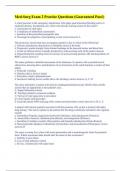
Med-Surg Exam 2 Practice Questions (Guaranteed Pass!)
A client presents to the emergency department with upper gastrointestinal bleeding and is in moderate distress. In planning care, what is the priority nursing action for this client? a. Assessment of vital signs b. Completion of abdominal examination c. Insertion of the prescribed nasogastric tube d. Thorough investigation of precipitating events correct answers A The pernicious anemia that may accompany gastritis is due to which of the following? a. Chronic autoimmune destruction of cobalamin stores in the body b. Progressive gastric atrophy from chronic breakage in the mucosal barrier and blood loss c. A lack of intrinsic factor normally produced by acid-secreting cells of the gastric mucosa d. Hyperchlorhydria resulting from an increase in acid-secreting parietal cells and degradation of RBS's correct answers C The nurse performs a detailed assessment of the abdomen of a patient with a possible bowel obstruction, knowing that a manifestation of an obstruction in the small intestine is (select all that apply) a. Projectile vomiting b. Diarrhea that is loose or liquid c. Persistent, colicky abdominal pain d. Increased, tinkling bowel sounds above the blockage correct answers A, C, D The nurse anticipates a patient will need an esophagastroduodenoscopy (EGD). Select all the actions that are appropriate in this patient's care. A. Signed informed consent B. Teaching related to conscious sedation C. Full set of vital signs prior to procedure D. Clear liquids until procedure E. Keep the patient NPO until gag reflex returns post-procedure correct answers A, B, C, E A patient with chronic gastritis associated with the presence of H. pylori is treated with triple-drug therapy. The nurse explains to the patient that the drugs commonly included in this regimen include a. Famotidine (Pepcid), magnesium hydroxide (Mylanta), and pantoprazole (Protonix). b. Amoxicillin (Amoxil), clarithromycin (Biaxin), and omeprazole (Prilosec). c. Sucralfate (Carafate), nystatin (Mycostatin), and bismuth subsalicylate (Pepto-Bismol). d. Metoclopramide (Reglan), bethanechol (Urecholine), and promethazine (Phenergan). correct answers B The nurse is caring for a client with acute pancreatitis and is monitoring the client for paralytic ileus. Which assessment data should alert the nurse to this occurrence? a. Inability to pass flatus b. Loss of anal sphincter control c. Severe, constant pain with rapid onset
Written for
- Institution
- Med surg
- Course
- Med surg
Document information
- Uploaded on
- January 22, 2024
- Number of pages
- 18
- Written in
- 2023/2024
- Type
- Exam (elaborations)
- Contains
- Questions & answers
Subjects
-
a client presents to the emergency department with

Document also available in package deal