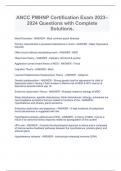
ANCC PMHNP Certification Exam 2023– 2024 Questions with Complete Solutions.
Mood Disorders - ANSWER - Most common psych illnesses Primary characteristic is persistent disturbance in mood - ANSWER - Major Depressive Disorder Often occurs without precipitating event - ANSWER - MDD Object loss theory - ANSWER - Fairbairn, Winnicott & guntrip Aggression turned inward theory of MDD - ANSWER - Freud Cognitive Theory - ANSWER - Beck Learned Helplessness-Hopelessness Theory - ANSWER - Seligman Genetic predisposition - ANSWER - Strong genetic load for depression for child of depressed parent -having 3 fold increase in lifetime risk of MDD & 40% chance of depressive episode before age 18. Endocrine dysfunction Theory - ANSWER - Probably related to etiology of MDD Sleep disturbances, appetite disturbances, libido disturbances, lethargy, anhedonia are neurovegitative symptoms that are related to functions of the - ANSWER - Hypothalamus and pituitary gland secretions Endocrine dysfunction and pregnancy - ANSWER - A high incidence of postpartum mood disturbances is suggested with this Hypothalamic-pituitary-adrenal axis (HPA) - ANSWER - A theory of MDD, may be a result of an abnormal stress response related to dysregulation of this system HPA axis - ANSWER - Controls the physiological response to stress and is composed of interconnective feedback pathways between the hypothalamus, pituitary gland, and adrenal gland. Hypothalamus releases - ANSWER - corticotropin-releasing hormone (CRH) Adrenocorticotropin hormone (ACTH) - ANSWER - Released by pituitary in response to CRH by hypothalamus Cortisol - ANSWER - Released by adrenal glands in response to ACTH by pituitary gland Hyperactivity of the HPA axis - ANSWER - Demonstrated to be present in individuals with MDD. May also have elevated cortisol levels Elevated cortisol levels - ANSWER - Over time damages the CNS by altering neurotransmission and electrical signal conduction. Cortisol over time can cause changes in size and function of brain tissue Dexamethasone suppression test (DST) - ANSWER - Not commonly used in clinical
Written for
- Institution
- ANCC PMHNP
- Course
- ANCC PMHNP
Document information
- Uploaded on
- January 22, 2024
- Number of pages
- 9
- Written in
- 2023/2024
- Type
- Exam (elaborations)
- Contains
- Questions & answers
Subjects
-
ancc pmhnp certification exam questions
-
ancc pmhnp certification stuvia

Also available in package deal