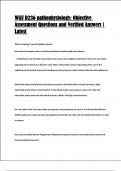
WGU D236 pathophysiology: Objective Assessment Questions and Verified Answers | Latest
What is Starling's Law of Capillary forces? How doesthis explain why a nutritionally deficient child would have edema? - DDStarling's Law describes how fluids move across the capillary membrane. There are two major opposing forces that act to balance each other, hydrostatic pressure (pushing water out of the capillaries) and osmotic pressure (including oncontic pressure, which pushesfluid into the capillaries). Both electrolytes and proteins (oncontic pressure) in the blood affect osmotic pressure, high electrolyte and protein concentrations in the blood would cause water to leave the cells and interstitial space and enter the blood stream to dilute the high concentrations. On, the other hand, low electrolyte and protein concentrations (as seen in a nutritionally deficient child) would cause water to leave the capillaries and enter the cells and interstitial fluid which can lead to edema. How doesthe RAAS (Renin-Angiotensin-Aldosterone System) result in increased blood volume and increased blood pressure?
Written for
- Institution
- WGU D236 pathophysiology: Objective Assessment
- Course
- WGU D236 pathophysiology: Objective Assessment
Document information
- Uploaded on
- January 21, 2024
- Number of pages
- 70
- Written in
- 2023/2024
- Type
- Exam (elaborations)
- Contains
- Questions & answers
Subjects
- wgu d236 pathophysiology
-
wgu d236 pathophysiology objective assessment qu
-
wgu d236 pathophysiology objective assessment
-
wgu d236 pathophysiology objective

Also available in package deal