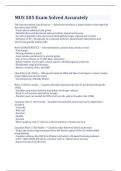
MUS 505 Exam Solved Accurately
MUS 505 Exam Solved Accurately The rock movement Social factors: - - Baby boom produces a large number of teenagers by the mid-to late-1950s - Teen culture redefined and grows - Identification with this broad national culture important to teens - Growth of popular radio and record labels getting larger, signing more artists - Influence of TV—broadcasts to a national audience, disseminates information and advertising quickly and broadly Rock CHARATERISTICS - - Instrumentation: guitars, bass, drums, vocals - Fast tempo - Driving rhythm on guitar - Loud volume, particularly in electric guitar - Use of verse-chorus or 12-Bar Blues structures - Subject matter of cars, girls, school, dances, rebelling against authority - Flamboyant stage performance - Roots in country, blues, and R&B Chuck Berry (b. 1926) - - Influenced mainly by R&B and blues, but began to insert country music influences into his music - Contemporary of Muddy Waters Rock 'n' Roll in Canada - - Canada culturally dominated by the US and Britain during the 1950s - Canadian pop music industry dependent on foreign releases - Rock 'n' roll records sold well in Canada - Popular music accounted for 90% of all records sold in Canada in the 1950s Canadian rock 'n' roll records: - Canadian record labels at the time were independent. Included: - Yorkville - Red Leaf - Revolver - Quality - Sparton - Most Canadian rock 'n' roll was a direct imitation of American rock Canadian Rock 'n' Roll Radio - - Canadian radio followed American formats - Elitist and racist programming policies left broad regions of the US without R&B programming - Canadian stations like CKLW in Windsor attracted a US-based listening audience - 1957: 1050 CHUM-AM starts a 24-hour rock 'n' roll format in Toronto - Started its own Top-40 chart The Beau-Marks - - Started in 1958 1960: first Canadian group to hit Top 40 with a rock 'n' roll record produced entirely in Canada, "Clap Your Hands" - Recorded a French version of the song called "Frappe Tes Mains" - Released liner notes in English and French 1950s and 1960s Culture - - Baby boom -children born between 1947 and 1957 - Possess incredible purchasing power - Able to purchase music and associated products - Have own disposable income, either from their parents or part-time jobs - Sense of extended youth meant more free time to invest in pleasurable activities - Sense of collective identity Girl Groups (Early 1960s) - - 1960-64 dominated by girl groups, doo-wop groups, and countrypolitan - New York music publisher Don Kirshner hired numerous songwriters to work in the Brill Building around the clock to produce a TPA-like bombardment of songs - Among these are Carole King and Neil Sedaka - Many of the early girl groups such as the Ronettes and the Crystals were African-American; white groups as well The Producer - - Producer becomes a major force in 1960s music - Known as an artist, many have own signature sound - Phil Spector, owned Philles Records and recorded the Crystals and Ronettes, among others - Created the "Wall of Sound" - Incorporated two of everything - Created bombastic sound - Sound rarely was subtle, carried through the duration of the song - Used orchestral instruments, large sets of backing vocals, plus a full rock band - Considered the "Wagner" of pop music Motown - - Centred in Detroit - Owner, Berry Gordy Jr. - Successful black-owned and operated label - Was actually a collection of labels with different functions or artists - Produced some of the most popular artists known today: Supremes, Temptations, Smokey Robinson - Critical to Motown was its ability to create and maintain its own sound, similar across all of its recordings - These sounds are attributed to its house band, The Funk Brothers, who backed most of the recording artists Countrypolitan - - Country sales dropped drastically in the 1950s - Started a cycle of soft-shell and hard-core country music - By the 1960s, Nashville had become the centre of country music production - All studios and record labels there - "Music Row," a collection of studios and labels produced the majority of country recordings - Producer assumes the same role as in the pop industry; ability to create complex recordings with new technology in the studio - People such as Chet Atkins, Owen Bradley taking over process of country recording - Session musicians like Floyd Cramer on piano playing on all recordings (slip-note piano) - Emergence of country "stars", e.g., Patsy Cline - Tuxedos and evening gowns - Sang about personal relationships and pain - Distanced from the audience - Crooning voices - Backed by complex arrangements: piano, rhythm section, full orchestra, and backing vocals - Slick production, highly stylized performances - Contrasts the hillbilly music heard earlier, with smaller groups, rough vocal timbre, acoustic instruments, improvisation, limited production The Beatles - - Formed in 1957 - All members lived in Liverpool and met in high school Originally called: - The Quarrymen - Johnny and the Moondogs - The Silver Beetles - Played extended periods at Keiserkeller in Hamburg, located in the Reeperbahn district - Also played the Cavern Club in Liverpool Musical Roots - Influenced by early rock n' roll by Elvis, Chuck Berry, Buddy Holly, Bill Haley - Played covers of these artists in early shows - Maintain a connection to black forms of music (e.g., R&B), evident in "Twist and Shout," released in 1963 - Also recognized their country roots, presence of country music in Liverpool The Mersey Beat Sound - - Music that emerged from northern England: Liverpool, Manchester, Birmingham - Gerry and the Pacemakers - Managed by Brian Epstein - Rivalled the Beatles on the British charts - Signed to EMI in 1962 - Please Please Me released in 1963 - Fan requests for Beatles airplay late in the year increased their popularity - Beatlemania was already well-established in Britain - By early 1964, "I Want to Hold Your Hand," from their second album, With the Beatles was #1 - Appeared on Ed Sullivan in February 1964—at this point Beatlemania had begun in the US Blues-Based Rock, 1960s - - British Invasion includes blues-based bands such as the Kinks, the Rolling Stones, Cream, Yardbirds emerging throughout the 1960s - These bands contrast the lighter pop sound of early Beatles, etc. Musical Roots: - Rockabilly of Elvis, Buddy Holly, and Chuck Berry - Urban blues of Muddy Waters - Downhome blues of Robert Johnson, Charley Patton Rolling Stones - - Formed in 1963 - Members: Keith Richards, Mick Jagger, Brian Jones - Charlie Watts and Bill Wyman joined later - Early recordings mainly covers of blues songs, some rock - Marketed as the opposition to the Beatles; rougher, symbolized "rock" of the 1960s - Andrew Loog Oldham (manager) - Campaign: "Would You Let Your Daughter Go Out With a Rolling Stone?" Civil Rights Movement, Early 1960s - The sit in - The sit in - A passive form of protest in which masses of people gathered to quietly create change - Proved to be an effective, non-violent approach to political change - Used to protest segregation, particularly in service industries and schools (universities) - Often led by Martin Luther King Jr. - Fostered by groups such as the Student Non-Violent Co-ordinating committee Civil Rights Movement, Early 1960s - The Freedom Ride - - Anti-racist activists boarded buses and rode into the South to protest segregation of interstate travel - Met resistance from the police and racists in the Southern States, most were attacked and jailed Civil Rights Movement, Early 1960s - Marches - - Long walks between cities and states to protest various forms of segregation and racist practices - Often thousands participated - Were non-violent in nature, a show of solidarity and strength in numbers - Often led by Martin Luther King Jr. - Most famous march led to MLK's "I Have a Dream" speech at the steps of the Lincoln Memorial in Washington, D.C. - 250,000 marchers, both white and African-American
Geschreven voor
- Instelling
- MUS 505
- Vak
- MUS 505
Documentinformatie
- Geüpload op
- 20 januari 2024
- Aantal pagina's
- 20
- Geschreven in
- 2023/2024
- Type
- Tentamen (uitwerkingen)
- Bevat
- Vragen en antwoorden
Onderwerpen
- rock charateristics
- chuck berry
-
mus 505 exam solved accurately
-
the rock movement social factors

Ook beschikbaar in voordeelbundel