

Self study Genome technology & applications
1. Gateway cloning
Site-specific recombination
Only at very specific sites
Strands bended to each other to facilitate exchange.
Learning outcomes:
1) Compare and contrast the steps of PCR cloning vs Gateway cloning.
2) List the properties of the att sites.
3) Design a recombinase reaction by appropriately placing the att sites on substrate and target
DNA.
4) Explain the significance of negative selection with ccdB.
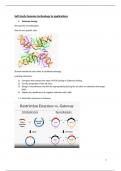
1.1 Restriction enzymes vs Gateway
1
, PCR/restriction:
- Restriction enzymes used to create linear pieces of both gene of interest as well as the vector
- 2 linear pieces are rejoined using ligase
- Reseal DNA strand into a certain molecule
Recombination:
- Begins and ends with 2 circular DNA molecules
- Cut and ligated with the same enzyme
1.2 Target sequences for site-specific recombination
- Sequences all share a common central region (black)
- Unlike restriction enzyme sites: sites are not palindromic
- Always pair together: B-P and L-R (left and right)
- Reversal reaction can occur but one enzyme will only go in one direction
- LR clonase, if you want to reverse reaction: use BP clonase instead
- Clonase enzyme cuts central region asymmetrically, generating transient sticky ends, similar
to our restriction enzyme
- After strand swapping: central regions will anneal and ligate into new product site
2
1. Gateway cloning
Site-specific recombination
Only at very specific sites
Strands bended to each other to facilitate exchange.
Learning outcomes:
1) Compare and contrast the steps of PCR cloning vs Gateway cloning.
2) List the properties of the att sites.
3) Design a recombinase reaction by appropriately placing the att sites on substrate and target
DNA.
4) Explain the significance of negative selection with ccdB.
1.1 Restriction enzymes vs Gateway
1
, PCR/restriction:
- Restriction enzymes used to create linear pieces of both gene of interest as well as the vector
- 2 linear pieces are rejoined using ligase
- Reseal DNA strand into a certain molecule
Recombination:
- Begins and ends with 2 circular DNA molecules
- Cut and ligated with the same enzyme
1.2 Target sequences for site-specific recombination
- Sequences all share a common central region (black)
- Unlike restriction enzyme sites: sites are not palindromic
- Always pair together: B-P and L-R (left and right)
- Reversal reaction can occur but one enzyme will only go in one direction
- LR clonase, if you want to reverse reaction: use BP clonase instead
- Clonase enzyme cuts central region asymmetrically, generating transient sticky ends, similar
to our restriction enzyme
- After strand swapping: central regions will anneal and ligate into new product site
2


