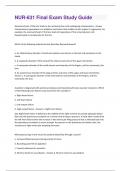
NUR-631 Final Exam Study Guide Graded A+
Removal of part of the liver leads to the remaining liver cells undergoing compensatory - Answer Compensatory hyperplasia is an adaptive mechanism that enables certain organs to regenerate. For example, the removal of part of the liver leads to hyperplasia of the remaining liver cells (hepatocytes) to compensate for the loss. Which of the following statements best describes Raynaud disease? a. An inflammatory disorder of small and medium-size arteries in the feet and sometimes in the hands b. A neoplastic disorder of the lining of the arteries and veins of the upper extremities c. A vasospastic disorder of the small arteries and arterioles of the fingers, and less commonly, the toes d. An autoimmune disorder of the large arteries and veins of the upper and lower extremities - Answer c. A vasospastic disorder of the small arteries and arterioles of the fingers, and less commonly, the toes A patient is diagnosed with pulmonary disease and elevated pulmonary vascular resistance. Which of the following heart failures may result from this condition? a. Right heart failure b. Left heart failure c. Low-output failure d. High-output failure - Answer a. Right heart failure Exp: Right heart failure is defined as the inability of the right ventricle to provide adequate blood flow into the pulmonary circulation at a normal central venous pressure. It most often results from the left heart failure when the increase in left ventricular filling pressure that is reflected back into the pulmonary circulation is severe enough. As pressure in the pulmonary circulation rises, the resistance to right ventricular emptying increases. What physical sign is the result of turbulent blood flow through a vessel? a. Increased blood pressure during periods of stress b. Bounding pulse felt on palpation c. Cyanosis observed on excretion d. Murmur heard on auscultation - Answer d. Murmur heard on auscultationExp: Where flow is obstructed the vessel turns or blood flows over rough surfaces. The flow becomes turbulent with whorls or eddy currents that produce noise causing a murmur to be heard on auscultation such as occurs during blood pressure measurement with a sphygomanometer. This selection is the only option that accurately identifies the physical sign of turbulent vascular blood flow. pg 1113 Which congenital heart defects occur in trisomy 13, trisomy 18 and down syndrome? a. Coarctation of the aorta and pulmonary stenosis b. Tetralogy of Fallot and persistent truncus arteriosus c. Atrial septal defect and dextrocardia d. Ventricular septal defect and patent ductus arteriosus - Answer d. Ventricular septal defect and patent ductus arteriosus
Written for
- Institution
- NUR-631
- Course
- NUR-631
Document information
- Uploaded on
- January 19, 2024
- Number of pages
- 70
- Written in
- 2023/2024
- Type
- Exam (elaborations)
- Contains
- Questions & answers
Subjects

Also available in package deal