HeartCode BLS 2025 Questions with Complete Solutions, A+
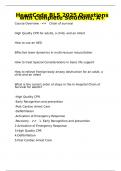
Course Overview - Chain of survival High Quality CPR for adults, a child, and an infant How to use an AED Effective team dynamics in multi-rescuer resuscitation How to treat Special Considerations in basic life support How to relieve Foreign-body airway obstruction for an adult, a child and an infant What is the correct order of steps in the In-Hospital Chain of Survival for adults? -High Quality CPR -Early Recognition and prevention -Post Cardiac Arrest Care -Defibrillation -Activation of Emergency Response -Recovery - 1. Early Recognition and prevention 2.Activation of Emergency Response 3.High Quality CPR 4.Defibrillation 5.Post Cardiac Arrest Care 6.Recovery What are the correct actions to take for Scene Safety and Assessment - -Look for no breathing and only gasping and check pulse (scan victims chest for rise and fall for no more than 10 sec) (Check carotid pulse) -Verify Scene Safety -Check for Responsiveness (Tap shoulders, Shout 'Are you OK?") - Activate the Emergency Response System and get an AED (Activate ERS via mobile device) (Get the AED or send someone to do) To minimize delay in starting CPR you may..... - Assess breathing and pulse at the same time. (no more than 10 sec) What do we know about gasping? - Gasping is not normal breathing and is a sign of cardiac arrest. Pulse check on an adult - 1. Locate the Trachea (on the side closest to you), using 2 or 3 fingers 2. Slide those fingers into the grove between the trachea and the muscles at the side of the neck, where you can feel the carotid pulse 3. Feel for a pulse for at least 5 but no more than 10 seconds (No pulse, begin CPR starting with chest compressions) What is the correct chest compression rate for adults ? - 100 to 120/min What can Feedback devices monitor? - - Compression Depth - Compression Rate - Chest Recoil Feedback devices can monitor CPR and provide real-time feedback How do you open the airway for breaths if SINGLE RESCUER is present? - Head tilt - Chin lift Step 1 One hand on the victims forehead, push with palm to tilt head back. Step 2 Place fingers of the other hand under the bony part of the lower jaw, near the chin. Step 3 Lift the jaw to bring the chin forward. When using a pocket mask, where should the rescuer be positioned? - At the side of the victim Bag Mask Device - -Provides positive-pressure ventilation -May be used with or without oxygen flow, provides about 21% oxygen from air -Bag attached to a face mask -May include a 1 way valve depending on device After positioning yourself directly above the victim's head, what is the correct order of steps for using a bag-mask device? - 1. Place Mask on Victims Face using bridge of nose as a guide 2. Use the E-Clamp Technique to hold the mask in place while you lift the jaw to hold the airway open (E Clamp : thumb and index finger make a C, pressing edges of the mask to the face while remaining fingers lift the angles of the jaw opening the airway) 3. Squeeze the bag to give breaths (1 second each) while watching for chest rise If there are two rescuers, 1. positioned directly above the victim opening airway and positioning bag-mask device. 2. Positioned at the side of the victim squeezing the bag Why is an AED Needed? (Automated external defibrillator) - To analyze the heart rhythm and provide a shock in order to restore normal heart rate and rhythm There are Two life threatening arrhythmias that can cause cardiac arrest pVT and VF (pulseless ventricullar tachycardia and ventricular fibrillation) What is pVT? - Pulseless ventricular tachycardia What is VF? - Ventricular fibrillation What are two life threatening arrhythmias? - Pulseless ventricular tachycardia (pVT) and Ventricular Fibrillation (VF) After an AED delivers a shock, what should the rescuers do next? - Resume CPR, Starting with chest compressions Steps to Using an AED - 1. Power on the AED & follow Prompts 2. Choose adult pads for victims 8 years of age and older 3. Attach the adhesive AED Pads to the victims bare chest 4. When the AED prompts you, clear the victim during analysis, be sure that no one is touching the victim. (the AED may take a few seconds to analyze, and some AEDs will tell you to push a button to begin analysis) 5. If AED advises a shock, it will charge then tell you again to clear the victim. Clear the victim before delivering the shock button. After any shock delivery, immediately resume CPR Where should AED pads be placed in the anterolateral placement for adults and children 8 years and older? - Side of the left nipple & Below the right collarbone Where should AED pads be placed in the anteroposterior placement for adults and children 8 years and older? - left side of chest halfway between the tip of the breast bone and left nipple, with the upper edge of the pad below the nipple line
Written for
- Institution
- HeartCode BLS 2025
- Course
- HeartCode BLS 2025
Document information
- Uploaded on
- January 18, 2024
- Number of pages
- 18
- Written in
- 2023/2024
- Type
- Exam (elaborations)
- Contains
- Questions & answers
Subjects
- heartcode bls 2025
- heartcode bls
-
heartcode bls 2025 questions

Also available in package deal