Principles of Management IIB (Entrepreneurship) by ProfessorBurgerQueen
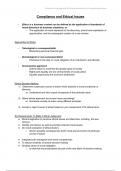
Compliance and Ethical Issues
- Ethics in a business context can be defined as the application of standards of
moral behaviour to business situations, or
- The application of moral standards to the discovery, pursuit and exploitation of
opportunities, and the subsequent creation of a new venture
Approaches to Ethics
- Teleological or consequentialist
- Maximising personal financial gain
- Deontological or non-consequentialist
- Premised on the duty or moral obligation of an individual to act ethically
- Social justice approach
- Actions taken to maximise the greater good of society
- Rights and equality are two central tenets of social justice
- Equality opportunity and economic distribution
Ethical Decision Making
1) Determine a particular course of action which presents a moral complexity or
dilemma.
a) Understand and fully unpack all aspects of the particular issue
2) Select ethical approach and screen issue accordingly
a) Scrutinise morality of action using different principles
3) Accept or reject course of action based on your assessment of its ethical tenor
Six Requirements To Make A Moral Judgement
● Moral imagination to perceive ethical issues and dilemmas, including the less
obvious
● Identify and discern as well as prioritise relevant moral issues
● Do moral evaluation of ethical factors
○ discern possible consequences (both moral and economic) of particular
course of action
● Integrate both managerial and moral competencies
● To reduce incidents of amoral decision-making
● Develop sense of moral obligation
○ so that that moral standards are part of the very fabric of decision-making
Compliance and Ethical Issues
- Ethics in a business context can be defined as the application of standards of
moral behaviour to business situations, or
- The application of moral standards to the discovery, pursuit and exploitation of
opportunities, and the subsequent creation of a new venture
Approaches to Ethics
- Teleological or consequentialist
- Maximising personal financial gain
- Deontological or non-consequentialist
- Premised on the duty or moral obligation of an individual to act ethically
- Social justice approach
- Actions taken to maximise the greater good of society
- Rights and equality are two central tenets of social justice
- Equality opportunity and economic distribution
Ethical Decision Making
1) Determine a particular course of action which presents a moral complexity or
dilemma.
a) Understand and fully unpack all aspects of the particular issue
2) Select ethical approach and screen issue accordingly
a) Scrutinise morality of action using different principles
3) Accept or reject course of action based on your assessment of its ethical tenor
Six Requirements To Make A Moral Judgement
● Moral imagination to perceive ethical issues and dilemmas, including the less
obvious
● Identify and discern as well as prioritise relevant moral issues
● Do moral evaluation of ethical factors
○ discern possible consequences (both moral and economic) of particular
course of action
● Integrate both managerial and moral competencies
● To reduce incidents of amoral decision-making
● Develop sense of moral obligation
○ so that that moral standards are part of the very fabric of decision-making