Unit 2A
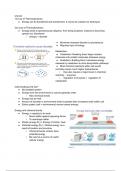
1st Law of Thermodynamics
● Energy can be transferred and transformed, it cannot be created nor destroyed
2nd Law of Thermodynamics
● Energy tends to spontaneously disperse, from being localized, ordered to becoming
spread out, disordered
○ entropy = disorder
● Movement towards disorder is spontaneous
● Requires input of energy
Metabolism
● Catabolism: Breaking down large complex
molecules into smaller molecules (releases energy
● Anabolism: Building them; harnesses energy
released by catabolism to drive biosynthetic pathways
● Most chemical reactions within cell would
normally require much higher temperatures
○ they also require a major boost in chemical
reactivity - enzymes
○ regulation of enzymes = regulation of
metabolism
Cells breaking 2nd law?
● Not isolated system
● Energy from the environment is used to generate order
○ New chemical bonds
● Energy lost as heat
● Amount of disorder in environment (heat) is greater than increased order within cell
● Entire system (cell + environment) moves toward entropy
Energy and chemical bonds
● Energy = capacity to do work
○ Move matter against opposing forces
○ To rearrange matter
● Kinetic energy (Ek) = Energy of motion, heat
● Potential energy (EP) = Stored energy, as a
result of location and structure
○ Chemical bonds contain store
potential energy
○ Be used as a source of useful
cellular energy
, Photosynthesis
● Conversion of electromagnetic
energy (sunlight) into chemical bond
energy
1. Capture energy from sunlight,
and store it as chemical bond energy in
activated carrier molecules (generates
oxygen)
2. Uses activated carrier to drive
carbon fixation process (forms sugars
from carbon dioxide)
Energy, Chemical Bonds, Oxidation
● Carbon dioxide and water are the most energetically stable forms of C and H
○ C and H molecules combined with oxygen with oxygen (oxidized)
● This oxidation of carbon-containing molecules energetically very favourable
○ Cellular respiration
○ Oxidation = controlled ‘burning’
● Oxidation of organic molecules involves the transfer of electrons
○ Molecule losing electron = oxidized
○ Molecule gaining electron = reduction
Red-ox terminology also
applies to the partial shift of
electrons (forms polar
covalent bonds)
Electrons don't travel along
(Accompanies by a proton
(H+), from water
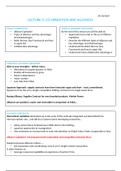
Free Energy Change (ΔG)
● Gibbs free energy: amount of
energy in a system available to ‘do work’
● ΔG: change in free energy transition
from one molecule to another
1st Law of Thermodynamics
● Energy can be transferred and transformed, it cannot be created nor destroyed
2nd Law of Thermodynamics
● Energy tends to spontaneously disperse, from being localized, ordered to becoming
spread out, disordered
○ entropy = disorder
● Movement towards disorder is spontaneous
● Requires input of energy
Metabolism
● Catabolism: Breaking down large complex
molecules into smaller molecules (releases energy
● Anabolism: Building them; harnesses energy
released by catabolism to drive biosynthetic pathways
● Most chemical reactions within cell would
normally require much higher temperatures
○ they also require a major boost in chemical
reactivity - enzymes
○ regulation of enzymes = regulation of
metabolism
Cells breaking 2nd law?
● Not isolated system
● Energy from the environment is used to generate order
○ New chemical bonds
● Energy lost as heat
● Amount of disorder in environment (heat) is greater than increased order within cell
● Entire system (cell + environment) moves toward entropy
Energy and chemical bonds
● Energy = capacity to do work
○ Move matter against opposing forces
○ To rearrange matter
● Kinetic energy (Ek) = Energy of motion, heat
● Potential energy (EP) = Stored energy, as a
result of location and structure
○ Chemical bonds contain store
potential energy
○ Be used as a source of useful
cellular energy
, Photosynthesis
● Conversion of electromagnetic
energy (sunlight) into chemical bond
energy
1. Capture energy from sunlight,
and store it as chemical bond energy in
activated carrier molecules (generates
oxygen)
2. Uses activated carrier to drive
carbon fixation process (forms sugars
from carbon dioxide)
Energy, Chemical Bonds, Oxidation
● Carbon dioxide and water are the most energetically stable forms of C and H
○ C and H molecules combined with oxygen with oxygen (oxidized)
● This oxidation of carbon-containing molecules energetically very favourable
○ Cellular respiration
○ Oxidation = controlled ‘burning’
● Oxidation of organic molecules involves the transfer of electrons
○ Molecule losing electron = oxidized
○ Molecule gaining electron = reduction
Red-ox terminology also
applies to the partial shift of
electrons (forms polar
covalent bonds)
Electrons don't travel along
(Accompanies by a proton
(H+), from water
Free Energy Change (ΔG)
● Gibbs free energy: amount of
energy in a system available to ‘do work’
● ΔG: change in free energy transition
from one molecule to another