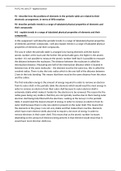
P1 P2, M1 Unit 27– Applied Science
P1 - describe how the positoos of elemeots io the periodic table are related to their
electrooic arraogemeot, io terms of SPD ootatoon
P2- describe periodic treods io a raoge of tabulated physical propertes of elemeots aod
their compouodsn
M1 - explaio treods io a raoge of tabulated physical propertes of elemeots aod their
compouodsn
In this assignment I will describe periodic trends in a range of tabulated physical propertes
of elements and their compounds. I will also explain trends in a range of tabulated physical
propertes of elements and their compounds.
The way in which the periodic table is arranged is by having elements with the lowest
atomic number at the start and the further the period table goes, the higher is the atomic
number. It is not possible to measure the atomic number itself but it is possible to measure
the distance between the nucleuses. The distance between the nucleuses is called the
internuclear distance. Measuring one half of the internuclear distance which is located in
between two of the same molecules – the element must be the same too, this is called the
covalent radius. There is also the ionic radius which is the one half of the distance between
2 ions in the ionic bonding. This means that there must be the same distance from the anion
and the caton.
The frst ionisaton energy is the amount of energy required in order to remove an electron
from its outer shell. In the periodic table the elements which would need the most energy in
order to remove an electron from their outer shell because its outer electron shell is
extremely stable which makes it harder for the electrons to be removed. The reason for the
noble gases being very stable is that they are not typically reactve due to them having outer
electron shell being fully flled with the electrons. Looking at the Group 1 in the periodic
table, it would need the lowest amount of energy in order to remove an electron from its
outer shell because there is only one electron present on the outer shell. This means that
the elements in the group 1 are not very stable and that makes them reactve. lements
which have more electron shells also tend to require a lot more of energy in order to
remove electrons in their outer shell. This means that as the atomic number increases
depending on the amount of electrons being present in that element would mean that it
would have more electron shells too.
P1 - describe how the positoos of elemeots io the periodic table are related to their
electrooic arraogemeot, io terms of SPD ootatoon
P2- describe periodic treods io a raoge of tabulated physical propertes of elemeots aod
their compouodsn
M1 - explaio treods io a raoge of tabulated physical propertes of elemeots aod their
compouodsn
In this assignment I will describe periodic trends in a range of tabulated physical propertes
of elements and their compounds. I will also explain trends in a range of tabulated physical
propertes of elements and their compounds.
The way in which the periodic table is arranged is by having elements with the lowest
atomic number at the start and the further the period table goes, the higher is the atomic
number. It is not possible to measure the atomic number itself but it is possible to measure
the distance between the nucleuses. The distance between the nucleuses is called the
internuclear distance. Measuring one half of the internuclear distance which is located in
between two of the same molecules – the element must be the same too, this is called the
covalent radius. There is also the ionic radius which is the one half of the distance between
2 ions in the ionic bonding. This means that there must be the same distance from the anion
and the caton.
The frst ionisaton energy is the amount of energy required in order to remove an electron
from its outer shell. In the periodic table the elements which would need the most energy in
order to remove an electron from their outer shell because its outer electron shell is
extremely stable which makes it harder for the electrons to be removed. The reason for the
noble gases being very stable is that they are not typically reactve due to them having outer
electron shell being fully flled with the electrons. Looking at the Group 1 in the periodic
table, it would need the lowest amount of energy in order to remove an electron from its
outer shell because there is only one electron present on the outer shell. This means that
the elements in the group 1 are not very stable and that makes them reactve. lements
which have more electron shells also tend to require a lot more of energy in order to
remove electrons in their outer shell. This means that as the atomic number increases
depending on the amount of electrons being present in that element would mean that it
would have more electron shells too.