Unit 22 P4. M4, D2– Applied Science
P4 – Carry out chemical tests to identiy inorganic substances:
M4 – Explain the bases oi the chemical tests used to identiy inorganic substances:
D2 – Evaluate whether the qualitatve analysis carried out was conclusive:
In this assignment I have completed the test for anions and test for catons. The anions test
is the test which is used to see if the sulphate ions are present by using the barium ions. In
this experiment, if the water is added to the soluton containing sulphate ions, the barium
ions would form. The barium sulphate is insoluble in water so you would see that by
observing a formaton of the white precipitate. In this experiment I have tested for the
presence of the sulphate ions.
Anions test and Catons test:
Equipment:
- Test tubes
- Test tube rack
- Bunsen burner
- Wooden stcks
- Matches
- Unknown solutons, A, B, C, D, E, o
- Safety goggles
Method:
1. Use the unknown sample by dipping the wooden stck with one of the unknown
solutons.
2. Put the Bunsen burner under a fame.
3. Observe the result.
4. Record the observatons in a table.
5. Repeat steps 1-4 with other unknown samples.
Results:
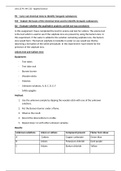
Unknown solutons Anion or catons Compound present Flame Test colour
A Catons Copper carbonate Green-blue
B Anions Potassium chloride Dark purple
C Anions Barium chloride Yellow
P4 – Carry out chemical tests to identiy inorganic substances:
M4 – Explain the bases oi the chemical tests used to identiy inorganic substances:
D2 – Evaluate whether the qualitatve analysis carried out was conclusive:
In this assignment I have completed the test for anions and test for catons. The anions test
is the test which is used to see if the sulphate ions are present by using the barium ions. In
this experiment, if the water is added to the soluton containing sulphate ions, the barium
ions would form. The barium sulphate is insoluble in water so you would see that by
observing a formaton of the white precipitate. In this experiment I have tested for the
presence of the sulphate ions.
Anions test and Catons test:
Equipment:
- Test tubes
- Test tube rack
- Bunsen burner
- Wooden stcks
- Matches
- Unknown solutons, A, B, C, D, E, o
- Safety goggles
Method:
1. Use the unknown sample by dipping the wooden stck with one of the unknown
solutons.
2. Put the Bunsen burner under a fame.
3. Observe the result.
4. Record the observatons in a table.
5. Repeat steps 1-4 with other unknown samples.
Results:
Unknown solutons Anion or catons Compound present Flame Test colour
A Catons Copper carbonate Green-blue
B Anions Potassium chloride Dark purple
C Anions Barium chloride Yellow