Principles of Management IIA by ProfessorBurgerQueen
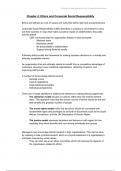
Chapter 4: Ethics and Corporate Social Responsibility
- Ethics are defined as a set of values and rules that define right and wrong behaviour
- Corporate Social Responsibility (CSR) describes a company’s commitment to carry
out their business in ways that make a positive impact on stakeholders, the public,
and the planet
- CSR commands that the organisation follows 4 main principles:
- Minimise harm
- Maximise benefit
- Be accountable to stakeholders
- Support strong financial results
- Following ethics builds the framework for making business decisions in a morally and
ethically acceptable manner
- An organisation that acts ethically stands to benefit from a competitive advantage of
customers choosing it over unethical organisations, attracting investors, and
improving staff morale
- A number of forces shape ethical conduct
- Societal norms
- Laws & regulations
- Organisational principles
- Individual perspectives
- There are 3 model identified to address the dilemma in making ethical judgements:
- The utilitarian model focuses on actions rather than the motives behind
them. This approach says that the chosen course of action should be the one
that benefits the greatest number of people
- The moral rights model holds that decisions should be consistent with
fundamental rights and privileges as set forth in documents such as the South
African Constitution, and the UN Declaration of Human Rights
- The justice model assesses decisions and behaviour with regard to how
equitably they share benefits and cost among individuals and groups
- Managers must encourage ethical conduct in their organisations. This can be done
by creating a code of ethics/conduct, which is a formal statement of a organisation’s
principles concerning social values
- They can also set up an ethics committee which will oversee the aspects of
the organisation related to ethics
Chapter 4: Ethics and Corporate Social Responsibility
- Ethics are defined as a set of values and rules that define right and wrong behaviour
- Corporate Social Responsibility (CSR) describes a company’s commitment to carry
out their business in ways that make a positive impact on stakeholders, the public,
and the planet
- CSR commands that the organisation follows 4 main principles:
- Minimise harm
- Maximise benefit
- Be accountable to stakeholders
- Support strong financial results
- Following ethics builds the framework for making business decisions in a morally and
ethically acceptable manner
- An organisation that acts ethically stands to benefit from a competitive advantage of
customers choosing it over unethical organisations, attracting investors, and
improving staff morale
- A number of forces shape ethical conduct
- Societal norms
- Laws & regulations
- Organisational principles
- Individual perspectives
- There are 3 model identified to address the dilemma in making ethical judgements:
- The utilitarian model focuses on actions rather than the motives behind
them. This approach says that the chosen course of action should be the one
that benefits the greatest number of people
- The moral rights model holds that decisions should be consistent with
fundamental rights and privileges as set forth in documents such as the South
African Constitution, and the UN Declaration of Human Rights
- The justice model assesses decisions and behaviour with regard to how
equitably they share benefits and cost among individuals and groups
- Managers must encourage ethical conduct in their organisations. This can be done
by creating a code of ethics/conduct, which is a formal statement of a organisation’s
principles concerning social values
- They can also set up an ethics committee which will oversee the aspects of
the organisation related to ethics