NCLEX-PN® TEST QUESTIONS and answers verified 100% CORRECT!!!
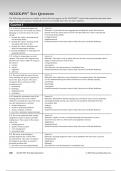
NCLEX-PN® TEST QUESTIONS The following questions are similar to those that may appear on the NCLEX-RN® exam. Some questions may have more than one correct response. During this review, you should select the one best response. CHAPTER 1 1.1 A client is being discharged and needs instructions on wound care.When planning to teach the client, the nurse should: a. identify the client’s learning needs and learning ability. b. identify the client’s learning needs and advise him what to do. c. identify the client’s problems and make the appropriate referral. d. provide pamphlets or videotapes for ongoing learning. Answer: a Rationale: To provide the most appropriate teaching, the nurse first needs to identify what the client needs to know and determine the client’s educational level and learning ability. Comprehension Implementation Health Promotion: Prevention and/or Early Detection of Health Problems 1.2 A client is requesting a second opinion. The nurse who supports and promotes the client’s rights is acting as the client’s: a. teacher. b. adviser. c. supporter. d. advocate. Answer: d Rationale: The nurse’s role as client advocate involves actively promoting clients’ rights to make decisions and choices. Comprehension Assessment Safe, Effective Care Environment: Coordinated Care Health Promotion: Prevention and/or Early Detection of Health Problems 1.3 The client tells the nurse she has been smoking one pack of cigarettes a day for the past 20 years. The nurse recognizes this is what part of the nursing process? a. assessment b. planning c. implementation d. evaluation Answer: a Rationale: Data collection occurs during the assessment phase; the information can be obtained during the initial assessment as well as during ongoing assessment. Knowledge Assessment Health Promotion: Prevention and/or Early Detection of Health Problems 1.4 During the assessment step of the nursing process, the nurse collects subjective and objective data. The nurse uses the information to identify: a. medical diagnoses. b. actual or potential problems. c. client’s response to illness. d. need for community support groups. Answer: b Rationale: Information obtained during the assessment step is used in planning and implementing nursing care, based on the problems identified from the assessment data. Analysis Planning Health Promotion: Prevention and/or Early Detection of Health Problem Answer: b Rationale: Quality of care is evaluated through documentation reviews, interviews and surveys, observation and equipment checks. Application Implementation Health Promotion: Prevention and/or Early Detection of Health Problems 1.5 The nurse performs daily, routine equipment checks to detect possible malfunction. This is part of the nurse’s role in the: a. nursing process. b. quality assurance plan. c. care management. d. assessment plan. 1.6 The nurse is developing a nursing diagnosis for a client who has pneumonia. The nurse recognizes the diagnosis describes an actual or potential problem that: a. the nurse can treat independently. Answer: a Rationale: Nursing diagnoses reflect client problems that the nurse can treat independently. Application Planning Safe, Effective Care Environment: Coordinated Care © 2007 Pearson Education, Inc. NCLEX-PN® Test Bank Questions 399 b. the nurse can treat with a physician’s order. c. requires physician’s intervention. d. relates to the clients’ primary diagnosis. 1.7 After administering pain medication, the nurse returns to check the client’s level of comfort. This stage of the nursing process is known as: a. assessment. b. planning. c. implementation. d. evaluation. Answer: d Rationale: In the evaluation step the nurse determines if the interventions were effective. Analysis/Diagnosis Evaluation Safe, Effective Care Environment: Coordinated Care 1.8 A client has lost 10 pounds related to nausea and vomiting. The nurse identifies an appropriate expected outcome: The client will: a. gain weight. b. gain 2 pounds within 1 week. c. not lose weight. d. gain 10 pounds in 2 days. Answer: b Rationale: Expected outcomes should reflect a goal that is client centered, realistic, and measurable. Answers a and c are not measurable; d is not realistic. Analysis/Diagnosis Planning Physiological Integrity: Physiological Adaptation 1.9 A problem-solving process that requires empathy, knowledge, divergent thinking, discipline, and creativity is known as: a. critical thinking. b. nursing process. c. framework for nurses. d. care management. Answer: a Rationale: Critical thinking involves self-directed thinking, combining the nurse’s cognitive skills as well as attitude, experience, empathy, and discipline. Comprehension Analysis/Diagnosis Safe, Effective Care Environment: Coordinated Care 1.10 At the end of the shift, the nurse is ready to leave but has not been relieved by the oncoming shift nurse. The nurse’s responsibility to provide care for clients is part of the nurse’s: a. Code of Ethics. b. nursing process. c. critical thinking. d. quality assurance. Answer: a Rationale: The Code of Ethics guides the behavior of nurses. The nurse’s primary commitment is to the client, ensuring he or she receives safe, competent, and continual care. Comprehension Implementation Safe, Effective Care Environment: Coordinated Care CHAPTER 2 2.1 According to Havighurst, the developmental tasks that describe adults as learning to live with a mate, have children, and hold a job are found in which of the following stages? a. young adult (18–35 years of age) b. middle adult (36–60 years of age) c. older adult (over 60 years of age) d. productive adult (18–60 years of age) Answer: a Rationale: These tasks occur predominantly in the young adult age group. Knowledge Assessment Health Promotion: Growth and Development 2.2 When caring for the middle age adult the nurse recognizes a major risk factor is: a. cigarette smoking. b. multiple sex partners. c. decreased physical activity. d. obesity. Answer: c Rationale: Due to a decrease in basal metabolic rate and often activity level as well, the middle adult is at risk for weight gain and obesity. Comprehension Integrative process: Assessment Test plan: Health Promotion: Prevention and/or Early Detection of Health Problems 400 NCLEX-PN® Test Bank Questions © 2007 Pearson Education, Inc. 2.3 Because of the physiologic changes in the gastrointestinal system, the nurse should encourage the older adult to consume a diet high in: a. Na. b. fiber. c. carbohydrates. d. calories. Answer: b Rationale: A decrease in peristalsis can lead to constipation; increasing fiber in the diet will help to combat this. Comprehension Planning Health Promotion: Growth and Development 2.4 Women in the middle adult age group are at risk for cancer of the breast and reproductive organs. The nurse can suggest the following in health promotion teaching: a. “You need to contact your physician about mammography.” b. “If there is not a history of cancer in the women of your family, you need not be concerned.” c. “An annual physical exam is important to detect early signs and symptoms of cancer.” d. “Self-breast exam monthly and an annual Pap smear are necessary for early detection of cancer.” Answer: d Rationale: This option gives the most specific recommendations for tests that should be done to detect cancer. The other options provide more general information. Application Implementation Health Promotion: Prevention and/or Early Detection of Health Problems 2.5 When teaching the old-old adult (over age 85) who has been diagnosed with a new illness, the nurse recognizes this age group: a. needs client teaching at a slower pace, with visual aids and repetition. b. does not profit from patient teaching. c. learns at the same rate as young-old adults. d. is generally cognitively impaired and unable to learn new information. Answer: a Rationale: Due to neurovascular and sensory losses, older adults need adjustment in teaching methods, although they still have the ability to learn. Application Planning Health Promotion: Growth and Development 2.6 When planning care for elderly clients in long-term care facilities, the nurse gives highest priority to: a. ensuring that they consume at least 1,200 calories a day. b. providing regular periods of exercise daily. c. maintaining a safe environment. d. providing opportunities for social interactions. Answer: c Rationale: Although all the options are important, maintenance of a safe environment is always of highest priority. Application Implementation Safe, Effective Care Environment: Safety and Infection Control 2.7 The nurse visits an elderly client who lives alone, is not eating well, and has very little food available in the home. The nurse may also want to assess the client’s: a. ability to do her own grocery shopping. b. access to local restaurants. c. number of visits by family. d. availability of local grocery stores. Answer: a Rationale: Assessing the client’s ability to obtain food would be essential to determine why the client isn’t eating and has little food available. Analysis Assessment Health Promotion: Prevention and/or Early Detection of Health Problems © 2007 Pearson Education, Inc. NCLEX-PN® Test Bank Questions 401 2.8 A client is experiencing a significant change from his normal health. In the first stage of an acute illness, the nurse can expect the client to report having: a. bleeding. b. cough. c. fever. d. pain. 2.9 When caring for a client with a chronic illness, the nurse is aware the client will have: a. impaired function. b. persistent pain. c. reversible conditions. d. severe symptoms. Answer: a Rationale: Chronic illness is characterized by impaired functioning of one or more body systems. Persistent pain and severity of symptoms vary with the client and condition. Chronic conditions are not reversible. Comprehension Assessment Physiological Integrity: Physiological Adaptation 2.10 The nurse is planning interventions beneficial to clients with chronic illness. The nurse should focus on: a. pain management. b. education to promote independent functioning. c. securing assistance from family members. d. assisting the client to accept her illness. Answer: b Rationale: Nursing interventions should focus on promoting independence, reducing health care costs, and improving quality of life. Application Intervention Safe, Effective Care Environment: Coordinated Care 3.2 When doing a physical assessment of an old-old client, the nurse could expect to see which of the following? a. dilated pupils b. thin and brittle nails c. an increase in tear production d. a decrease in pubic hair Answer: d Rationale: Age-related physical changes include decreased scalp, axillary, and pubic hair. Pupils are smaller. Nails often become thick and brittle. Tear p
Geschreven voor
- Instelling
- NCLEX-PN
- Vak
- NCLEX-PN
Documentinformatie
- Geüpload op
- 12 januari 2024
- Aantal pagina's
- 100
- Geschreven in
- 2023/2024
- Type
- Tentamen (uitwerkingen)
- Bevat
- Vragen en antwoorden
Onderwerpen
- nclex pn test questions
-
398 nclex pn test bank questions 2007 pearson e

Ook beschikbaar in voordeelbundel